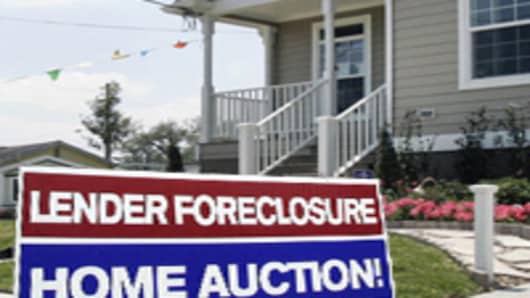
With many economists anticipating that the unemployment rate will rise into the double digits from its current 8.9 percent, foreclosures are expected to accelerate. That could exacerbate bank losses, adding pressure to the financial system and the broader economy.
“We’re about to have a big problem,” said Morris A. Davis, a real estate expert at the University of Wisconsin. “Foreclosures were bad last year? It’s going to get worse.”
Economists refer to the current surge of foreclosures as the third wave, distinct from the initial spike when speculators gave up property because of plunging real estate prices, and the secondary shock, when borrowers’ introductory interest rates expired and were reset higher.
“We’re right in the middle of this third wave, and it’s intensifying,” said Mark Zandi, chief economist at Moody’s Economy.com. “That loss of jobs and loss of overtime hours and being forced from a full-time to part-time job is resulting in defaults. They’re coast to coast.”
Those sliding into foreclosure today are more likely to be modest borrowers whose loans fit their income than the consumers of exotically lenient mortgages that formerly typified the crisis.
Economy.com expects that 60 percent of the mortgage defaults this year will be set off primarily by unemployment, up from 29 percent last year.
Real Estate Slideshows from CNBC.com
Robert and Kay Richards live in the center of this trend. In 2006, they took a 30-year, fixed-rate mortgage — a prime loan — borrowing $172,000 to buy a prefabricated house.
They erected the building on land they owned in the northern Minnesota town of Babbitt, clearing the terrain of pine trees with their own hands. Mr. Richards worked as a truck driver, hauling timber from a nearby mill. His wife oversaw the books.
Together, they brought in about $70,000 a year — enough to make their monthly mortgage payments of $1,300 while raising their two boys, now 11 and 16.
But their truck driving business collapsed last year when the mill closed. Mr. Richards has since worked occasional stints for local trucking companies. His wife has failed to find clerical work.
“Every month that goes by, you get a little further behind,” Mr. Richards said.
Last June, they missed their first payment, and they have since slipped $10,000 into arrears. They are trying to persuade their bank to cut their payments ahead of a foreclosure sale.
From November to February, the number of prime mortgages that were delinquent at least 90 days, were in foreclosure or had deteriorated to the point that the lender took possession of the home increased more than 473,000, exceeding 1.5 million, according to a New York Times analysis of data provided by First American CoreLogic, a real estate research group.
Those loans totaled more than $224 billion. During the same period, subprime mortgages in those three categories increased by fewer than 14,000, reaching 1.65 million.
The number of similarly troubled Alt-A loans — those given to people with slightly tainted credit — rose 159,000, to 836,000.
Over all, more than four million loans worth $717 billion were in the three distressed categories in February, a jump of more than 60 percent in dollar terms compared with a year earlier.
Under a program announced in February by the Obama administration, the government is to spend $75 billion on incentives for mortgage servicing companies that reduce payments for troubled homeowners.
The Treasury Department says the program will spare as many as four million homeowners from foreclosure.
But three months after the program was announced, a Treasury spokeswoman, Jenni Engebretsen, estimated the number of loans that have been modified at “more than 10,000 but fewer than 55,000.”
In the first two months of the year alone, another 313,000 mortgages landed in foreclosure or became delinquent at least 90 days, according to First American CoreLogic.
“I don’t think there’s any chance of government measures making more than a small dent,” said Alan Ruskin, chief international strategist at RBS Greenwich Capital.