- Bear, Lehman Execs Weren't Wiped Out by Crisis: Study
- Wall Street 'Bonuses' Disappearing—but Only in Name
- How Real Estate Investors Skew Housing's Reality
- Even Buffett's Huge Fame Can't Help the Name 'Warren'
- Wave of Debt Payments Facing US Government
- JPMorgan's Dimon Could Succeed Geithner: Report
- Suze Orman’s 'A Healthier, Wealthier You'
- Maria Blog: Are Crazy Retail Deals Good for Business?
- Latest Holiday Drinks: The Madoff...and the TARPatini
- Help Wanted—Please Run $4 Billion University
- Apple Comes to AT&T's Rescue
- Rally Could 'Have Some Legs in 2010': Market Strategist
- Investors May Skew Housing Reality
- Buffett's Wealth and Fame Hasn't Helped 'Warren' As a Name
- Are Crazy Retail Deals Good for Business?
- Expect a 'Square Root-Shaped' Recovery: Chief Investor
- Madoff—The Holiday Drink
- HP to Feed on Enterprise Spending Next Year: Tech Analyst
MOST SHARED
- The 'Real' Jobless Rate: 17.5% Of Workers Are Unemployed
- Existing-Home Sales Jump To Highest Level in 2-1/2 Years
- Wave of Debt Payments Facing US Government
- Paul: Audit the Fed
- Start-Up Proves Everything Really Is Better With Bacon
- TV Retailer QVC Joins 'Black Friday' Frenzy
- Buffett's Wealth and Fame Hasn't Helped 'Warren' As a Name
- S&P Stocks Trading at New 52-Week Highs
- Madoff—The Holiday Drink
- China Asks Its Banks to Slow Down
As large cities around the world try to go green by doing everything from banning plastic shopping bags to installing wind turbines on roofs, a whole new generation of sustainable communities are getting built from the ground up.
“The good thing with starting from scratch is that you don’t have to contend with old infrastructure,” says developer Anthony Pugliese, who is planning on building a massive 41,300-acre sustainable city in central Florida called Destiny. He hopes 300,000 people will eventually call it home when the city is fully complete in the next 20 to 40 years.
![]() |
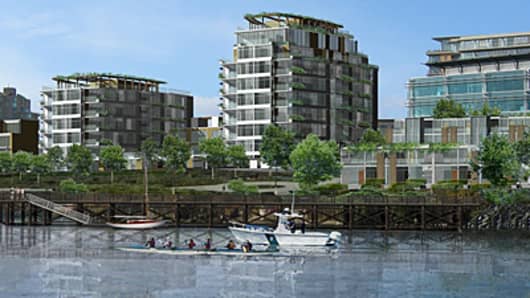
Dockside Green A rendering of Dockside Green, in Victoria, British Columbia, Canada. |
The project is one of 16 that was selected by the Clinton Climate Initiative to participate in the Climate Positive Development Program which will set green standards and provide an open flow of information on green technology.
The 16 developments are meant to serve as a model for building sustainable communities.
Besides Destiny, Fla., the only other American project selected is Treasure Island in San Francisco. The rest of the developments are scattered all over the world (Sweden, Brazil, Panama, Canada, Australia, South Africa, the United Kingdom and South Korea.)
The projects are extremely costly and it will take several years—in some cases, decades—before they are completed. Only a couple have actually started construction.
One of them is Dockside Green in Victoria, British Columbia, Canada. Once an abandoned industrial area, developers Vancity Credit Union and Windmill West won over the city with their plan to build a sustainable city and sold the land to them in 2005. Construction began on the 15-acre project in 2006; so far six residential buildings and one commercial one have been built and occupied.
When it is completed, Dockside Green will have 26 buildings and be home to 2,500 people with a percentage of the homes going to lower income people, which is a common theme in all 16 of the communities. The project includes rooftop gardens, a sewage treatment and a pond and stream ecology that treats and filters rain water.
Developer Joe Van Bellegem says joining the Climate Positive Development Program makes it easier to share what he’s learned with other developers. Van Bellegem says he’s already received thousands of requests to tour the site from “developers, mayors, government officials and anyone who is interested in changing policy.”
To limit car use, and the carbon footprint of the community, Dockside Green set up a car sharing program, installed bike racks and made accessing transportation to the city of Victoria easier.
Making the developments more pedestrian friendly, and less dependent on cars, is a major part of all the developments.
Existing cities, like Atlanta and Houston were built to be car oriented, which causes “a lot of environmental problems,” says Maximo Rumis, a principal at DPZ Latin America, which has designed plans for a 120-acre sustainable city in Brazil called Pedra Branca.
Pedra Branca, which is expected to house around 30,000 people when it is completed within the next decade, will be designed so that people can easily walk to stores, libraries and schools, or get around on a bike.
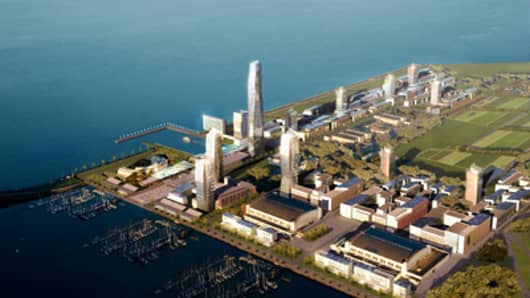
Other developments are finding additional ways to discourage driving. Plans to redevelop Treasure Island, a former Navy Base sitting on a man-made island in San Francisco Bay, includes charging drivers who decide to leave the island during peak hours and offering more accessible public transportation like bus and ferry service.
The redevelopment of the Lower Don Lands in Toronto will extend the city’s already existing light rail system to the site so that when people begin moving in they can use transportation immediately.
![]() |
Treasure Island A rendering of what Treasure Island, an island within the city limits of San Francisco, will look like after it is redeveloped. |
“Creating jobs is our first approach,” says Pugliese one of the developers of Destiny, Fla.
His plan, along with co-developer Fred DeLuca—who founded the Subway sandwich franchise—is to create what Pugliese calls “the Silicon Valley for green technology," a place where items like solar panels and LED lights can be manufactured and distributed.
With Destiny’s central location in Florida and proximity to major ports and airports, Pugliese envisions it as a major player in distributing green technology.
At Elephant & Castle in South London, 5,200 jobs are expected to be created when a redevelopment plan is completed in the next several years. At Panama Pacifico, a development in Panama, major companies like Dell [DELL
Loading...
()
] and 3M [MMM
Loading...
()
] already have offices within the city limits, and the new sustainable city will give people homes to live in. Panama Pacifico will bring 35,000 jobs to the city.
“We’re not basing success on selling homes,” adds Pugliese. “We’re basing success on building an industrial base for Florida. If we create the green job base, then people will come.”
- The show attracts a big TV audience every year, but this year it may take on even more importance.
- …you'll want to be prepared. Tips for getting the most out of the post-Thanksgiving shopping frenzy.
- Congressman Ron Paul explains to Squawk Box why he’s pushing legislation to audit the Federal Reserve.
- CNBC’s Phil LeBeau took a test drive of GM’s flagship electric car. Here’s what he thought of the Volt.
- The energy company Power Efficiency is building tools that regulate the power electric motors use.
- CNBC’s technology reporter Jim Goldman guides you through the best gadgets to buy this holiday season.