Skip navigation

Warren Buffett Watch

RSS FEED

» Help

Current DateTime: 07:34:53 22 Nov 2009
LinksList Documentid: 30078629
powered by digg
TRANSCRIPT:  Warren Buffett's Live Lunch Interview on CNBC
Published: Wednesday, 24 Jun 2009 | 4:05 PM ET
Text Size
By: Alex Crippen
Executive Producer

BECKY
:  When we sat down with you here last year, you said inflation was a very big worry for you.  What do you see today?  Do you worry about inflation or deflation?

BUFFETT:  Well, I don't worry about deflation at all.  We won't see deflation in any significant amount in your lifetime, which is more relevant than my lifetime.  We've taken action in fighting the economic war that we face that certainly sows the seeds of substantial inflation down the road.  Not in the next six months or year or two years, but we have done things that raise the probability of really high rates of inflation at some point.  We're flooding the system with dollars.  We're monitizing debt.  We're doing all the things that lead to that.  Now those are appropriate things to do.  Our economy was like a fellow going down in quicksand last September and up to his shoulders, and somebody tosses a rope.  You can tie it around and yank him out with a truck, you may dislocate a couple of shoulders but it's still pays to get him out.  And we may dislocate the economy in certain ways.  There's really no choice.  But we could see a lot of inflation.

BECKY:  You mentioned that the financial system was in tatters just last year.  It's turned around quite a bit.  In fact, some of the big banks have been paying back TARP money, or have made plans to pay back that TARP money.  One of your big investments, though, Wells Fargo [WFC  Loading...      ()   ], has not.  Does that put Wells Fargo at a disadvantage?
Berkshire Portfolio

BUFFETT:  Well, it doesn't put them at a disadvantage with the person on the street that's putting in deposits.  And they've got the widest spreads, really, in terms of interest income of anybody.   But I'm sure they would like to get out of TARP.  There's been unanimity among the people in the TARP plan that they want to get out as fast as possible, so I'm sure they'd like  to get out at Wells.   But from my standpoint, the earning power of Wells is dramatic with or without the TARP money.

BECKY: So, with or without, it doesn't matter to you as an investor?

BUFFETT:  It doesn't really, no, no.  I wish they didn't have the warrants outstanding that came with the TARP money because that's a call on the future profits of it, but the government set the terms on it.  They just signed a blank piece of paper.

BECKY
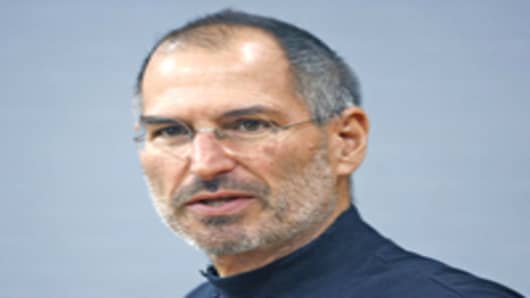
:  Over the last few days, Steve Jobs and Apple's [AAPL  Loading...      ()   ] board have gotten a lot of attention because of the disclosure, or lack of disclosure of the liver transplant that he had while he was out.  You're someone who has also gotten some criticism about your succession plans.  What do you think about how the Apple board went about it and do you think that criticism there has been fair?

BUFFETT:  Well, I think it probably has.  I think if I have any serious illness, or something coming up of an important nature, an operation or anything like that, I think the thing to do is just tell the American, the Berkshire shareholders about it.  I work for 'em. 
AP
Steve Jobs

Some people might think I'm important to the company.  Certainly Steve Jobs is important to Apple.  So it's a material fact.  Whether he is facing serious surgery or not is a material fact.  Whether I'm facing serious surgery is a material fact.  Whether (General Electric CEO) Jeff Immelt is, I mean, so I think that's important to get out.   They're going to find out about it anyway so I don't see a big privacy issue or anything of the sort.

BECKY:  Just this past week, the Class B shares of Berkshire were able to start trading options on them.  What happened?  Why did you do that and what's it mean?

BUFFETT:  They didn't ask me.

BECKY:  What does it mean for the stock though?

BUFFETT:  Well, it means people can speculate on it instead of invest in it and I'm basically not for it.  We have the lowest turnover of any stock in the New York Stock Exchange by far.  We've got more real owners.  People buy our stock to own a piece of the business.  The people that buy puts or calls, or sell puts or calls, are just betting on what it's going to do in the short term.  So it's no plus to us.  It is no big minus either.  I don't think there will be a lot of trading in it.

BECKY:  It doesn't bother you?

BUFFETT:  No.  If I had my choice it wouldn't happen, but it doesn't bother me.

BECKY:  You know, cap and trade is something we talked about when we spoke with you back in May as well.  And you raised some of the issues and concerns you have about cap and trade.  It does look like it is still on the agenda for right now.  So is health care.  Does it concern you to see Washington, Congress and the administration, moving on some of these big initiatives while you're still concerned about the economy?

BUFFETT:  Well, I think if they're important issues and they get well thought out solutions.  It is important that we move on carbon emissions.  It's important we move on health care.  But I don't think they should be jammed through in a hurry.  But those are issues that should be addressed by America.  But I do think the economy is number one.

BECKY:  You said you didn't like cap and trade especially in this economy though, because it puts a tax on people.

BUFFETT:  I think if you get into the way it was written, it's a huge tax and there's no sense calling it anything else.  I mean, it is a tax.  And it's a fairly regressive tax.  If we buy permits, essentially, at our utilities, that goes right into the bills of the utility customers and an awful lot of people in Iowa, in Oregon, and Utah, and places where we are, very poor people are going to pay a lot more money for electricity.   So I think that can be improved.

BECKY:  And finally, the last question.  You've written about the economy and where you see the stock market in the past.   You wrote an op-ed for the New York Times.  How are your thoughts on where the stock market stands right now compared to where you saw it then?

BUFFETT: Well, I think it's attractive over the next ten years compared to alternatives.  If your alternative is buying some fixed-dollar investment, I think inflation will eat away at that.  I think it's almost certain over a ten-year period that equities will do better than fixed-dollar investments.  So, if people are keeping their money in cash and getting virtually nothing for it they may feel comfortable, but it will be very expensive for them over time.            

Current Berkshire stock prices:

Class A: [US;BRK.A  Loading...      ()   ]

Class B: [US;BRK.B  Loading...      ()   ]

For more Buffett Watch updates follow alexcrippen on Twitter.

Questions?  Comments?  Email me at

© 2009 CNBC, Inc. All Rights Reserved
Add This share icon
Text Size
  • digg share
ADD COMMENTS
Remaining characters


Current DateTime: 07:34:54 22 Nov 2009
LinksList Documentid: 29778428

Current DateTime: 07:32:22 22 Nov 2009
LinksList Documentid: 29779196

Current DateTime: 07:34:54 22 Nov 2009
LinksList Documentid: 29779199

Current DateTime: 07:34:54 22 Nov 2009
LinksList Documentid: 29779198
  Data is a real-time snapshot  *Data is delayed at least 15 minutes
Global Business and Financial News, Stock Quotes, and Market Data and Analysis

© 2009 CNBC, Inc.  All Rights Reserved.
A Division of NBC Universal
Thomson ReutersThomson Reuters