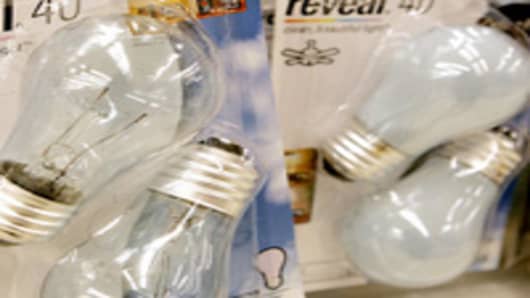
“There’s a massive misperception that incandescents are going away quickly,” said Chris Calwell, a researcher with Ecos Consulting who studies the bulb market. “There have been more incandescent innovations in the last three years than in the last two decades.”
The first bulbs to emerge from this push, Philips Lighting’s Halogena Energy Savers, are expensive compared with older incandescents. They sell for $5 apiece and more, compared with as little as 25 cents for standard bulbs.
But they are also 30 percent more efficient than older bulbs. Philips says that a 70-watt Halogena Energy Saver gives off the same amount of light as a traditional 100-watt bulb and lasts about three times as long, eventually paying for itself.
The line, for now sold exclusively at Home Depot and on Amazon.com, is not as efficient as compact fluorescent light bulbs, which can use 75 percent less energy than old-style bulbs. But the Energy Saver line is finding favor with consumers who dislike the light from fluorescent bulbs or are bothered by such factors as their slow start-up time and mercury content.
“We’re experiencing double-digit growth and we’re continuing to expand our assortment,” said Jorge Fernandez, the executive who decides what bulbs to stock at Home Depot . “Most of the people that buy that bulb have either bought a C.F.L. and didn’t like it, or have identified an area that C.F.L.’s don’t work in.”
For lighting researchers involved in trying to save the incandescent bulb, the goal is to come up with one that matches the energy savings of fluorescent bulbs while keeping the qualities that many consumers seem to like in incandescents, like the color of the light and the ease of using them with dimmers.
“Due to the 2007 federal energy bill that phases out inefficient incandescent light bulbs beginning in 2012, we are finally seeing a race” to develop more efficient ones, said Noah Horowitz, senior scientist with the Natural Resources Defense Council.
Some of the leading work is under way at a company called Deposition Sciences here in Santa Rosa. Its technology is a key component of the new Philips bulb line.
Normally, only a small portion of the energy used by an incandescent bulb is converted into light, while the rest is emitted as heat. Deposition Sciences applies special reflective coatings to gas-filled capsules that surround the bulb’s filament. The coatings act as a sort of heat mirror that bounces heat back to the filament, where it is transformed to light.
While the first commercial product achieves only a 30 percent efficiency gain, the company says it has achieved 50 percent in the laboratory. No lighting manufacturer has agreed yet to bring the latest technology to market, but Deposition Sciences hopes to persuade one.
“We built a better mouse trap,” said Bob Gray, coating program manager at Deposition Sciences. “Now, we’re trying to get people to beat a path to our door.”
With the new efficiency standards, experts predict more companies will develop specialized reflective coatings for incandescents. The big three lighting companies — General Electric , Osram Sylvania and Philips — are all working on the technology, as is Auer Lighting of Germany and Toshiba of Japan.
And a wave of innovation appears to be coming. David Cunningham, an inventor in Los Angeles with a track record of putting lighting innovations on the market, has used more than $5 million of his own money to develop a reflective coating and fixture design that he believes could make incandescents 100 percent more efficient.
“There’s enormous interest,” Mr. Cunningham said. “All the major lighting companies want an exclusive as soon as we demonstrate feasibility.”