Skip navigation

Current DateTime: 06:32:10 25 Nov 2009
LinksList Documentid: 24355697
  • Runway Angels

      The superbowl of fashion shows, models walk down the runway at the 2009 Victoria's Secret Show.

  • Smartphone Guide

      Here's a need-to-know guide to nine devices, based on features, price, network and platform.

  • Wines for the Holidays

      Not quite sure what wine to pair with Turkey or Creme Brulee? Our experts do.

FEATURED QUIZZES


Current DateTime: 06:32:10 25 Nov 2009
LinksList Documentid: 33793611
  • How Well Do You Know Your Bird?

      Let's talk turkey. Test your turkey knowledge and perhaps pick up a bit of trivia to trot out at your holiday meal.

  • A Healthier & Wealthier You

      Take the following quiz and find out how much you know about the impact of obesity on the health of the U.S. economy.

  • The Billionaire BFF's

      Philanthropists. Bridge partners. Hockey players. Which responses are based on facts from Buffett's and Gates' real lives?


Current DateTime: 06:32:10 25 Nov 2009
LinksList Documentid: 24890560
  • Winterizing Your Portfolio

      If 2009 was the winter of our discontent, will 2010 be a winter wonderland for investors? A lot depends on the recovery—or lack thereof.

  • Investor's Guide to Real Estate

      Some even say the long-awaited recovery is here. Regardless, buyers and sellers alike can profit from our guide.

  • Alternative Investing

      Stocks and bonds? Sure. But it's a big world out there for investors.

powered by digg
Roubini: Risk of Double-Dip Recession Not Quite Past Yet
Published: Wednesday, 12 Aug 2009 | 9:15 AM ET
Text Size
By: CNBC.com

The world economy still risks a double-dip recession if oil prices rise toward $100 per barrel and if huge U.S. government debts frighten investors, Nouriel Roubini, professor of economics and chairman of RGE Monitor, told CNBC.
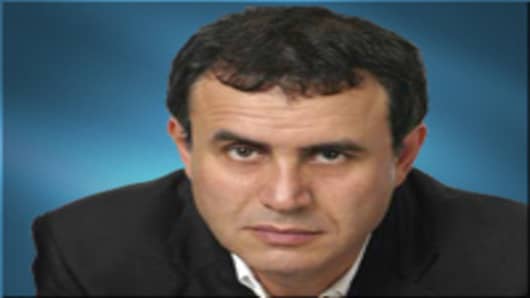
Nouriel Roubini
CNBC.com
Nouriel Roubini

"There is a risk, a low probability for a double dip," Roubini said on "Squawk Box."

Although the risk of a depression has been virtually eliminated by the massive monetary stimulus, "we are in the middle of the worst recession in 60 years" and the rallying stock market may have gotten ahead of itself, he added.

"Asset prices should go higher, the question is too much, too soon, too high? In my view there is the risk of a correction," Roubini said.

"I can still see downside risks for financial institutions," he said.

Because of the United States' large budget deficit—monetized by the Federal Reserve—investors may at some point next year begin to worry and pull out of government bonds, pushing yields higher, according to Roubini.

Another risk is that if the oil price goes toward $100 a barrel, the shock would be similar to the one felt last year when it went above $145, which was the tipping point for the world economy, he said.

"It could lead to a double dip. I'm not saying it's going to happen but it's a risk," Roubini added.

However, any correction in stocks would not be as severe as pushing the S&P 500 toward 666 unless there is a clear risk of a double-dip, he said.

On other issues, Roubini warned that China could see a slowdown and said emerging markets overall may not grow as quickly as some think.

The  potential growth of emerging markets of 6 percent is higher than the 3 percent potential growth for developed countries, he said.

"But they're so dependent on net exports so far that until they switch their growth model … there will be something of a limit on how much emerging markets can grow," Roubini said. "I see weak economic growth, weak consumption, even if there will be a recovery."

Roubini's comments were buttressed by fellow "Dr. Doom" Marc Faber, who faulted policymakers for not reacting quickly enough to changing global economic conditions.

"Usually an economic and financial crisis leads to some fundamental changes. That is the purpose of a recession, of a depression, to clean the system," said Faber, who faulted Fed Chairman Ben Bernanke for bailing out the financial system and making transparency even worse.

"Let the derivatives players go bankrupt and the system is clean," he said. "The total breakdown of the system is ahead of us and it will devastate the global economy."

"My view is that the Fed and the other central bankers will leave interest rates far too low and far too long," Faber said.

© 2009 CNBC.com
Add This share icon
Text Size
  • digg share

CNBC HIGHLIGHTS

  • For nearly three decades, these on-call experts have been dishing advice on how to – and not to – cook turkey.
  • Eric Schmidt pledges to create a virtual copy of the Iraq National Museum at Google’s expense.
  • Bill Griffeth is taking a leave of absence from CNBC and Power Lunch for a year. Here's a message from Bill.
  • More shoppers than ever plan to comparison-shop this season. Who will benefit?
  • It may be the most unusual guide to business you'll read.
  • Cut Credit cards
  • How can you get out of debt and back on the road to recovery? Follow these ten steps.
ADD COMMENTS
Remaining characters


Current DateTime: 12:56:54 25 Nov 2009
LinksList Documentid: 29778428

Current DateTime: 10:38:04 25 Nov 2009
LinksList Documentid: 29779196

Current DateTime: 04:32:23 25 Nov 2009
LinksList Documentid: 29779199

Current DateTime: 10:38:10 25 Nov 2009
LinksList Documentid: 29779198
  Data is a real-time snapshot  *Data is delayed at least 15 minutes
Global Business and Financial News, Stock Quotes, and Market Data and Analysis

© 2009 CNBC, Inc.  All Rights Reserved.
A Division of NBC Universal
Thomson ReutersThomson Reuters