![]()
- Fed Audit Would Hurt Economic Prospects: Bernanke
- Russia: Bomb Caused Train Wreck That Killed Dozens
- Dow Ends Week Flat Despite Dubai Selloff
- Stocks Pare Losses After Initial Dubai Drop
- Dubai's Debt Woes Signal New Era for Creditors
- EU Names New Leadership Team to Boost Economy
- Futures Sharply Lower on Dubai Worries
- Car Insurance Scofflaws Raise Health Reform Doubt
- Dubai Debt Woes 'A Blip', Won't Lead to Global Fallout: Strategist
- Dubai Debt Delays Revive Fear of Financial Crisis
- Abu Dhabi Will Aid Debt-Fraught Dubai 'Case by Case'
- Banks With The Biggest Exposure to The UAE
- Dubai's Debt Woes Signal New Era for Creditors
- Next Week: Cash In Now Or Wait For A Santa Rally?
- Dubai Stock Selloff May Bring Buying Opportunity
- Longer Lines, Fuller Carts This Black Friday
- Big US Banks May Be Forced to Raise Capital: Bove
- Bank of America Amends Pay for Senior Executives
- Tiger Woods Out of Hospital After Accident
- U.S. Stocks Fall on Dubai Worries
- Black Friday at Best Buy
- Strategists on Dubai: Avoid 'Rash Moves' Now
- Longer Lines, Fuller Carts This Black Friday
- Dubai Stock Market Fear Has 'Legs': Dennis Gartman
- Obama's Emission Reduction Pledge Paints Future for Autos
- Is Super Bowl Halftime Act Too Old?
- Surprising Options Trades in TiVo Shares
- EA Sports Hopes to Pump Up Sales Through Pop-Up Locations
President Barack Obama's campaign for a health care overhaul is an intense installment in a long-running story, dating to Theodore Roosevelt in 1912.
It did not go well nearly a century ago. Roosevelt made national health insurance an issue in his last, losing campaign for the White House, and successive efforts to get it enacted have lost, too.
![]() |
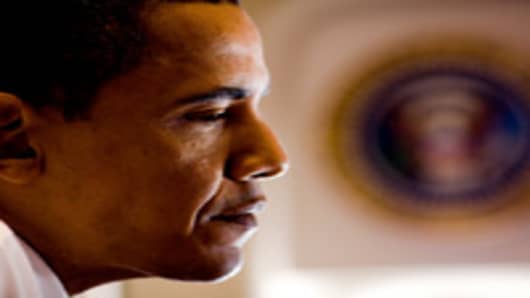
Source: Pete Souza President Barack Obama |
The basic issue, affordable health care for all Americans, has not changed. But possible solutions have not evolved either, in part because new proposals seldom build on old ones. Obama's broad, leave-the-details-to-Congress proposal has little in common with the 1,300-page measure President Bill Clinton couldn't even get to a vote in a Democratic Senate in 1993.
The Obama strategy was designed to avoid mistakes Clinton made in confronting Congress with a massive bill written in the White House under the management of Hillary Rodham Clinton and essentially telling the House and Senate to take it or leave it. Clinton threatened to veto any bill that did not deliver universal health care. He got nothing to veto.
The Obama team missed part of the lesson when the president pressed for passage of House and Senate bills before Congress took its summer vacation so that they could negotiate a final version when they reconvene in September. What he got was narrow committee approval in the House, a preface to debate and action after Labor Day. In the Senate, the Finance Committee was trying to meet a Sept. 15 deadline to deliver its bill.
Obama's push for action before the summer recess created a goal the Democrats couldn't meet and a psychological setback he didn't need to risk. He now says that it was no big deal and that what he wants is a reform law by the end of the year, to get all Americans insured and curb medical costs.
That is a big deal, underscored by his aggressive television and traveling campaign to try to build public support — and pressure in Congress — to enact health care overhaul this time.
"Now is the hard part — because the history is clear — every time we come close to passing health insurance reform, the special interests fight back with everything they've got," Obama told a town hall in Portsmouth, N.H., on Tuesday. "They use their influence. They use their political allies to scare and mislead the American people. They start running ads. This is what they always do."
Within hours of Obama's comments, the U.S. Chamber of Commerce said it will begin airing 30-second ads in about 20 states Wednesday criticizing the Democratic proposal to offer optional government health coverage. The multimillion-dollar ad buy would be one of the largest so far critical of Obama's effort; opponents this year have been heavily outspent by supporters of Obama's plan.
Short of enacting an overhaul plan, Obama and the Democrats could have a major political burden going into the 2010 congressional elections, just as Clinton did when Democrats lost the 1994 elections after his health care failure.
An issue that affects all Americans, their doctors, insurers and employers is bound to carry political risk.
Franklin D. Roosevelt wanted national health insurance but, even with his power in the New Deal Congress, he did not dare to tie it to Social Security in 1935 lest he lose the whole program. Harry S. Truman pushed it on a Congress that wouldn't buy it.
While Dwight D. Eisenhower balked at national insurance, he tried to get Congress to support a reinsurance program to buttress private insurers and gain coverage for high-risk patients and the needy.
Congress said no, twice.
![]() |
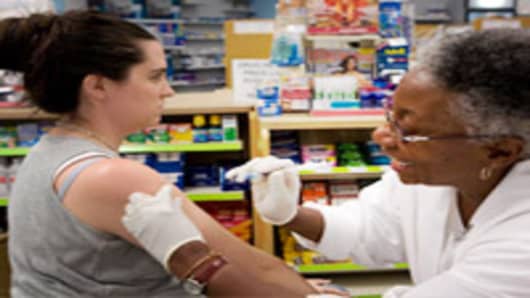
Mark Lennihan / AP |
John F. Kennedy made health care a major issue in his 1960 campaign. He concentrated on what then was called medical care for the aged, a title that wouldn't play well with the current Medicare set, people now described as senior citizens. He couldn't get it through Congress.
Lyndon B. Johnson did, but even with his legendary legislative skills and the overwhelming Democratic majorities in Congress after the 1964 elections, it took more than a year of hard, sometimes arm-bending persuasion to get Medicare enacted. It was a hard sell with conservative Democrats, not unlike the problem Obama faces now.
That one major victory for government health insurance was an exception to the pattern of starting each attempt from scratch instead of evolving it from what had gone before. When Johnson signed the Medicare bill in 1965 and gave Truman card No. 1, he traveled to Independence, Mo., to share "this moment of triumph" with the president who had first proposed it 20 years before.
It provided government health insurance at age 65, tied to Social Security. Broader coverage, which FDR, Truman and Johnson all would have liked to gain, was beyond political reach.
Not only for LBJ, but also for Republican Richard M. Nixon, who proposed universal health insurance in 1974, seeking to use employer-based coverage along with federal subsidies so that all Americans would be insured. It was to be done by private insurers, not the government. There was bipartisan support until Watergate intervened.
The political perils of change were dramatized in 1988 after Congress enacted a Medicare overhaul that included prescription drug benefits financed with higher fees on upper-income recipients, who rebelled. They protested, demonstrated and even chased the sponsor, then-Rep. Dan Rostenkowski, D-Ill., to his car. Those changes were repealed the next year.
Prescription drug coverage was added to Medicare in 2003, pushed by President George W. Bush, who claimed it as one of his major achievements in winning re-election. It did not come easily. The administration understated cost estimates by half, and Republican leaders muscled it through the House by one vote. To hold down the cost, they wrote a gap into the coverage.
That may be changed in an Obama health plan. It points to a chronic challenge in health overhaul efforts: the price of change. Covering nearly 50 million uninsured Americans would cost an estimated $1 trillion-plus over the next decade. Obama promised to do it without adding to the deficit. Now he and Congress have to figure out how.
- These four sectors will be the next to lead the market.
- Zhu Zhu Pets are this year's must-have toy, fetching $40 or more on eBay.
- From the why-didn’t-I-think-of-that file, we present Jason Sadler, a man whose job is wearing T-shirts.
- It may be the most unusual guide to business you'll read.
- Shopping for a gadget hound? The choices can be baffling. Here are a few that should be a hit.
- "The Who" will be the halftime act for Super Bowl XLIV on Feb. 7 in Miami. Is the NFL behind the times?