

For two Canadian guys who've spent the past 17 years together building one of the world's most important tech companies, Research in Motion co-CEOs Jim Balsillie and Mike Lazaridis have surprisingly little in common.
Blackberry.com
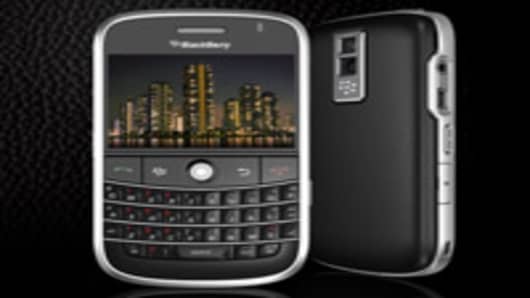
blackberry bold 9000
Balsillie, 48, is tall, sinewy, and bald. He likes to spend his free time doing triathlons or jetting off to Europe to ride his bike up the Tour de France's toughest mountain climbs. Lazaridis, also 48, is stout and unathletic with a thick shock of white hair. He laments that by the time he could afford to drive a Porsche, his posterior was too big to fit in the seat.
The extroverted Balsillie is a freewheeling conversationalist who will talk your ear off about his quest to buy the Phoenix Coyotes hockey team and bring the NHL franchise to Canada. The reserved Lazaridis would rather not discuss his personal life but admits that at age 12 he won a prize for reading every science book in the Windsor Public Library.
Balsillie is the financial whiz who drives corporate strategy. Lazaridis is the engineering genius who spearheads product development for the BlackBerry maker.
The two don't socialize outside of work. Their offices in RIM's headquarters in Waterloo, Ontario, about an hour's drive southwest of Toronto, aren't even in the same building. But the lack of personal connection doesn't hinder their effectiveness. Quite the opposite, in fact. They say it just makes them more efficient.
"We each know what we're good at," says Lazaridis. "We don't even have to ask."
Individually, Balsillie and Lazaridis may not be the equal of a certain black-mock-turtleneck-and-jeans-wearing consumer-product-design genius in Cupertino, Calif., who just happens to be their biggest rival. But together the pair is pretty darn formidable.
Do two collaborative Canadians match up to one Steve Jobs? For the moment, at least, they're more than holding their own.
Despite the incredible success of Apple's iPhone, Research in Motion retains a dominant position in the ultra-fast-growing smartphone business—the combo phone/e-mail device category that Balsillie and Lazaridis essentially created.
Over the past decade RIM has sold some 65 million phones to its now 28.5 million subscribers, increasing its stock market capitalization from $96 million to $42 billion in the process. (Balsillie and Lazaridis each have a 6 percent stake, good for roughly $2.5 billion apiece.)
RIM has a commanding 56 percent share of the $12 billion U.S. smartphone market. And its sales are still accelerating. In fact, according to industry tracker IDC, the bestselling smartphone in the U.S. so far this year by units is not the iPhone but the BlackBerry Curve.
Thanks to those booming sales, Research in Motion ranks No. 1 on Fortune's 2009 list of Fastest-Growing Companies, with a three-year average earnings-per-share growth of 84 percent and revenue growth of 77 percent. Even after last year's stock market meltdown, shares of RIM have a three-year annualized total return of 45 percent. Apple, which is three times the size of RIM in both sales and market value, checks in at No. 39.
Once considered mostly a business tool, of late the BlackBerry has made huge gains as a consumer product. RIM launched its first television ad campaign targeting a mass audience in 2008, and last quarter 80% of its new subscribers came from the nonbusiness crowd. Teens, for instance, love BlackBerry Messenger, RIM's proprietary instant messaging feature. Then there's the influence of a certain e-mailer-in-chief.
- Wednesday on CNBC: An In-Depth Look at the Fastest Growing Companies List
"President Obama carrying a BlackBerry was a tremendously sexy marketing tool," says analyst Philip Cusick of Macquarie Research Equities. "It keeps my nephews thinking it's cool."
The good news for both RIM and Apple is that the overall smartphone market is growing faster than ever. In 2008 a total of 1.19 billion mobile phones were sold worldwide, according to IDC, of which some 155 million were smartphones, or 13 percent. In 2013, IDC predicts that 20 percent of the 1.4 billion phones sold will be smartphones, or 280 million.
The competition, though, is getting increasingly stiff. New entrants like computer manufacturers Acer and (if rumors are true) Dell are rushing into the market. A revitalized Palm has taken aim at the iPhone with its Pre, which debuted on the Sprint network in June and will be available on Verizon next year.

Fortune
And Google is pouring resources into its Android smartphone operating system and training its sights on the enterprise portion of the market that Research in Motion currently dominates. Motorola is poised to debut two new devices running Android this fall. "There are going to be more smartphone launches in the next couple of months than we've ever seen before," says Gartner analyst Ken Dulaney.
While BlackBerry is making inroads with consumers, the iPhone is winning over an increasing share of business customers. According to ChangeWave Research, as of May Apple had 20% of the enterprise market, up from 6% just a year ago. (Much of the gain came at the expense of Palm's Treo.)
Over the same period RIM's share dipped slightly from 76 percent to 74 percent. Apple also makes more on each sale. According to Sanford Bernstein analyst Toni Sacconaghi, Apple currently has an operating margin of 40 percent on its iPhones vs. RIM's average per handset of 20.7 percent. (The industry mean is 9.7 percent.)
Catering to the Consumer
Another challenge is that the consumer's expectations about what smartphones should provide are also evolving rapidly. Mobile phone users increasingly want to access the web more than they want to make calls. They're gravitating toward Tweeting rather than long e-mails. And they want applications, those programs that let you check the weather, play games, and even balance your checkbook.
Apple now boasts some 65,000 choices in its App Store that range from the über-practical to the ultra-absurd. The new BlackBerry app store, by contrast, which launched only in April, offers just 2,000. Whereas RIM led the mobile-phone industry into e-mail, it is a follower in the race to build a dominant software ecosystem for handheld computing.
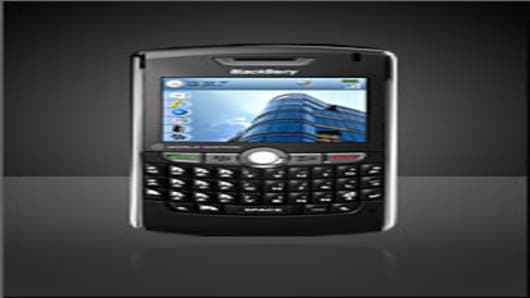
Blackberry 8800
"The Apple model will be one portion of the community, and Android will be another," says Cusick of Macquarie Research. "It will be tough for RIM to remain competitive."
But if RIM's co-CEOs are daunted by this changing environment, neither is showing it. While artfully dodging direct questions about Apple, they come across as defiantly confident. The pair seem more concerned about managing the company's explosive growth than about its coming to an end.
"Sometimes we have to put the brakes on," says Lazaridis matter-of-factly. "We've shown that we can handle annual 100% growth. I'm not sure we could handle more than that."
Look south from Lazaridis's second-floor office window, and you'll see a cluster of new buildings that have crept down a slope in recent years to nudge right up against the edge of the University of Waterloo, a math and engineering school the caliber of MIT. On the other side of the campus is the horse-and-buggy Mennonite community of St. Jacobs.
In a typical year, 2,000 Waterloo students are spending their "co-op" semester of work placement as RIM employees. They serve as a much-needed supplement to Research in Motion's ballooning operations. Last year alone the company grew 50% in headcount to 12,000 employees. RIM has easily supplanted once-mighty Nortel as Canada's flagship tech company.
Lazaridis dropped out of Waterloo in 1984, just one month shy of graduation, to start Research in Motion as a computer science consulting business with his childhood friend Doug Fregin. (A behind-the-scenes guy, Fregin served as vice president of operations until he retired in 2007.) The two biked daily to their first office, a 500-square-foot space above a bagel store in a strip mall.
One early application they created enabled businesses to conduct credit card transactions. In the late 1980s they helped develop technology that made for faster direct-to-video movies (making RIM indirectly responsible for the Olsen twins' fame and fortune).
Then they had the insight that would eventually make them billions. Watching Waterloo students eagerly embrace e-mail, they realized it would be the communication medium of the future and would eventually move to devices much like phones. A company that could provide those products would have an enormous opportunity.
"We knew e-mail was going to be the foundation of business, that it'd replace fax," said Lazaridis. "We basically had to wait around and get ready." Unfortunately, they had nearly run out of money.
So in 1992, Lazaridis and Fregin turned to Jim Balsillie, a management consultant they had previously worked with on a failed project. Balsillie, a onetime college roommate of author Malcolm Gladwell (The Tipping Point) at the University of Toronto's Trinity College, invested $125,000 for a one-third stake in the business.
He took the co-CEO title and threw himself into fundraising. In 1997, RIM went public with a listing on the Toronto Stock Exchange and raised $115 million from investors. Two years later the company introduced its first BlackBerry brand e-mail device, a bulky rectangle with a narrow screen that ran off one AA battery.
Balsillie took an unconventional approach to winning the company's first customers that proved highly successful. He sank his energy into investor relations, crisscrossing the U.S. to sit down with analysts and bankers.
"Every time I'd go up there and present, I'd sit there and ask, 'Who here uses Microsoft Exchange?'?" he remembers. "And two-thirds would raise their hands. Then I'd say, 'Who here would like to get e-mail on their belt for free?'?"
He collected business cards and sent "e-mail evangelists"—kids just out of college—back to get the bankers up and running. Within a year the BlackBerry had become a staple on Wall Street.
"It was a puppy dog sale," he says. "?'Take a puppy dog home, and if you don't like it, bring it back.' They never come back."
Most people think of Apple as RIM's biggest threat. While that may be true, there is probably no single event that has done more for RIM's business than the iPhone launch. It was Apple that convinced consumers that they could enjoy the ease and power of a desktop in a handheld device, thus opening a vast new market.
Overnight the smartphone became, by popular demand, a consumer device. Since the iPhone's introduction in June 2007, BlackBerry quarterly sales have more than tripled, from $1.1 billion to $3.4 billion. Three of the five top-selling mobile phones in the U.S. are now BlackBerrys.
While Apple has chosen to develop one phone on its own through one carrier (AT&T ) and wait for customers to seek it out, RIM has pursued the opposite strategy—what Balsillie calls "constructive engagement." Rather than creating devices independently, RIM partners with carriers to make individualized products.
It produces numerous versions of its seven basic handsets. And because RIM works with every major carrier, consumers are able to buy a subsidized BlackBerry no matter what their plan.
A phone for every customer
This approach has paid great dividends. For instance, when Verizon needed a strong competitor for the iPhone it sought out RIM to develop the Storm, which introduced a sensory touchscreen keypad. Verizon provided a generous subsidy for the device and put a multimillion-dollar marketing campaign behind it. Though early reviews were mixed, the Storm has become the third-best-selling smartphone since its debut last year.
RIM believes one way to continue growing in the crowded U.S. market is to develop targeted products for specific groups of customers. On July 27, for example, RIM announced the Curve 8520, a new BlackBerry aimed at social media maniacs (read: tweens) with buttons that allow users to upload media directly to YouTube and Facebook. It went on sale this month at Wal-Mart for just $48.88 with a two-year T-Mobile contract.
Fortune
Balsillie and Lazaridis, however, think that their biggest growth opportunity may lie outside the U.S.? Foreign consumers are only beginning to embrace smartphones in large numbers. And Finnish phone giant Nokia, long the global powerhouse, has been losing share rapidly.
So RIM has begun positioning itself in foreign markets, forming partnerships with 475 carriers in 160 countries in recent years.
"The thought that Latin America and Western Europe could someday be like North America in terms of market penetration gets us very, very excited," says Balsillie.
But the act of going global alone won't be enough for RIM to succeed in the long run. Just as it once made e-mail in a phone into its Killer App, the company must adapt to a world with thousands of killer apps.
"What you carry on your belt is now your MP3 player, will be your plasma TV, is your social-networking machine, is your Internet terminal, your camera, your personal navigation device," says Balsillie.
More and more, phones are becoming devices for users to download the software programs, or applications, they want. (As Apple's TV commercials promise: "There's an app for that!") No single company can come up with the massive portfolio of applications that will please consumers, however. That would be like asking Wal-Mart to make all the products it also sells.
And that's why smartphone makers are trying so hard to woo software developers to make the programs that will run on their phones. The market for this software is relatively small now, but it's growing quickly. Juniper Research estimates sales of mobile applications could hit $25 billion in 2014, up from $7 billion last year.
RIM has long had one of the largest enterprise developer communities, but more recently it has worked aggressively to court a wider group by doing what it does best: partnering with them. That challenge falls to RIM's vice president of business, marketing, and alliances, Jeff McDowell.

CNBC.com
Though his division brings in only a tiny portion of the company's revenues, Balsillie and Lazaridis shower him with attention.
"I talk to Mike at least once a day, and Jim usually four times," says McDowell. "I can show up at Jim's office anytime he's in and he'll see me."
McDowell oversees the BlackBerry Alliance Program, which offers its 1,700 partners dedicated teams of RIM developers, technical expertise, and marketing support. Last fall the company held its first developer conference in Silicon Valley, a packed event in which it gave developers insight into plans for new products as well as one-on-one instruction and a chance to hobnob with the company's most prestigious engineers.
And in April the company launched BlackBerry App World, a virtual storefront that collects most BlackBerry applications in one central location. Developers keep 80% of what they charge for their programs. (Apple offers developers 70%.)
"Our objective is to help developers make money," explains McDowell. "That creates the buzz, and then I don't have to worry about the benefits to RIM."
Ultimately, though, Balsillie and Lazaridis know they'll need more than buzz. The challenge is to anticipate the fickle tastes of a new consumer market. And in their own pragmatic way, they're confident that they're up for the task.
"We don't just throw spaghetti at the wall and see what works," says Lazaridis, a touch defensively. "We have a lot of faith in our own capabilities, and we do a lot of research into what people want and don't want. Our products just keep getting better and better and better."
With the iPhone as a competitor, they need to be.