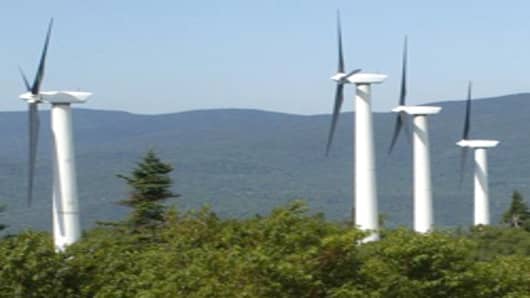
These projects are just a slice of the energy experiment unfolding across Hawaii’s six main islands. With the most diverse array of alternative energy potential of any state in the nation, Hawaii has set out to become a living laboratory for the rest of the country, hoping it can slash its dependence on fossil fuels while keeping the lights on.
Every island has at least one energy accent: waves in Maui, wind in Lanai and Molokai, solar panels in Oahu and eventually, if all goes well, biomass energy from crops grown on Kauai. Here on the Big Island of Hawaii, seawater is also being converted to electricity.
Still, the state faces enormous challenges in delivering the power to the people who need it. While the urban sprawl around Honolulu consumes the bulk of the energy, most potential renewable sources are far from the city, 150 miles southeast or 100 miles to the northwest.
Each of the state’s six electric grids belongs to its own island and is unconnected to the others. And according to state figures, Hawaii still relies on imported oil to generate 77 percent of its electricity, a level of dependency unique in the United States. Coal-fired power provides 14 percent, and 9 percent comes from renewable sources like the wind or the sun.
Hawaii’s governor, Linda Lingle, a Republican, has resolved to throw off the yoke of oil dependence and harness the state’s potential.
Under an agreement reached last year with the federal government and the dominant local utility, the Hawaiian Electric Company, Hawaii plans to generate 40 percent of its power from renewable sources by 2030. The state’s six grids will be connected by cables, and planners hope that conservation steps like reducing the air-conditioning load at high-rise hotels will cut Hawaii’s energy consumption by nearly a third. “The goals are very, very aggressive,” said Debra Lew, a senior project leader for the federal National Renewable Energy Laboratory. Three decades ago, Hawaii mapped out a similar vision, if in less detail, that came to nothing. But this time, planners say, failure is not an option. “We don’t have anywhere else to go,” said Ted Peck, the point man for the Hawaii Clean Energy Initiative, overseen by the State Department of Business, Economic Development and Tourism.
Even if the state were indifferent to the environmental costs of burning oil and gas, including carbon-dioxide emissions that contribute to global warming, it would have to embrace renewable energy sources, said Robert Alm, a vice president of the Hawaiian Electric Company. “Our hedge won’t be buying oil futures, it will be buying wind,” Mr. Alm said.
Heavy reliance on imported oil has proved economically perilous. When oil prices hit $147 a barrel a year ago, electricity rates approached or briefly exceeded 50 cents per kilowatt hour on Maui and Kauai, about five times the national average.
The spike in prices lent urgency to the Hawaii Clean Energy Initiative, which Governor Lingle unveiled in January 2008.
The technical and political obstacles have since become clearer.
Hopscotching around this brightly colored archipelago by plane, a visitor gets a vivid sense of Hawaii’s essentially rural nature and the scope of the challenge.
The biggest priority is laying undersea cables between the outer islands and Oahu. Once those connections are made — first with cables stretching from Molokai and Lanai, the islands nearest Oahu — the capital will get power through them.
Then there is the daunting challenge of feeding fluctuating wind and solar power into the small electric grids on the individual islands while devising backup systems to keep the energy output smooth and reliable.
On Maui, for instance, General Electric is working on ways to modulate demand and store energy for later use either in electric batteries or by pump storage — filling an elevated reservoir in low-demand periods to produce hydropower when needed. “The whole trick is making the system work in the right way, like conducting an orchestra,” said Bob Gilligan, G.E.’s vice president for transmission and distribution.
On the financial side, the state must attract developers with enough financing to help underwrite their own wind, solar, wave or other renewable projects, carry out the required environmental reviews and secure local approval. Addressing local concerns can be especially challenging. As in any state with a rural-urban divide, residents of Hawaii’s less populous outlying areas are wary about being pushed around by planners in Honolulu.
The outer islands have higher concentrations of Native Hawaiians who are well versed in a local history of exploitation, from the American overthrow of their monarch in 1893 to environmental costs of sugar plantations and tourism.
Some have formed groups like the Pele Defense Fund, which sprang up here in the 1980s to protect religious gathering rights in the rain forest on the Big Island. The fund seeks to prevent desecration of Pele, the native goddess of fire and volcanoes, and finds geothermal energy projects sacrilegious.
One avenue for developers, utilities and state officials is to offer outlying communities support or financing for needs that the local population identifies, like fish conservation. “We’re asking the small islands to be significantly burdened on behalf of Oahu, so Oahu needs to do well by them,” said Mr. Alm, the utility’s vice president.
For all the optimism, planners studiously remind themselves of the detritus of past failures, like the dismembered and rusting wind turbines of a defunct wind farm near the southern end of the Big Island. “This transformation is going to take a generation,” said Ted Liu, director of the state economic development department. “There are no short-term easy solutions.”