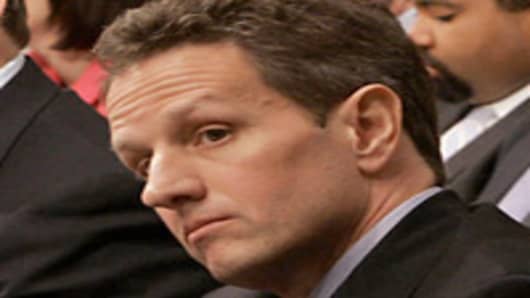
Before taking the Treasury job, “I had spent most of my life trying not to be on television,” Mr. Geithner said in an interview here. Indeed, results so far suggest that is where he does his best work.
After stumbling in his transition from backstage player to out-front crisis manager, Mr. Geithner has since quieted critics inside and outside the administration at a time when health care and foreign policy challenges increasingly command the headlines. But with the economy still hovering between recession and recovery, multiple tests of his judgment and political dexterity lie ahead.
A Shaky Start
Mr. Geithner made his professional reputation over two decades of behind-the-scenes government work that began in the Reagan-era Treasury Department. His profile rose considerably last fall as president of the New York Federal Reserve, when he joined President George W. Bush’s Treasury secretary, Henry M. Paulson Jr., and the Federal Reserve chairman, Ben S. Bernanke, in the frantic effort to prevent financial collapse.
His public struggles began when Mr. Obama chose him as Treasury secretary. First he survived a confirmation controversy over unpaid taxes; later he drew fire for comments about Chinese currency policies that some analysts considered too blunt.
Mr. Geithner’s shaky initial rollout of a plan to help banks clean up so-called toxic assets generated calls for his ouster. Rahm Emanuel, the White House chief of staff, grew concerned enough about Treasury’s performance that he escalated his own involvement in the department’s affairs.
As it happened, the toxic asset plan’s signal contribution was the announcement itself; the increase in market confidence it engendered all but obviated the need for financial institutions to use it. Meanwhile, signs that economic growth is resuming have eased the sense of crisis surrounding Mr. Geithner’s work.
The economic “message” meetings in Mr. Emanuel’s office have slowed from daily to weekly. The administration’s immediate domestic priority is health care, while foreign policy challenges with Iran and the war in Afghanistan have gained fresh urgency.
Aides say the president never lost confidence in Mr. Geithner, who was born two weeks after Mr. Obama in August 1961. Mr. Emanuel said Mr. Obama values the same quality in Mr. Geithner that he values in himself: the ability to “stay calm and focused and dispassionate in a storm.”
Tempering Populism
Conservatives continue accusing Team Obama of dangerously expanding government control over the economy, from Wall Street to Detroit. But some Bush White House veterans credit Mr. Geithner with tempering the populist impulses of other Obama advisers.
One example: the administration has resisted calls, domestically and from G-20 allies like France, for specific dollar limits on executive compensation in the financial industry. “He’s doing as good a job as he can under the circumstances,” said Lawrence B. Lindsey, once Mr. Bush’s top economic adviser.
Such praise only fuels those on the left who cast Mr. Geithner as a tool of Wall Street interests for having rebuffed their calls to nationalize troubled banks.
“Progressives have been disappointed,” said Robert L. Borosage, director of the Committee for America’s Future. But he added, “I don’t think we see a lot of distance between Obama and Geithner.”
Mr. Geithner proved that point by successfully pushing for Mr. Obama to reappoint Mr. Bernanke, his close ally in the battles of the last year. The decision was fraught because a leading alternative was the National Economic Council director, Lawrence H. Summers, Mr. Geithner’s onetime mentor in the Clinton Treasury Department. Staying put in his current job, Mr. Summers will remain as a rival to Mr. Geithner for influence over administration economic policy.
The president’s decision to impose tariffs on imported Chinese tires, which Mr. Geithner opposed, showed he does not win every argument. Over the next year, he will face a raft of new fights over financial regulation in Congress, deficit reduction, and when to roll back Washington’s economic interventions.
That rollback may be the toughest strategic choice, pitting inflation fears against persistently high unemployment. Kevin M. Warsh, a Fed governor, warned in The Wall Street Journal last week that “policy likely will need to begin normalization before it is obvious it is necessary, possibly with greater force than is customary.”
His early public battering largely behind him, Mr. Geithner sounded sanguine last week. “As long as I feel confident we’re making the best decisions among a set of options,” he concluded, “I feel good.”