

If you’re getting a little queasy about the sagging U.S. dollars in your savings account, join the club.
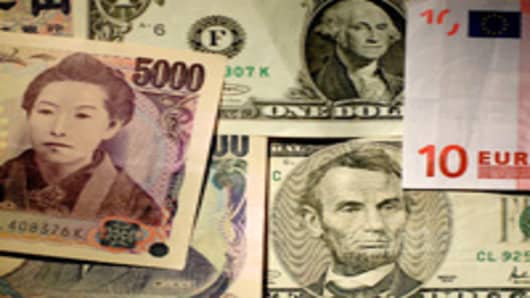
With deficits high and interest rates low, one potential outcome is high inflation, which would eat away at the value of the greenback.
Now it seems banks are sharing the unease: They’re putting almost two-thirds of their new cash into the euro and the Japanese yen, according to Barclay’s Capital. Compare that to a decade ago, when it was the U.S. dollar that garnered two-thirds of that cash. Global reserve currency? Not so much.
So what’s an investor to do about the shakiness of the dollar? Enter currency exchange-traded funds (ETFs), which let even casual investors put a little foreign spice in their cash holdings. There are now a total of 35 on the market, covering everything from the Indian rupee to the Brazilian real.
Other People's Money
“What currency ETFs provide are democratization,” says Bradley Kay, an ETF analyst with research firm Morningstar. “Previously foreign currencies were largely inaccessible to individuals, because of things like minimum investments. ETFs have opened that all up.”
In fact they now hold more than $4.5 billion in assets, up $500 million in the third quarter of this year alone. The first currency ETF only opened at the end of 2005. Whereas currency trading used to be the province of institutions and private banks catering to the ultra-wealthy, any investor can now bet heavily on, say, the Chinese yuan or the Swedish krona.
But that doesn’t mean you should put your life savings into foreign currencies, just because you can. When it might make the most sense for investors: If you have significant cash holdings, and want to hedge some of it against a potential fall of the greenback. With the U.S. government massively increasing its balance sheet, a spike in inflation in the next few years is a distinct possibility, which would eat away at the value of the dollar.
In a worst-case scenario there could be a loss of faith among major debt-holders like China and Korea, who could decide to shift their central bank reserves to other currencies.
It’s not so far-fetched: The dollar’s already slid to a 14-month low, partly thanks to such worries.
“If you’re concerned about the dollar, by all means hold some of your cash in another currency,” says Morningstar’s Kay. “Or if you’re going to have major expenses abroad—like a big family trip, or you’re relocating to work in another country—you can fix those costs now, for the $8 cost of a brokerage fee.”
Currencies, however, should not be a core, long-term holding for investors.
“They belong in the trading-risk end of a portfolio,” says Joe Trevisani, chief market analyst for Saddle River, N.J.-based FX Solutions. “They’re not investments in the classic buy-and-hold sense.” Instead, speculative plays should be—as FX Solutions’ own disclaimer says—“conducted with risk capital you can afford to lose."
Remember that big, bad currencies banks have been the undoing of major funds and banks over the years. Do Barings Bank and Nick Leeson ring a bell?
Rules Of The Road
A few caveats aboutcurrency investing. Remember that you’re buying cash, not asset-backed vehicles like stocks, bonds or real estate. As such, it’s a zero-sum game—other currencies have to fall, in order for your investment to rise—and appreciation potential is limited.
And if it’s the U.S. dollar you’re worried about, you can reduce your exposure in other ways, such as buying stock in large multinational firms or broad international-equity funds, particularly small-caps, which are very tied to local currencies.
For solid long-term bets, consider baskets of currencies to reduce your risk, suggests Morningstar’s Kay. Make a single bet like the Mexican peso, and you’re taking your chances.
But buy a broad ETF, and you spread your risk appropriately. Consider the PowerShares DB US Dollar Bearish , a basket of developed-market currencies dominated by the euro, or WisdomTree Dreyfus Emerging Currency , a geographically-diversified collection of currencies in emerging-market economies.
For investors looking for a more direct play, there are a number of online trading platforms. GAIN Capital's Forex.com, GFTForex.com, CMS Forex, for example, allow investors to open trading accounts. Minimum investments and other requirements vary, but one thing is always the same. Currency markets trade around the clock and are very liquid, so price swings can be fast and furious.
Of course, the dollar’s slide isn’t guaranteed, since a double-dip world recession, or another international crisis—political or financial—could see investors flooding back to the relative safety of the greenback.
“But it’s primarily the dollar’s weakness that is driving currency markets now,” says FX Solutions’ Trevisani. “This will continue until the Fed makes clear its intention to begin raising rates—and I don’t think that’s likely until the second half of 2010.”