

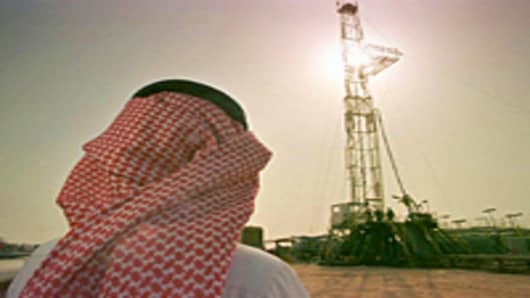
Saudi Arabia is trying to enlist other oil-producing countries to support a provocative idea: if wealthy countries reduce their oil consumption to combat global warming, they should pay compensation to oil producers.
AP
The oil-rich kingdom has pushed this position for years in earlier climate-treaty negotiations. While it has not succeeded, its efforts have sometimes delayed or disrupted discussions. The kingdom is once again gearing up to take a hard line on the issue at international negotiations scheduled for Copenhagen in December.
The chief Saudi negotiator, Mohammad al-Sabban, described the position as a “make or break” provision for the Saudis, as nations stake out their stance before the global climate summit scheduled for the end of the year.
“Assisting us as oil-exporting countries in achieving economic diversification is very crucial for us through foreign direct investments, technology transfer, insurance and funding,” Mr. Sabban said in an e-mail message.
This Saudi position has emerged periodically as a source of dispute since the earliest global climate talks, in Rio de Janeiro in 1992. It is surfacing again as Saudi Arabia tries to build a coalition of producers to extract concessions in Copenhagen.
Petroleum exporters have long used delaying tactics during climate talks. They view any attempt to reduce carbon dioxide emissions by developed countries as a menace to their economies.
The original treaty meant to combat global warming, the 1992 United Nations Framework Convention on Climate Change, contains provisions that in Saudi Arabia’s view require such compensation.
Mr. Sabban outlined his stance at climate talks in Bangkok this month.
Environmental advocates denounced the idea, saying the Saudi stance hampered progress to assist poor nations that are already suffering from the effect of climate change, and that genuinely need financial assistance.
“It is like the tobacco industry asking for compensation for lost revenues as a part of a settlement to address the health risks of smoking,” said Jake Schmidt, the international climate policy director at the Natural Resources Defense Council. “The worst of this racket is that they have held up progress on supporting adaptation funding for the most vulnerable for years because of this demand.”
Saudi Arabia is highly dependent on oil exports, which account for most of the government’s budget. Last year, when prices peaked, the kingdom’s oil revenue swelled by 37 percent, to $281 billion, according to Jadwa Investment, a Saudi bank. That was more than four times the 2002 level. At one point in 2008, the average gasoline price in the United States surpassed $4 a gallon.
Saudi exports are expected to drop to $115 billion this year, after oil prices fell. American gasoline prices are hovering around $2.50 a gallon.
The one-year swing in the kingdom’s revenues shows that oil prices are likely to be a bigger factor in Saudi Arabia’s future that any restrictions on greenhouse gases, said David G. Victor, an energy expert at the University of California, San Diego.
Mr. Victor dismissed the Saudi stance as a stunt, saying that the real threat for petroleum exporters came from improvements in fuel economy and rising mandates for alternative fuels in the transportation sector, both of which would reduce the need for petroleum products. “Oil exporters have always, in my view, far overblown the near-term effects of carbon limits on demand for their products,” Mr. Victor said. “For the Saudis this may be a deal-breaker, but the Saudis are not essential players. In some sense, one sign that a climate agreement is effective is that big hydrocarbon exporters hate it.”
A recent study by the International Energy Agency, which advises industrialized nations, found that the cumulative revenue of the Organization of the Petroleum Exporting Countries would drop by 16 percent from 2008 to 2030 if the world agreed to slash emissions, as opposed to the projection if there were no treaty.
But with oil projected to average $100 a barrel, the energy agency estimated that OPEC members would still earn $23 trillion over that period.
Mr. Sabban, however, cited an older study by Charles River, a consulting firm, which found that the losses in revenue for Saudi Arabia alone would be $19 billion a year starting in 2012.
The Copenhagen talks were a major point on the agenda of the last OPEC conference.
But not every oil-exporting country is falling in line with the Saudi position. Some have been trying a different approach that has earned the backing of environmental groups. For example, Ecuador, OPEC’s newest member, said last year that it was willing to freeze oil exploration in the Amazon forest if it got some financial rewards for doing so.
The Saudi negotiator said that the compensation mechanism was an integral part of the global climate regime that has been in place since the 1990s and that was not up for renegotiation.
“It is a very serious trend that we need to follow and influence if we want to minimize its adverse impacts on our economies and our people,” Mr. Sabban said in an e-mail message to other OPEC officials. “That does not mean we would like to obstruct any progress or that we do not want to join any international agreement. We will do that if the deal is fair and equitable and does not transfer the burden to us.”