- Dubai Debt Delay Rattles Stock, Bond Markets
- Fannie Mae to Tighten Lending Standards: Report
- China Overcapacity Worsening, EU Chamber Warns
- Investing in Good Karma – and Making a Profit
- Black Friday to Avoid Red Ink; Greenback Gets the Blues
- Wal-Mart Price Pressure Hurts China Workers: Report
- Bankruptcies Jump, Hitting Highest Level in Four Years
- Steepest Black Friday Discounts, Revealed
- Where Do Pardoned Turkeys Go?
- 4 Thanksgiving Week Buys For Your Portfolio: Market Pros
- There's a 'Great Chance' For a Double-Dip Recession: Strategist
- Revenge of the Gangsta Nerds
- Will TCU See The "Flutie Effect?"
- Retail Earnings and Sales to Improve in Q4: Analyst
- Consumers Catching the Holiday Spirit
- It's Beginning To Look A Lot More Riskless
- Crescenzi: Claims Level Suggests End to Job Losses
- Hedge Funds Take Early Lead in Warren Buffett's 'Big Bet'
MOST SHARED
- The Executive Job Search
- Chinese Overcapacity is Worsening, EU Chamber Warns
- US Mint to Suspend American Eagle Gold 1-Ounce Coins
- Judge Erases Couple's $525,000 Mortgage Payment
- Salvation Army's Kettles Now Credit Card-Ready
- Topless Business Is Taking Off
- Wal-Mart Price Pressure Hurts China Workers: Report
- Black Friday: Bargain or Bust?
- The 'Real' Jobless Rate: 17.5% Of Workers Are Unemployed
This global recession will turn into a "full-blown depression," Nicu Harajchi, CEO of N1 Asset Management, said Friday, adding that global stimulus hasn't come down to Main Street.
Wall Street is making money, while consumers aren't, Harajchi told CNBC.
"We have seen the G20 coming out with cross border capital injections of $5 trillion this year… But a lot of this money hasn't really come down to Main Street," he said.
"When it comes down to corporate America, corporate Europe or even in Asia, in Japan, we are not seeing Main Street making any money," he said. "Consumers are losing their jobs. They are struggling with their mortgages, with their credit. And we are just seeing this continuing."
The $5 trillion injection is "monetary expansion," according to Harajchi. "At some point, which we believe to be 2010/11, some of the central banks are going to recall some of that money and that will turn from monetary expansion to monetary contraction."
He also said he doesn't see the corporates or the public "being able to pay back that debt."
"We see 2010 becoming a much more risky year than 2009," he said.
Harajchi said unemployment data are "a leading indicator" instead of a lagging indicator.
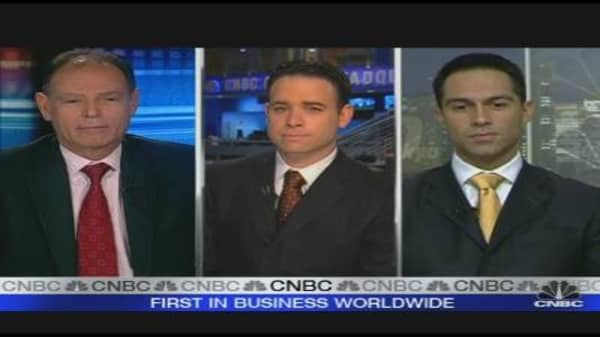
Mike Lenhoff, chief strategist at Brewing Dolphin Securities, told CNBC that the recovery will depend on the improvement in cyclical sectors.
"The sooner companies generate their profits, and I think it is moving towards mainstream, it's not just the financials now," Lenhoff said. "If present trends continue, we're talking about jobs being created sometime in the second quarter of next year. That could do a lot for consumer confidence."
Weak Dollar is Everybody's Friend
It is no longer up to the U.S. but more to the rest of the world to decide about the dollar's status as the global reserve currency, Harajchi said.
China and the Gulf countries which have their oil pegged to the dollar "would like to see some other currencies, maybe the euro, playing a more dominant role," he said.
Lenhoff disagreed with Harajchi, saying he believes the dollar will continue to play a dominant role in global trade and global finance.
Central banks will continue to keep interest rates very low in order to avoid a depression, he said. The reason for the dollar's recent weakness "is really down to Fed policy," he added.
![]() |
"The Federal Reserve has made it crystal clear that interest rates are staying where they are for an extended period of time. We're getting to see a more confident tone to global growth, to a recovery, and as a result of that, we're seeing the tolerance towards risk aversion drop and that in turn has washed back onto the dollar as investors go in search of risk assets," he said.
"This is something we're going to see for a while, until there is a change in Fed policy. That doesn't seem imminent and certainly it doesn't seem at all likely until sometime in the latter half of next year."
The dollar's depreciation will help boost the S&P 500 index over the coming quarters, Lenhoff told CNBC.
"A weak dollar is everybody's friend," he said.
"If the dollar serves the role of an additional stimulus in reflating the U.S, then I think that it's very good," he said.
- For nearly three decades, these on-call experts have been dishing advice on how to – and not to – cook turkey.
- Eric Schmidt pledges to create a virtual copy of the Iraq National Museum at Google’s expense.
- Bill Griffeth is taking a leave of absence from CNBC and Power Lunch for a year. Here's a message from Bill.
- More shoppers than ever plan to comparison-shop this season. Who will benefit?
- It may be the most unusual guide to business you'll read.
- How can you get out of debt and back on the road to recovery? Follow these ten steps.


