

Thousands of American homeowners are starting to see their monthly mortgage payments skyrocket, dealing a fresh blow to the already shaky housing recovery.
The widely feared reset of thousands of option adjustable-rate mortgages—where both interest and principal payments rise sharply—is already leaving many homeowners struggling to keep a roof over their head.
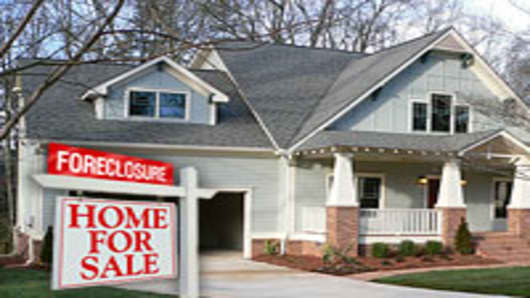
Home with foreclosure sign
"It's going to kill off housing," warns Patrick Pulatie, CEO of Loan Fraud Investigations, a predatory lending audit firm. "We have pretty close to 500,000 option ARM payments going higher in California over the next couple of years. The impact of the higher payments will be devastating for homeowners who are having trouble now making ends meet."
Option ARM mortgages, which have been around since 1981 and are aimed primarily for people who had fluctuating incomes, became popular during the housing boom. Terms of the loan usually allowed the borrower to make low monthly payments initially—sometimes by just paying interest only.
But as the terms of those mortgages now readjust, homeowners are facing much higher mortgage payments at a time when the value of their house has plummeted and many are out of work. In some cases, homeowners who chose a very low starting interest rate have actually seen the overall amount of their mortgage increase—known as negative amoritization—putting them even deeper in debt.
"Option ARMs have been a disaster from day one and a lot of them have already defaulted," says Greg McBride, senior financial analyst with Bankrate.com. "This is a very big issue because interest rates are rising."

There are no specific numbers on how many option ARM loans there are. But analysts estimate that as many as 1.3 million borrowers took out $389 billion in option ARMs in 2004 and 2005 alone.
Many of those option ARM loans have already re-adjusted to higher payments, but more are on the way. Some 88 percent of Option ARMs originated between 2004 and 2007 are going to adjust higher between now and 2012. Those option ARM borrowers could see their housing bills go up as much as 63 percent, according to Fitch ratings.
And there's more misery. If the Fed increases rates in the months ahead to fight inflation, rates tied to option ARM indexes will rise further—causing more payments to adjust up even sooner. And while Option ARM borrowers might want to re-finance, they often can't because of falling home values and tighter credit restrictions.
"I don’t see how the option ARM problem is not a huge issue," says Sylvia Alayon, vice president and director of operations for the Consumer Mortgage Audit Center, which provides auditing services to advocacy groups. "This is a major hit for housing. It will continue to feed the excess supply of housing with more foreclosures."
But Mark Zandi, chief economist at Moody's, says the option ARM problem is just one of many for housing.
"It's more of a bump in the road," Zandi says. "Many of these loans defaulted before they even got to higher payments. "I think the jobless situation is hurting more and the increase in interest rates. Add that with the coming ending of the home buyer tax credit and those are the bigger problems facing housing."
And David Adamo, ceo of mortgage banking firm Luxury Mortgage, says lenders are helping to ease the situation.
"Many of the good ones are entering into agreements to help borrowers ease their payments," says Adamo. "I don’t think that the re-casting of option ARMs will have any greater effect on housing than any other troubles facing borrowers."
In fact, some 21,000 home loans modified in the third quarter of 2009 included a principal reduction or deferral, according to Mortgage Metrics.
But that's not nearly enough says Loan Fraud Investigations Pulatie and getting most lenders to help now is not that easy. He also says they were part of the problem from the beginning. "They were pushing option ARMs. Anytime they sold to Wall Street, they received 3-4 points in commission," Pulatie said. "If you have $500,000 loan you’re talking about $15,000 in your pocket. That's why Wall Street liked them."
As for borrowers, Adamo says they need to do some honest personal appraisals when applying for a loan. "A lot of option ARM loans should not have been made in the first place, " Adamo says. "Many of them had lower stated income levels than should have been listed. Both the lenders and borrowers are at fault for that."
As the option ARM implosion hits housing, solutions seem few and far between. Homeowners are advised to work with their lenders in reducing loans payments if they are behind or can't re-finance. The White House has been increasing pressure on banks to help borrowers, but it's still up to the banks to decide if they will.
And there is HARP, the government program designed to help homeowners refinance an existing mortgage with lower mortgage rate or to refinance to lower monthly payments. But this too has had limited effect with tough restrictions and qualifiers.
While the number of foreclosures has slowed somewhat, it could reach 4 million in the US in 2010 according to RealtyTrac. Numbers like that, says one analyst, mean housing needs a major financial overhaul.
"We need to have these option ARM loans modified and help homeowners pay them off," says Alayon. "People who say 'don't help my neighbor because I made my payments' are missing the point. Missed mortgage payments mean foreclosures and falling home values. This effects us all."
