

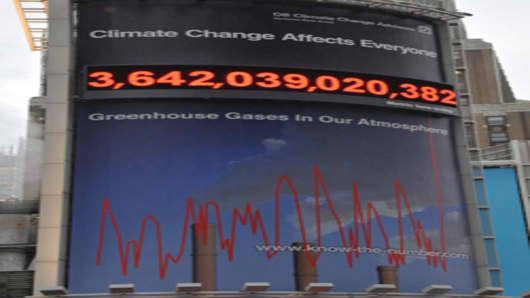
Several hundred investors recently huddled together at the UN with government officials and non-profit groups to discuss one thing—carbon. They heard from US climate change negotiator Todd Stern, international political royalty and a host of economic prognosticators about topics including the recent talks in Copenhagen, potential Congressional action, and whether new cleantech would set us free from our fossil fuel addiction.
And what was the take-away? That everyone expects someone else to make the first move.
To put this in perspective, Al Gore spoke about how investors put money to work based on assumptions. In the sub-prime mess, for example, he pointed out that we all assumed home values would keep rising to cover loans that people couldn’t afford and that securitizing such loans would spread the cost of a few defaults over a portfolio of generally good assets so investors would be OK. Once those assumptions were no longer true the markets crashed. He likened that debacle to the climate crisis, saying we assume today that oil and coal will always be plentiful and cheap and that carbon emissions will always be free.
Given that we now fight wars over declining oil reserves and can see the end of cheap coal (climate change, mountain top mining, air pollution and mercury emissions are just a few of the costs that King Coal will soon have to absorb), the time when those assumptions fail may now be upon us—but investors are just as ill prepared for this fundamental shift as they were for the sub-prime meltdown.
Mindy Lubber of CERES, a national network focusing on sustainability issues. underscored Gore’s point by sharing a survey showing that almost half of the world’s leading money managers do not consider carbon risks when making investments.
Although the climate change conference in Copenhagen last december failed to get a global agreement on carbon pricing, the European Union already imposes those costs and over half the states in the U.S. are poised to do so by 2012, so that omission is astonishing to say the least.
Abbey Joseph Cohen of Goldman Sachs put an exclamation point on this myopia by saying her firm would gladly arrange financing for a new coal-fired power plant if the numbers made sense today—despite the fact that such an investment is a 50-year wager full of carbon-related uncertainty.
Against this backdrop, UN Secretary General Ban Ki-Moon said that governments hesitate to regulate carbon because they fear the new clean technologies are too costly under the current economic conditions.
He urged investors to put up more money to mass-produce solar, hydrogen powered cars and other technologies to lower costs, essentially saying that companies and their bankers would have to move to a low carbon economy before global governments could take meaningful regulatory action.
But Kevin Parker of Deutsche Asset Management said investors are waiting for government. He said they need TLC from government—transparency, longevity, and certainty—before they could shift money from high-carbon old technologies to the new, low-carbon ones.
A statement issued by the investors’ network that hosted the event confirmed this game of chicken, saying, "Investors remain committed to taking action, but for us to deploy capital at the scale needed to truly catalyse a low-carbon economy, policy makers must act swiftly."
So is the investment community engaged in a game of chicken or is it simply a bunch of carbon chickens? The UN event revealed the very real opportunity to profit while the majority are still making long-term bets on the carbon equivalent of sub-prime mortgages—giving too much debt to borrowers, who won’t be able to repay it, and hoping that bundling high-carbon investments in mutual funds or other derivatives will disguise the truth until its too late.
