

Neil M. Barofsky is not a household name like some special investigators of the past — Kenneth Starr during the Clinton administration or Archibald Cox in the Watergate years.
But increasingly, Mr. Barofsky is setting off fireworks on Capitol Hill as he quietly and
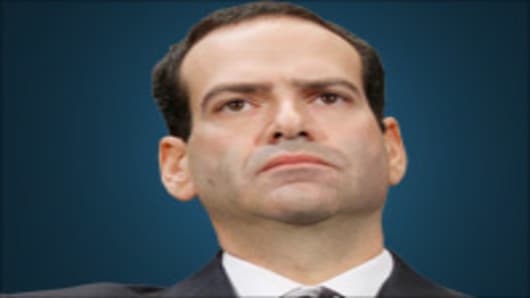
AP
Neil Barofsky
methodically pieces together the most complete historical record yet of the financial bailout. His reports are careful but not cautious, showing a willingness to stand up to some of the most powerful people and institutions in Washington or on Wall Street.
“Neil is not afraid to just follow things where they lead,” said Anthony S. Barkow, a friend and fellow former prosecutor in the United States attorney’s office for the Southern District of New York. “He is undeterred by having powerful people angry at him for doing what he does.”
So far, Mr. Barofsky has accused the former Treasury secretary, Henry M. Paulson Jr., of misleading the public about the health of the nation’s biggest banks during the crisis of 2008. He has been investigating the taxpayer-subsidized shotgun wedding of Merrill Lynch to Bank of America. He has named a group of bonus recipients at the American International Group who promised to return $45 million to their government-owned employer last year, then coughed up less than half of it.
On Wednesday, Mr. Barofsky will be one of several top officials to answer questions before a Congressional panel on how the government handled the bailout of A.I.G. Mr. Barofsky will cite contradictions in the Treasury’s public statements about the bailout, according to an excerpt from his written testimony obtained by The New York Times.
The Treasury issued a statement this month that “taxpayers will be made whole” on certain investments in A.I.G., but its own analysis has estimated that the Treasury will lose $30 billion on the same investments, according to the prepared testimony.
Mr. Barofsky will also announce that he has opened an investigation into possible misconduct in the New York Fed’s efforts to limit A.I.G.’s disclosures about the bailout in filings with the Securities and Exchange Commission.
If there turns out to be a crime in any aspect of the bailout, Mr. Barofsky is not the one who will lay it out before a jury — he does not have the mandate.
“He’s more like the F.B.I. than the Department of Justice,” said Mr. Barkow, the former prosecutor. “He can’t control when his cases are going to be brought.”
Officially, he is not categorized as a special prosecutor; his job is a narrower one, auditing the disbursement of money under the Troubled Asset Relief Program. He goes by the ungainly title of special inspector general for the TARP, or Sigtarp.
But in an interview in his new quarters in Washington — a building on L Street, a vast improvement over the mildewed Treasury basement where he started out — Mr. Barofsky likened his job to “building a case for a trial.”
“You want to pursue every lead, every bit of evidence, everything to persuade the jury,” he said.
In this case the jury is the public, who suspect they have poured trillions of dollars down a black hole.
“Taxpayers really want to know,” Mr. Barofsky said. “I think too often in Washington, people underestimate how interested the public is.”
There are, in fact, several other panels charged with reviewing and monitoring the bailout. But Mr. Barofsky is the only one backed by federal agents who carry guns and badges and, if necessary, can break the locks off file cabinets.
Those added powers, and an attitude honed during eight years of fighting white-collar criminals and Colombian drug lords as an assistant United States attorney — he still has the knife from a foiled attempt on his life in a field outside Bogota — are propelling Mr. Barofsky over barriers that have slowed the others.
Not long after his nomination was confirmed at the end of 2008, he beat back an effort by the Treasury to have his office put under supervision of the secretary.
He also forced the Treasury to let him obtain a statement, under oath, from every recipient bank about how it used the taxpayers’ money.
“We were told we were playing politics,” he said of that battle over several months with the Treasury, which said the recipients should be required to disclose only their lending activity. “That it was a meaningless exercise. At least three times, we were told we should consider it closed.”
Mr. Barofsky’s report on the uses of government money found that some institutions had applied it to projects that directly contradicted the Congressional intent for the program.
The public seems pleased that someone is standing up to the banks and the officials who bailed them out. A Web site that Mr. Barofsky set up for tips has received about 30 million hits, he said. And Congress expanded his powers last year.
He made his most recent waves in November, when he issued the results of an eight-month audit of how tens of billions of dollars, sent by the government to a teetering A.I.G., wound up at a group of big banks in the United States and Europe.
The audit was requested by Representative Elijah Cummings, a Democrat of Maryland, who rounded up 26 other Democrats to sign his letter in March 2009. But by the time it was finished, it was pounced on by a no-holds-barred Republican, Darrell Issa of California, who called it “extremely useful in laying the foundation for our investigation.”
The report describes how the Federal Reserve Bank of New York sealed its own fate in September 2008, when it tried unsuccessfully to put together a private bank loan for A.I.G., then in the throes of a terrifying worldwide run on the bank.
“This is the moment when the greatest amount of leverage to negotiate exists,” said Mr. Barofsky.
But instead of negotiating from a position of strength, the New York Fed poured $85 billion of its own money into A.I.G., on hard-nosed terms that Goldman Sachs and JPMorgan Chase had planned to charge before they got cold feet. Much of the Fed’s money was gone within minutes — and so was the Fed’s leverage, or any real chance of getting the money back.
“I don’t want to play Monday morning quarterback, but there are other things that could have happened,” Mr. Barofsky said. He said the Fed could have achieved better results if it had behaved more like a regulator and less like a creditor.
Mr. Issa, the ranking Republican on the House Oversight Committee, recently asked to see the original documents that Mr. Barofsky had collected while conducting that audit. Mr. Barofsky politely declined, saying that to gain the Fed’s cooperation, he had promised not to give out its documents without its permission.
Left empty-handed, Mr. Issa suddenly found himself on rare common ground with the Oversight Committee’s Democratic chairman, Edolphus Towns of New York. Mr. Towns took Mr. Issa’s cue and subpoenaed the Fed documents, and also called the Wednesday hearing, where the Treasury secretary, Timothy Geithner, will answer questions, as will Mr. Barofsky, among others. Mr. Paulson may also appear but has not confirmed.
Congressional staff members have been circulating e-mail messages showing close interactions between A.I.G. and the New York Fed in deciding how much information should be made public.
Mr. Barofsky said that as a lifelong Democrat, he was caught off-guard by his selection by President George W. Bush. He was three years into a complicated criminal case, and moving to Washington would disrupt his plans for a January wedding and honeymoon in Costa Rica.
His boss, the United States attorney, persuaded him with what he called “the God-and-country speech,” Mr. Barofsky said. The honeymoon was postponed until May.
When he arrived in Washington, he said he was shocked to find how much money was flying out the door, with so few controls.
In one conference call, he said, he asked what safeguards would be built into a new program to help investors buy banks’ impaired assets.
“They said, ‘Rating agencies and investor due diligence,’ and my jaw just dropped,” he said. “They said, ‘Yes, the ratings agencies will not be embarrassed again.’ I can’t tell you how often I heard the phrase, ‘reputational risk.’ ‘Oh, the banks wouldn’t do that.’ This is trying to shame the shameless.”
The Fed and Treasury have grown more receptive to his ideas, he said. And his office has also grown. It now has a branch in New York, and there are plans for two more in California.
“We’re following the TARP crimes,” he said.