

Senator Evan Bayh’s comments this week about a dysfunctional Congress reflected a complaint being directed at Washington with increasing frequency, and there is broad agreement among critics about Exhibit A: The unwillingness of the two parties to compromise to control a national debt that is rising to dangerous heights.
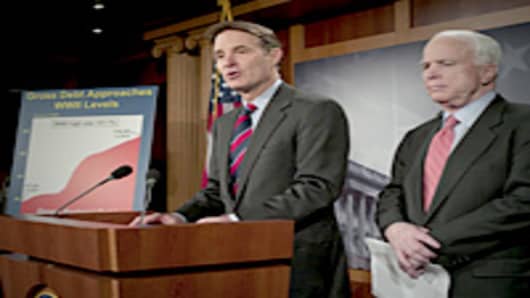
Scott J. Ferrell | Congressional Quarterly | Getty Images
Sen. Evan Bayh and Sen. John McCain during a news conference on their bill aimed at reining in government spending and to address the national debt.
After decades of warnings that budgetary profligacy, escalating health care costs and an aging population would lead to a day of fiscal reckoning, economists and the nation’s foreign creditors say that moment is approaching faster than expected, hastened by a deep recession that cost trillions of dollars in lost tax revenues and higher spending for safety-net programs.
Yet rarely has the political system seemed more polarized and less able to solve big problems that involve trust, tough choices and little short-term gain. The main urgency for both parties seems to be about pinning blame on the other, before November’s elections, for deficits now averaging $1 trillion a year, the largest since World War II relative to the size of the economy.
Mr. Bayh, the centrist Democrat from Indiana, lodged his complaint about excessive partisanship and Congressional gridlock on Monday by way of explaining his decision not to seek re-election. But he is hardly alone in sounding an alarm about the long-term budgetary outlook, which has Medicare, Medicaid and Social Security costs growing at unsustainable rates and an inefficient tax system that cannot keep up.
“I used to think it would take a global financial crisis to get both parties to the table, but we just had one,” said G. William Hoagland, who was a fiscal policy adviser to Senate Republican leaders and a witness to past bipartisan budget summits. “These days I wonder if this country is even governable.”
Sensing political advantage, Republicans are resisting President Obama’s call for a bipartisan commission to cut the debt, although recent studies have implicated the tax cuts and spending policies of the years after 2000 when they controlled Congress and the White House. Even seven Republican senators who had co-sponsored a bill to create a commission nonetheless voted against it recently.
The president is not giving up. On Thursday, administration officials say, he will sign an executive order establishing the 18-member National Commission on Fiscal Responsibility and Reform. He also will name as co-chairmen Alan K. Simpson, a former Republican Senate leader from Wyoming, and Erskine Bowles, a moderate Democrat from North Carolina who, as President Bill Clinton’s White House chief of staff, brokered a 1997 balanced budget agreement with Congressional Republicans.
“There isn’t a single sitting member of Congress — not one — that doesn’t know exactly where we’re headed,” Mr. Simpson said in a telephone interview Tuesday just before word of his role got out. “And to use the politics of fear and division and hate on each other — we are at a point right now where it doesn’t make a damn whether you’re a Democrat or a Republican if you’ve forgotten you’re an American.”
While he criticized some liberal Democrats’ refusal to reduce entitlement benefits, Mr. Simpson also dismissed Republicans’ antitax arguments that deficits could be controlled with spending cuts alone. “But they don’t cut spending,” he said, referring to the years Republicans governed with President George W. Bush.
Elected Republicans, however, are under intense pressure from their party’s conservative base to oppose any tax increases — a line in the sand that dims any prospects for bipartisan cooperation. Yet economists, including veterans of past Republican administrations, are vocal in insisting that the debt problem is too great to be solved without increasing revenues somehow and perhaps moving to a new consumption tax system like Europe’s.
The same economists also say a significant deficit-reduction plan is not possible unless Mr. Obama breaks his campaign promise not to raise taxes for households making less than $250,000. Last week, Mr. Obama said he would not impose that condition or any other on a fiscal commission.
The situation is complicated by a debate over how quickly Washington should act even if it could. The Obama administration, Congressional Democratic leaders and many economists are pushing for additional government stimulus measures while the private sector remains weak. But anger about big deficits has stoked the populism roiling politics, and Republicans as well as some conservative Democrats want to cut spending right now as a way of addressing perceptions among voters that government has gotten too big, too intrusive and too profligate. Mr. Obama himself proposed a budget that would freeze spending on some categories of domestic spending for three years.
Many analysts say the president and Congress could send a strong signal to global markets by agreeing this year to a package of both long-term tax increases and spending reductions, especially in the popular entitlement programs, that would not take effect until 2012. That is the recommendation of two new studies, one from a diverse group sponsored by the National Academy of Sciences and a separate joint project of the Peter G. Peterson Foundation, the Pew Charitable Trusts and the Committee for a Responsible Federal Budget.
As debt rises, so do interest costs; by 2014, at a projected $516 billion, they will exceed the budget for annual appropriations for domestic programs. The government will be competing with the private sector for credit, forcing interest rates higher and imperiling future prosperity.
Foreign investors now own more than half of the publicly held debt, and officials for the largest creditor, China, have fretted publicly about the fiscal course of the United States. While few expect foreigners to dump their assets, since the resulting plunge in values would hurt them as well as everyone else, the fear is that investors will demand higher interest payments and reduce or stop future debt purchases, threatening the government’s ability to finance its borrowing.
Lesser financial and fiscal crises have brought the two parties together to compromise on tough choices about taxes and spending. They include the 1983 accord between President Ronald Reagan and a Democratic-controlled Congress that reduced the financial strains on Social Security, based on proposals from a commission led by Alan Greenspan, and budget agreements in the 1990s that contributed to a four-year run of surpluses at the end of the decade.
The incentive problem.
Those bipartisan deals were done during times of divided government, when one party had the White House and the other controlled at least one chamber of Congress, giving each side some governing responsibility to find solutions. Now, with Democrats controlling the White House and Congress, the parties have less incentive to work together.
AP
Republicans today see opposition as a way back to power in November, and their party is more ideologically antitax than in the past, especially now that it is courting the Tea Party movement. Conservative activists so oppose compromise of any sort that several lawmakers have drawn primary challengers for working with Democrats.
Because the worst of the fiscal problem remains years away and therefore somewhat hypothetical to most people, there is also not the same incentive to act immediately that drove, for example, the 1983 deal, when Social Security was facing an imminent crisis.
“We literally tweaked the Social Security system,” Mr. Simpson said. The changes, which still are being phased in 27 years later, resulted in big savings over time. Economists say future measures will have to be more severe the longer they are delayed.
In 1987, a global markets crash led the Reagan administration and Democrats to agree to a deficit-reduction package of spending cuts and tax increases. In 1990, the successful budget summit between Democrats and the administration of President George Bush came about after deficits had spiked again, threatening a fiscal crisis of mandatory and deep across-the-board cuts.
Yet Mr. Bush’s breaking of his “no new taxes” promise so infuriated conservatives that they helped defeat him in 1992. One of his critics was Newt Gingrich of Georgia. By the mid-1990s, Mr. Gingrich was House speaker and his party controlled Congress. After a politically damaging government shutdown, in 1997 he reached a deal with Mr. Clinton that helped balance the budget.
When George W. Bush took office in 2001, the government projected surpluses of $5.6 trillion for the coming decade.
In an analysis of what happened next, the economists Alan J. Auerbach and William G. Gale found that much of the accumulated debt owes to Bush-era policies and to the recession, with its costs in lost income taxes and automatic benefits for the unemployed. The one-time costs of stimulus and bailout measures are “really small stuff” relative to the rest, Mr. Auerbach said.
More than Mr. Obama could have imagined, the situation now tests his promise to break Washington’s gridlock and to lead in making “the hard choices.”
Privately, Treasury Secretary Timothy F. Geithner and other administration officials are courting Republicans with assurances of the administration’s sincerity about bipartisanship. Publicly, and with advice from some out-of-office Republicans, the White House is applying pressure by repeatedly reminding Americans of the mess Mr. Obama inherited.
Polls are helping the administration make its case, people in both parties say. In the latest New York Times/CBS News poll, Americans by a two-to-one ratio say Mr. Obama is trying to work with Republicans, while by more than two-to-one they say Republicans are not reciprocating. As for the deficit, 41 percent say the Bush administration is most to blame, 24 percent say Congress and 7 percent say Mr. Obama.
Yet politicians’ failure to reduce deficits has long reflected voters’ opposition to the necessary steps. The poll also found that by a two-to-one ratio Americans oppose cutting health care and education; 51 percent oppose lower military spending.