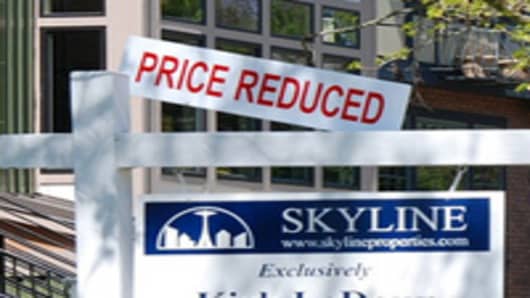
For the administration, there is also the concern that millions of foreclosures could delay or even reverse the economy’s tentative recovery — the last thing it wants in an election year.
Taking effect on April 5, the program could encourage hundreds of thousands of delinquent borrowers who have not been rescued by the loan modification program to shed their houses through a process known as a short sale, in which property is sold for less than the balance of the mortgage. Lenders will be compelled to accept that arrangement, forgiving the difference between the market price of the property and what they are owed.
“We want to streamline and standardize the short sale process to make it much easier on the borrower and much easier on the lender,” said Seth Wheeler, a Treasury senior adviser.
The problem is highlighted by a routine case in Phoenix. Chris Paul, a real estate agent, has a house he is trying to sell on behalf of its owner, who owes $150,000. Mr. Paul has an offer for $48,000, but the bank holding the mortgage says it wants at least $90,000. The frustrated owner is now contemplating foreclosure.
To bring the various parties to the table — the homeowner, the lender that services the loan, the investor that owns the loan, the bank that owns the second mortgage on the property — the government intends to spread its cash around.
Under the new program, the servicing bank, as with all modifications, will get $1,000. Another $1,000 can go toward a second loan, if there is one. And for the first time the government would give money to the distressed homeowners themselves. They will get $1,500 in “relocation assistance.”
Should the incentives prove successful, the short sales program could have multiple benefits. For the investment pools that own many home loans, there is the prospect of getting more money with a sale than with a foreclosure.
For the borrowers, there is the likelihood of suffering less damage to credit ratings. And as part of the transaction, they will get the lender’s assurance that they will not later be sued for an unpaid mortgage balance.
For communities, the plan will mean fewer empty foreclosed houses waiting to be sold by banks. By some estimates, as many as half of all foreclosed properties are ransacked by either the former owners or vandals, which depresses the value of the property further and pulls down the value of neighboring homes.
If short sales are about to have their moment, it has been a long time coming. At the beginning of the foreclosure crisis, lenders shunned short sales. They were not equipped to deal with the labor-intensive process and were suspicious of it.
The lenders’ thinking, said the economist Thomas Lawler, went like this: “I lend someone $200,000 to buy a house. Then he says, ‘Look, I have someone willing to pay $150,000 for it; otherwise I think I’m going to default.’ Do I really believe the borrower can’t pay it back? And is $150,000 a reasonable offer for the property?”
Short sales are “tailor-made for fraud,” said Mr. Lawler, a former executive at the mortgage finance company Fannie Mae.
Last year, short sales started to increase, although they remain relatively uncommon. Fannie Mae said preforeclosure deals on loans in its portfolio more than tripled in 2009, to 36,968. But real estate agents say many lenders still seem to disapprove of short sales.
Under the new federal program, a lender will use real estate agents to determine the value of a home and thus the minimum to accept. This figure will not be shared with the owner, but if an offer comes in that is equal to or higher than this amount, the lender must take it.
Mr. Paul, the Phoenix agent, was skeptical. “In a perfect world, this would work,” he said. “But because estimates of value are inherently subjective, it won’t. The banks don’t want to sell at a discount.”