

It's going to be another bad spring for the US housing market—unless you're a buyer.
With prices still falling and more distressed homes hitting the market, many experts are expecting the market to get even worse before it gets better.
AP
"There's been some increase in inventory lately, mostly from distressed sales," says Walter Malony, spokesman for the National Association of Realtors. "Buyer's are pretty much in the driver's seat."
Even the Obama administration's new plan to help troubled homeowners, while praised by some economists, won't help the market much right away.
The $14 billion program, announced Friday, will try to stem a rising tide of home foreclosures by giving lenders incentives to erase some mortgage debt and slash mortgage payments for the unemployed. But it will take months before there is any impact, experts say.
"This change by the Obama administration is good news," says Mark Zandi, chief economist at Moodys. "It will help homeowners in a meaningful way. We should see the impact of this by the fall with fewer foreclosures. Housing needs this."
In the meantime, home values are continuing to drop and the amount of distressed property on the market is growing.
"There are still a lot of foreclosures in the pipe line," says Greg McBride, chief economist at Bankrate.com. "They're backed up because of paper work at the banks or moratoriums at the state level. But they are the elephant in room. And who knows what will happen when that inventory hits the market. It will more than likely hurt housing prices even more."
One thing that may help the market this spring: fewer people will be voluntarily putting their homes up for sale. That's partly because prices are still falling—but also because they don't feel they can afford to "trade up" to a bigger house.
"People who might want to sell at this time for a bigger home are worried about their jobs," says Bob Walters, chief economist at QuickenLoans. com. "That's keeping them somewhat in check as to whether they will sell or not."
The April 30 expiration of the first-time homebuyer tax credit is also a factor.
"Buyers took advantage of the $8,000 credit in earlier months and it ate up a lot of the inventory that would be there in spring," Walters says. "That will show up in the weeks ahead with fewer homes on the market than might be."
Concern over the rise in foreclosed and other distressed property remains strong. More homeowners who are "underwater"—or owe more than their home is worth—are expected to just walk away in the coming weeks, leaving more empty homes—and more inventory.
Buyers might be able to get great deals on foreclosed homes, but purchasers are often required to put at least 20 percent down on bank-owned homes—and closings can take up to six months or more due to red tape.
At the same time, a big rise in distressed property could help deflate home prices even further.
Sellers, meanwhile, have learned this spring to lower their expectations when it comes to asking price.
"Since a year ago, (asking) prices are more in line with what will sell and that's good for the market even if sellers wanted to get more money," says Robert Abbott, co-owner VP of Abbott Casert Realtors, a real estate firm in northern New Jersey. "They realize they can't all they expect right now."
Case in point—Jennifer McCoy Bartko and her husband who just put their three bedroom home on the market in Columbus, Ohio, to buy a bigger house so her widowed mother could come live with them.
"We priced our house competitively so that it will sell as quickly as possible," says the 36 year old Bartko, a program assistant at Ohio State University. "We don’t expect to get the full asking price ($185,000) but pretty close to it. At this point, we won’t be making any real profit off it, but that’s OK with us. We want to sell."
But this spring's lower prices are keeping some potential sellers of the market.
"We tried selling our three bedroom home last year at this time but couldn't get our price," says one homeonwer from Morris Township, New Jersey, who fixed the home in order to sell and make a profit. "We are waiting for prices to go up. We really don't want to sell it now."
- Slideshow: Cities With the Most Home Price Reductions
End of housing tax credit will hurt
Asking prices aside, the housing market faces other hurdles this spring and beyond as the latest numbers show existing home sales are in a downward trend and mortgage applications are falling.
For one, there's the first time homeowners tax credit—scheduled to end on April 30. (In cases where a binding sales contract is signed by April 30, 2010, a home purchase completed by June 30, 2010 will qualify.) The program's demise is no help to housing, at least in the short term.
"We're not seeing a lot of move up or move down buyers," says Jim Gillespie, president of Caldwell Banker Real Estate. "Those first time buyers are what's really important to the market."
Whether the Obama administration and Congress will extend the tax break is still in doubt.
Also in doubt—the future of the Federal Reserve's program of buying mortgaged back securities. The Fed announced last Tuesday that the program—which helped keep interest rates low—will end as planned on March 31. However the Fed did leave the door open that it could resume the purchases down the line.
If it doesn't, that could mean an increase for rates and higher mortgage payments. Thirty year rates are beginning to inch up—now at 5.01 percent—which is above last year's level at this time of 4.63 percent.
AP
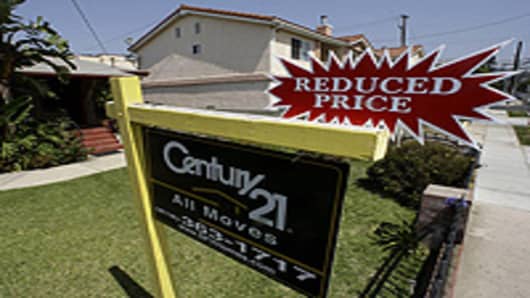
Home prices continuing to drop.
But some see that as a silver lining.
"If rates go up, I think it would spur on housing," says Dianne Saatchi, senior vice president with Saunders and Associates Realty in New York. "People will see rates rise and they will probably stimulate them to buy rather than wait for rates to go even higher."
Whether higher rates help or hurt the market, home buyers like Crystal Patterson, are learning that getting a loan continues to be tough.
Patterson and her husband are moving from Minneapolis, Minnesota to New Jersey for his new job as the CEO of the Bon Secours Charity Health System. They're currently living in a rental while the look to buy.
"We haven't talked to a bank yet but we've heard how difficult it is to get a loan," says the 34 year old Paterson who works as a lawyer. "That's why we sold our house in Minneapolis first, because we wanted to have the money to make a down payment. W don't want to get turned down."
Getting turned down may be more common in the days ahead. Stricter loan qualifications are still the order of the day—as well as a change on Wall Street.
"Banks have reconsidered their mortgage products," says Neil Garfinkel, a real estate attorney at AGMB law in New York. "There's going to be a hesitancy to lend for some time."
"I don't have a problem with that," Caldwell Banker's Gillespie adds. "Banks are restrictive but that's not so bad. We've gone back to like it used to be before the housing collapse. We need that to help stabilize the market."
With spring being a customary time of the year for housing to see some upswing, what sellers, buyers—and lenders—do over the next 2-3 months could be pivotal for a real housing recovery.
But if the housing collapse brought down the economy, it will take the economy to put the 'bloom' back on.
"There's been some good news on the job front lately with fewer cuts," says Bankrate's McBride. "But there's got to be a lot more job growth before housing really returns. It's the economy that's going to make housing recover."
