

California, New York and other states are showing many of the same signs of debt overload that recently took Greece to the brink — budgets that will not balance, accounting that masks debt, the use of derivatives to plug holes, and armies of retired public workers who are counting on benefits that are proving harder and harder to pay.
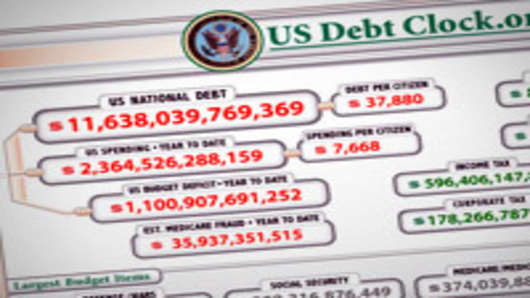
Source: usdebtclock.org
US Debt Clock
And states are responding in sometimes desperate ways, raising concerns that they, too, could face a debt crisis.
New Hampshire was recently ordered by its State Supreme Court to put back $110 million that it took from a medical malpractice insurance pool to balance its budget. Colorado tried, so far unsuccessfully, to grab a $500 million surplus from Pinnacol Assurance, a state workers’ compensation insurer that was privatized in 2002. It wanted the money for its university system and seems likely to get a lesser amount, perhaps $200 million.
Connecticut has tried to issue its own accounting rules. Hawaii has inaugurated a four-day school week. California accelerated its corporate income tax this year, making companies pay 70 percent of their 2010 taxes by June 15. And many states have balanced their budgets with federal health care dollars that Congress has not yet appropriated.
Some economists fear the states have a potentially bigger problem than their recession-induced budget woes. If investors become reluctant to buy the states’ debt, the result could be a credit squeeze, not entirely different from the financial strains in Europe, where markets were reluctant to refinance billions in Greek debt.
“If we ran into a situation where one state got into trouble, they’d be bailed out six ways from Tuesday,” said Kenneth S. Rogoff, an economics professor at Harvard and a former research director of the International Monetary Fund. “But if we have a situation where there’s slow growth, and a bunch of cities and states are on the edge, like in Europe, we will have trouble.”
California’s stated debt — the value of all its bonds outstanding — looks manageable, at just 8 percent of its total economy. But California has big unstated debts, too. If the fair value of the shortfall in California’s big pension fund is counted, for instance, the state’s debt burden more than quadruples, to 37 percent of its economic output, according to one calculation.
The state’s economy will also be weighed down by the ballooning federal debt, though California does not have to worry about those payments as much as its taxpaying citizens and businesses do.
Unstated debts pose a bigger problem to states with smaller economies. If Rhode Island were a country, the fair value of its pension debt would push it outside the maximum permitted by the euro zone, which tries to limit government debt to 60 percent of gross domestic product, according to Andrew Biggs, an economist with the American Enterprise Institute who has been analyzing state debt. Alaska would not qualify either.
State officials say a Greece-style financial crisis is a complete nonissue for them, and the bond markets so far seem to agree. All 50 states have investment-grade credit ratings, with California the lowest, and even California is still considered “average,” according to Moody’s Investors Service. The last state that defaulted on its bonds, Arkansas, did so during the Great Depression.
Goldman Sachs, in a research report last week, acknowledged the pension issue but concluded the states were very unlikely to default on their debt and noted the states had 30 years to close pension shortfalls.
Even though about $5 billion of municipal bonds are in default today, the vast majority were issued by small local authorities in boom-and-bust locations like Florida, said Matt Fabian, managing director of Municipal Market Advisors, an independent consulting firm. The issuers raised money to pay for projects like sewer connections and new roads in subdivisions that collapsed in the subprime mortgage disaster.
The states, he said, are different. They learned a lesson from New York City, which got into trouble in the 1970s by financing its operations with short-term debt that had to be rolled over again and again. When investors suddenly lost confidence, New York was left empty-handed. To keep that from happening again, Mr. Fabian said, most states require short-term debt to be fully repaid the same year it is issued.
Some states have taken even more forceful measures to build creditor confidence. New York State has a trustee that intercepts tax revenues and makes some bond payments before the state can get to the money. California has a “continuous appropriation” for debt payments, so bondholders know they will get their interest even when the budget is hamstrung.
The states can also take refuge in America’s federalist system. Thus, if California were to get into hot water, it could seek assistance in Washington, and probably come away with some funds. Already, the federal government is spending hundreds of millions helping the states issue their bonds.
Professor Rogoff, who has spent most of his career studying global debt crises, has combed through several centuries’ worth of records with a fellow economist, Carmen M. Reinhart of the University of Maryland, looking for signs that a country was about to default.
One finding was that countries “can default on stunningly small amounts of debt,” he said, perhaps just one-fourth of what stopped Greece in its tracks. “The fact that the states’ debts aren’t as big as Greece’s doesn’t mean it can’t happen.”
Also, officials and their lenders often refused to admit they had a debt problem until too late.
“When an accident is waiting to happen, it eventually does,” the two economists wrote in their book, titled “This Time Is Different” — the words often on the lips of policy makers just before a debt bomb exploded. “But the exact timing can be very difficult to guess, and a crisis that seems imminent can sometimes take years to ignite.”
In Greece, a newly elected prime minister may have struck the match last fall, when he announced that his predecessor had left a budget deficit three times as big as disclosed.
Greece’s creditors might have taken the news in stride, but in their weakened condition, they did not want to shoulder any more risk from Greece. They refused to refinance its maturing $54 billion euros ($72 billion) of debt this year unless it adopted painful austerity measures.
Could that happen here?
In January, incoming Gov. Chris Christie of New Jersey announced that his predecessor, Jon S. Corzine, had concealed a much bigger deficit than anyone knew. Mr. Corzine denied it.
So far, the bond markets have been unfazed.
Moody’s currently rates New Jersey’s debt “very strong,” though a notch below the median for states. Moody’s has also given the state a negative outlook, meaning its rating is likely to decline over the medium term. Merrill Lynch said on Monday that New Jersey’s debt should be downgraded to reflect the cost of paying its retiree pensions and health care.
In fact, New Jersey and other states have used a whole bagful of tricks and gimmicks to make their budgets look balanced and to push debts into the future.
One ploy reminiscent of Greece has been the use of derivatives. While Greece used a type of foreign-exchange trade to hide debt, the derivatives popular with states and cities have been interest-rate swaps, contracts to hedge against changing rates.
The states issued variable-rate bonds and used the swaps in an attempt to lock in the low rates associated with variable-rate debt. The swaps would indeed have saved money had interest rates gone up. But to get this protection, the states had to agree to pay extra if interest rates went down. And in the years since these swaps came into vogue, interest rates have mostly fallen.
Swaps were often pitched to governments with some form of upfront cash payment — perhaps an amount just big enough to close a budget deficit. That gave the illusion that the house was in order, but in fact, such deals just added hidden debt, which has to be paid back over the life of the swaps, often 30 years.
Some economists think the last straw for states and cities will be debt hidden in their pension obligations.
Pensions are debts, too, after all, paid over time just like bonds. But states do not disclose how much they owe retirees when they disclose their bonded debt, and state officials steadfastly oppose valuing their pensions at market rates.
Joshua Rauh, an economist at Northwestern University, and Robert Novy-Marx of the University of Chicago, recently recalculated the value of the 50 states’ pension obligations the way the bond markets value debt. They put the number at $5.17 trillion.
After the $1.94 trillion set aside in state pension funds was subtracted, there was a gap of $3.23 trillion — more than three times the amount the states owe their bondholders.
“When you see that, you recognize that states are in trouble even more than we recognize,” Mr. Rauh said.
With bond payments and pension contributions consuming big chunks of state budgets, Mr. Rauh said, some states were already falling behind on unsecured debts, like bills from vendors. “Those are debts, too,” he said.
In Illinois, the state comptroller recently said the state was nearly $9 billion behind on its bills to vendors, which he called an “ongoing fiscal disaster.” On Monday, Fitch Ratings downgraded several categories of Illinois’s debt, citing the state’s accounts payable backlog. California had to pay its vendors with i.o.u.’s last year.
“These are the things that can precipitate a crisis,” Mr. Rauh said.