CNBC Guest Blog
- Yoshikami: Four Things You Need to Know About Gold Now
- Steinbock: The Euro Zone Endgame Begins
- Laouchez: Leadership in Financial Services — Missing in Action?
- Kuntz: Finding Opportunity in Emerging Markets
- Busch: How to Trade the Euro on an Outside Reversal
- Dunkelberg: The Real Banking Crisis - They're Too Big to Manage
- Greek Exit a Worse Mistake Than Adoption of Euro
- Tamminen: Waste Not, Want Not
- Morici: The Eclipse of American Banking
- Will This Decade Be More Grim Than the 1930s?
MOST SHARED
- India's Tumbling Rupee Triggers Convertible Bond Turmoil
- Marubeni Nears $5 Billion-Plus Gavilon Deal
- Greece to Leave Euro Zone on June 18: Wealth Manager
- Olympus Expected to Settle With Former CEO Woodford
- Greece Pours $22.6 Billion Into Four Biggest Banks
- Asian Stocks Decline on Spanish Debt Woes
- Spain's Borrowing Costs Near Danger Level: Bailout Next?
- Draft EU Report Attacks Italy on Economy
- Facebook IPO Fiasco: 10 Things Underwriters Got Wrong
- European Firms Plan for Greek Unrest and Euro Exit
- A New Look at the ‘New Poor’
- Six Pack: Beer Buzz of the Week
- Greek Exit Could Trigger 50% Fall in Euro Stocks: Analyst
- Under Pressure, FHA Skews to Wealthier Home Buyers
- Big Stock Upside for Hudson City Deal: Analyst
- 5 High-Yield Stocks Ready to Boost Dividends
- Yoshikami: Four Things You Need to Know About Gold Now
- Steinbock: The Euro Zone Endgame Begins
- Option Bulls Take Another Shot on Idenix
- Spain's Debt Costs Near Danger Level: Is Bailout Next?
- US Markets Will Be Watching Europe—And Jobs Report
- India's Tumbling Rupee Roils Convertible Bond Market
- European Companies Plan for Greek Unrest and Euro Exit
- Japan's Marubeni Nears $5 Billion-Plus Gavilon Deal
- Public Pensions Faulted for Bets on Rosy Returns
- Greece to Leave Euro Zone on June 18: Wealth Manager
- Italy 2-Year Borrowing Costs at Peak Since December
- Euro Bond Wins Supporters, but Details Remain Vague
RSS FEED
Bond: Russia—Europe's Bright Light of Growth

Kingsmill Bond
Chief Strategist,
Troika Dialog
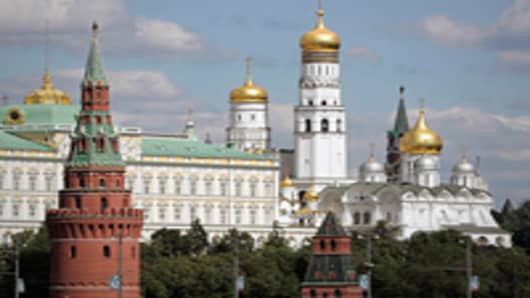
As the investment community gains confidence in the likelihood of a sustained economic rebound, Russia has emerged in far better shape than many other European markets. In fact, with low debt, inflation under control, a large consumer base primed to buy goods and services, and the price of oil recovering, Russia may well be the most dynamic place on the continent.
Let's start with debt.
At the end of 2008, gross levels of debt in Europe were about 300 percent of gross domestic product, according to data from McKinsey & Co. The worst offenders were even higher, with Spain at 350 percent and the United Kingdom at 380 percent of GDP. The reckoning stemming from that over-leveraging has only just begun, and the next decade could prove miserable for many countries as they try to right their fiscal ships.
By comparison, Russia has been a model of restraint, with total debt of 71 percent of GDP: 5 percent from the government, 10 percent from households, 16 percent from the financial sector and 40 percent from the corporate sector. This means Russian consumers are able to spend, the Russian government has significant room to maneuver, and there is no need to endure a long and painful process of systemic deleveraging - all of which make Russia a smart play for growth-oriented investors
Moreover, the financial crisis had a clear silver lining for Russia.
![]() |
AP |
For the first time since the end of the Soviet Union, the country has broken the back of inflation, with rates now in single digits for the past year and likely to be under 6 percent in 2010.
This allows consumers borrow at reasonable rates (mortgage rates are 13 percent and falling), businesses can borrow to invest in rubles and at low maturity (we expect the average duration of the domestic bond market to double by the end of the year), and money is encouraged to stay at home.
Meanwhile, Russia still has tremendous potential, as a market with 140 million consumers but with penetration levels for most goods and services at well under half of those in Western Europe.
For example, mortgage penetration is 3 percent of GDP, and only 20 percent of people have cars. Service sectors are still in their infancy, with retail, restaurants and broadband companies looking forward to many years of high growth. The transformation that we have seen take effect so dramatically across Eastern Europe over the last twenty years still has a long way to run.
We forecast 5 percent real GDP growth in Russia for the next few years, with earnings-per-share growth of more than 40 percent this year and 20 percent in 2011.
The foundation for this story is of course oil, and an oil price of more than $60 is now necessary to keep the current macroeconomic parameters of the country on track. However, high oil prices are in large part a play on the continued rise of China, which is perhaps a rather better bet than most other risks in our uncertain world. Russia is seizing this opportunity to improve its delivery infrastructure by building pipelines, roads and ports in the east; it is notable for example that in Russia it was the Far East Federal District alone that was able to grow during the crisis. Such investments will help create more consumers with disposable income, as well as provide an infrastructure for other businesses to use as they enter this market.
Despite this solid foundation for future growth, investors remain nervous: The RTS index remains the cheapest among major markets, with a 2010 price-to-earnings ratio of 8 and a price-to-book ratio of 1.1. The market continues to track the oil price, and we are thus far spared the enthusiasm that has driven the other BRIC markets.
In this contrast we see opportunity: As growth in Russia is compared with stagnation in Europe, we expect to see more capital flow to the East, into Europe's bright light of growth.
- Slideshow - World's Biggest Oil Reserves
- Beyond Russia - The Middle East's Most Competitive Countries
_________________________
Kingsmill Bond is chief strategist at Troika Dialog. In this position, he is responsible for Russian and CIS Strategy in Troika Dialog's Research department. Mr. Bond has over 15 years' experience in financial and strategic analysis. His major focus has been the emerging markets in general and Russia in particular, where he lived and worked from 1993 to 1998. Prior to joining Troika Dialog, Mr. Bond was at Deutsche Bank where he was Head of GEM and EMEA Strategy and was ranked number one by Institutional Investor for EMEA strategy.