

The man at the eye of the financial storm that has engulfed the euro has learnt to be patient after 20 years confined to a wheelchair. But Wolfgang Schaeuble, Germany’s finance minister, is also a man in a hurry.
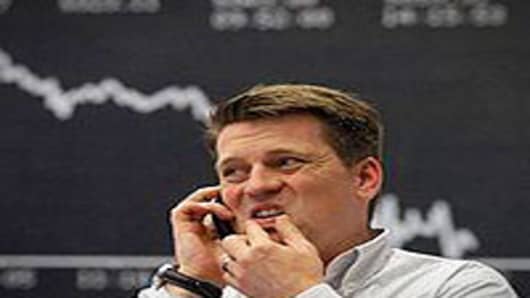
Martin Oeser | AFP | Getty Images
A trader sits in front of a board displaying Germany's share index DAX at the stock exchange in Frankfurt/Munich, western Germany.
He wants urgently to rewrite the rulebook of the euro zone to prevent any such crisis happening again, and at the same time to revive the momentum of international negotiations on tougher regulation of financial markets. He has returned to the idea of an international financial transaction tax, to make financial institutions share in the costs of the crisis, even if it can be agreed only inside the European Union.
He admits that the greatest problem affecting the markets is one of trust in the ability of the EU, and especially the 16 members of the common currency area at its heart, to bring their debt and deficits under control as they have promised. “That is the task we must perform,” he tells the Financial Times aboard his Luftwaffe Challenger jet bound for Berlin. “But that doesn’t alter the fact that financial market regulation is also necessary.
“I’m convinced the markets are really out of control. That is why we need really effective regulation, in the sense of creating a properly functioning market mechanism.”
Mr Schaeuble’s sense of urgency is compounded by his own state of health. Just 10 days ago, the 67-year-old survivor of a mentally disturbed would-be assassin was rushed to hospital with an allergic reaction to a new antibiotic as he arrived in Brussels for the emergency meeting of EU finance ministers called to agree on the 750 billion euro rescue package.
In his first newspaper interview since returning to work, he is adamant he is up to what is often seen as the toughest job in the German government. “I am quite clear about what I can be responsible for and what I cannot. It is my decision and my responsibility. I feel fine.”
The euro zone crisis was triggered by fears of a debt default in Greece, in spite of a massive joint rescue package by the EU and the International Monetary Fund. Market speculation switched to the sovereign debt of Portugal and Spain, causing a slump in the value of the euro on foreign exchange markets and sparking angry criticism across Europe of massive market speculation.
Mr Schaeuble’s return from Brussels on Tuesday came just hours before it was announced that Germany was to ban naked short-selling – selling securities without either owning or borrowing them – in euro zone sovereign bonds and credit default swaps as well as in the shares of 10 leading German financial stocks. The move was in line with the minister’s thinking about the danger of disconnection between financial transactions and real economic activity.
“A market does not function properly if the risks and rewards are completely unbalanced,” he says. “We need transparency. Given the complexity of modern technology, the individual needs a chance to judge what he is doing. That’s why we need standardization of products. And we need transparency for all market participants.
“We must regulate over-the-counter transactions, and we must also focus on the ratio of financial transactions to the real exchange of goods and services. They bear no relationship to each other. I understand that we need new financial instruments to cope with the huge financial tasks that we face. But, forgive my saying so, minimum profits of 25 per cent are simply unimaginable in the real economy. It isn’t healthy.”
Mr Schaeuble fears momentum has gone out of the international negotiations on financial regulation, and he is determined to recover it. That view, shared in Washington, was now “getting very strong in Europe”. But the EU needed to speed up its complicated decision-making process.
Although the idea of a global financial transaction tax appears to have been dismissed both by the US and the IMF, Mr Schaeuble says the Group of 20 leading industrial and developing nations “will have another look [at it] in an unbiased way”. He admits it is “very likely” that there would be no agreement at the G20 summit in Canada in June and “then the debate will take off again to see if it is possible to do it in Europe. If we get a Yes, that is good. If we get a No, then we will once again work intensively to see if we cannot have a transaction tax at a European level.”
Mr Schaeuble’s financial regulation agenda was seized on yesterday by Angela Merkel, the German chancellor, in her government declaration at the first reading in the Bundestag of legislation permitting Germany to play its part in the newly agreed euro zone stabilization fund.
Both tighter market regulation and forcing financial institutions to contribute more to the cost of the crisis – through a bank levy that the cabinet has already approved and a possible financial transaction tax – are popular in Germany but providing credit guarantees to weaker economies is not. By linking the two, the government clearly hopes to defuse a backlash.
The euro zone deal would commit Berlin to providing guarantees of up to 150 billion euros, as its share of the total 440 billion euros to come from all the euro zone member states. The rest would come from the IMF and the European Commission. What German citizens fear is that Germany becomes responsible for the entire burden of debt guarantees. They have coined the term “transfer union” to describe an EU that simply moves money from thrifty German taxpayers to extravagant ones in Greece, Spain or Portugal. Bild Zeitung, the mass-circulation Euroskeptic newspaper, has run a shrill campaign condemning any such action.
The European Debt Crisis - See Complete Coverage
The minister attempts to be reassuring. “In the end, you know, the Germans are rather more sensible than one might think if one reads newspaper articles,” he says. But as if he does not have enough to do in firefighting the euro zone crisis and planning his own austerity program for the next annual budget, Mr Schaeuble is raring to engage in a debate with German Euroskeptics.
Schaeuble Takes on Euroskeptics
“First one must say: Why is Germany so prosperous? Because it has more advantages from European integration than any other country.” Christine Lagarde, the French finance minister and a close friend, who called for Germany to boost growth and spend more on imports from the rest of the euro zone, was partially right. “The problem is not the German surplus,” he says. “I respect the reproach, which I also hear from [US Treasury secretary] Tim Geithner, that Germany must do more for growth. We have a role as a locomotive. But then I must ask: what should we do to grow faster? It cannot be by building up bigger deficits, contrary to the recommendations of the [EU] stability and growth pact. That is crazy. I must reduce my deficit.”
The European Debt Crisis - See Complete Coverage
Instead, he adds, Germany must act to boost its rate of employment. One way would be by better integrating immigrants into the German economy. “We must not cut spending on education and care services, or on the creation of equal opportunities in the labor market.”
He criticizes the effects of Germany’s long-term unemployment benefits, which raise the hurdle for job-seekers returning to the labor market. “We have to change that,” he says. “It is hard, but it is a key.” That could be one source of savings in Mr Schaeuble next round of budget cuts. “But even more important is to increase the employment rate among a shrinking and ageing population.”
Mr Schaeuble is asking for painful action from the euro zone members with the largest budget and trade deficits – such as Greece, Portugal, Spain and Ireland. If any of them were forced to ask for support from the stabilization mechanism, they would have to comply with strict conditions set by the IMF in conjunction with the European Central Bank and the Commission. Any decision to give credit guarantees must be unanimous, giving Germany an effective veto.
All face the need for more fundamental structural reforms to make themselves more competitive, he said. “Spain, for example, must solve its labor market problem. Because of regulation, it has a completely divided labor market, with a youth unemployment level of 40 per cent. Italy must solve its Mezzogiorno problem. Italy has no problem in the north, as far as growth is concerned, but it has a problem of regional differences.
“I am not giving advice for other countries, but I am just saying that everyone has a specific problem, and everyone also has specific budgetary room for maneuver to boost growth.”
But is Germany not simply trying to get the rest of Europe to behave like the thrifty Germans? “Nonsense,” he says. “I have studied a little about the world as it was before the beginning of the last century. Germany did not help the world become a better place, and that has not done the Germans any good. So we have a European responsibility. We must take Europe a bit further.
“Europe needs leadership. Any organization needs that. Germany cannot lead alone – that would be nonsense. France and Germany can do a great deal together. It would be better if Great Britain were also part of the leadership, but that is up to the UK, if they want to, or not.”
Indeed, far from reflecting a growing German Euroskepticism, Mr Schaeuble and Ms Merkel have both revived calls for closer political union to underpin economic and monetary union. “When we introduced the euro in the 1990s, Germany wanted a political union and France did not. That is why we have an economic union without a political union,” he says. “Political union naturally means a bit of federalism in the German sense of federal. It means that one can no longer take certain decisions on a national level. That is very hard for the UK. It’s often not so simple for France, but France finds it easier to take European decisions.
“Germany has a lot of experience with federalism, more than the UK or France. If you want to create a federal organization, you must be ready to have a certain amount of redistribution within it. You can dismiss that by rudely calling it a ‘transfer union’. But strong and weaker states both have their responsibility. We are asking a lot of the weaker ones, but the strong also have their responsibility, and we must explain that as well.
“We must say very clearly to Germany: we can play our role, but we must know that means there will be decisions taken against us. The weekend before last [in the negotiations over the euro zone stabilization mechanism], we saw that it was not in the German interest to be standing alone. That is also a good learning process for the German public.”