

Given high unemployment and low inflation, the Federal Reserve is likely to wait until 2012 before it starts to raise interest rates, a new Fed research paper states.
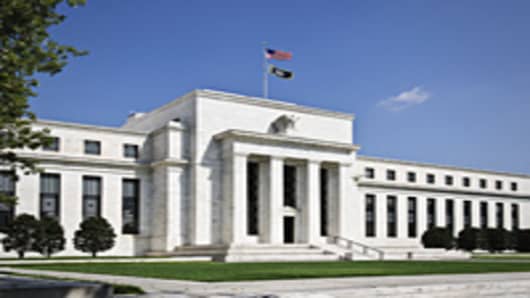
Tetra Images | Getty Images
United States Federal Reserve
The paper, released Monday by the Federal Reserve Bank of San Francisco, does not represent the official position of the central bank, whose governors have declined to specify when they might begin to raise rates. The benchmark short-term interest rate, known as the federal funds rate, has been essentially zero since December 2008, and most economists estimate that the Fed will increase it earlier than 2012.
But the paper, by Glenn D. Rudebusch, a senior vice president and associate director of research at the San Francisco Fed, is notable for its plainspoken conclusion. It could carry added significance because Janet L. Yellen, the president of the San Francisco Fed, is President Obama’s nominee to be vice chairwoman of the central bank.
“Fed staff economists rarely come so close to making specific forecasts of — or recommendations for — monetary policy, but I suspect Glenn’s views are shared by many others on the staff,” said Joseph E. Gagnon, a former Fed economist and now a senior fellow at the Peterson Institute for International Economics.
Mr. Rudebusch concluded from Fed decisions over the last two decades that there was a statistical relationship between core consumer price inflation and the gap between actual unemployment and the natural, or normal, rate of unemployment.
Given that relationship, as the recession worsened and inflation slowed in 2009, the Fed in theory should have lowered the federal funds rate by another 5 percent, Mr. Rudebusch wrote. In reality, since the Fed had already hit what it calls the “zero lower bound,” this was impossible; the central bank left its target range for the fed funds rate at zero to 0.25 percent.
“To deliver future monetary stimulus consistent with the past— and ignoring the zero lower bound — the funds rate would be negative until late 2012,” Mr. Rudebusch wrote. “In practice, this suggests little need to raise the funds rate target above its zero lower bound anytime soon.”
Mr. Rudebusch sought to address several objections, so far voiced by a minority of Fed policy makers, to keeping the federal funds rate near zero.
If the rate were raised too soon, it would be hard to reverse course, whereas if tightening is started too late, the Fed could catch up by raising rates at a rapid pace, he argued.
And while a few Fed officials have argued that extraordinarily low interest rates could lead to new price bubbles, or excessive leverage and speculation by banks, Mr. Rudebusch argued that the relationship between short-term interest rates and financial imbalances was “quite erratic and poorly understood,” noting that Japan had very low interest rates for about 15 years without those problems.
In addition, Mr. Rudebusch said the federal funds rate was less central than in the past because the Fed has been buying mortgage bonds and Treasury securities to hold down long-term rates.
“Changes in long-term interest rates have much larger effects on the economy than equal-sized changes in short-term interest rates,” he wrote.
Assuming that the Fed holds onto the roughly $2 trillion in mortgage-backed securities and Treasury debt on its books, the Fed would not need to start raising rates until the beginning of 2012, he wrote.