

Congress and the government have inhibited growth by creating uncertainty about business costs, Dallas Fed President Richard Fisher told CNBC Wednesday.
Jean Ayissi | AFP | Getty Images
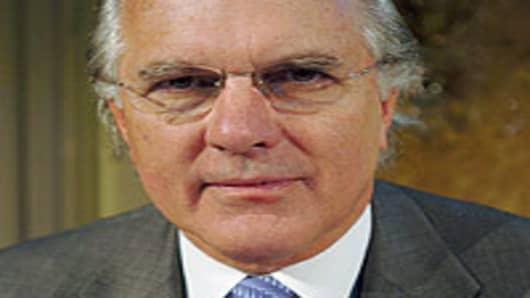
Richard W. Fisher, president of the Federal Bank of Dallas
“We need clarity," said Fisher. "My background [in business] tells me that you can’t eliminate uncertainty, but you have to reduce it as much as possible.”
Questions about healthcare expenses, for instance, have kept businesses from hiring new workers, said Fisher, because executives don't know how much it will cost them. Businesses also have concerns about other costs, such as whether a VAT [value-added tax] will be imposed.
"How do you cost a worker?" Fisher said. "Let’s say you run a delivery-truck system. What’s the price of a new delivery-truck driver? You don’t [know]. So how, as the CFO, do you go to your CEO or the board and say, 'I need to budget a new workforce.' And they say: 'What's it going to cost us?' And you say, 'I can’t tell you the answer.' "
Fisher used a football analogy to describe the state of the economy, which he said is not at the start of a double-dip recession. It will undergo sluggish growth in second half of this year, added Fisher.
“We were deep in the end zone [recession],” said Fisher. “What got us out [of the economic turmoil] were some spectacular runs by Mr. Inventory Adjustment, and also investment in software and equipment.
“They pretty much have run their course; inventory adjustment has run its course, now we’re running up the middle in a ground game, basic block and tackling.”
A double-dip recession is characterized by a period of growth and followed by a further decline in the economy, according to Robert Hall, chairman of the National Bureau of Economic Research, a group of academic economists who gauge the beginnings and ends of recessions.
Fisher believes the Fed has done enough, for now, to stimulate the economy and also added that he didn’t think contagion from Europe is affecting the US growth.