

They’ve been called McMansions, Starter Castles, Garage Mahals and Faux Chateaus but here’s the latest thing you can call them — History.
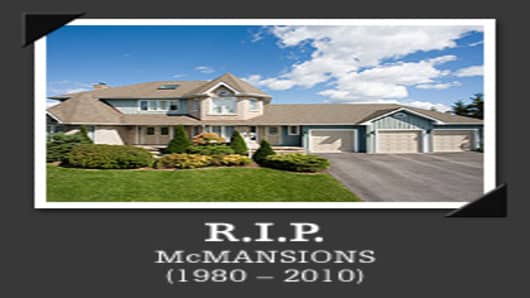
In the past few years, there have been an increasing number of references made to the “McMansion glut” and the “McMansion backlash,”as more towns pass ordinances against garishly large homes, which are generally over 3,000 square feet and built very close together.
What sets a McMansion apart from a regular mansion, according to Wikipedia, are a few characteristics: They’re tacky, they lack a definitive style and they have a “displeasingly jumbled appearance.”
Well, count 2010 as the year the last nail was hammered into the McCoffin: In its latest report on home-buying trends, real-estate site Trulia declares: “The McMansion Era Is Over.”
Just 9 percent of the people surveyed by Trulia said their ideal home size was over 3,200 square feet. Meanwhile, more than one-third said their ideal size was under 2,000 feet.
“That’s something that would’ve been unbelievable just a few years back,” said Pete Flint, CEO and co-founder of Trulia. “Americans are moving away from McMansions.”
The comments echoed those made in June by Kermit Baker, the chief economist at the American Institute of Architects.
“We continue to move away from the McMansion chapter of residential design, with more demand for practicality throughout the home,” Baker said. “There has been a drop off in the popularity of upscale property enhancements such as formal landscaping, decorative water features, tennis courts, and gazebos.”
“McMansions just look and feel out of place today, given the more cautious environment everyone’s living in,” said Paul Bishop, vice president of research for the National Association of Realtors.
And homebuilders are heeding the call: In a survey of builders last year, nine out of 10 said they planned to build smaller or lower-priced homes.
EVEN TEXAS IS DITCHING 'GO BIG'
Even in Texas, the land of go big or go home, they’re downsizing.
Diane Cheatham, owner of Urban Edge Developersin Dallas, said today, the average size of home they’re building is 2,200 square feet, down from 2,500 in 2005 — which was considered small for Dallas back then.
She said the trend there is more toward building green homes instead of big homes. Right now, they’re building a 1,200-square-foot uber-green home for a couple that’s downsizing from 3,000-square feet, Cheatham explained.
1,200? Some of the hair in Texas is bigger than that!
“We’ve never built one that small,” Cheatham confessed, but added: “I think that’s just a good example of the trend right now.”
For a little historical context, 1,200 square feet was the average home size in America in the 1960s. That grew to 1,710 square feet in the 1980s and 2,330 square feet in the 2000s.
What’s more, many in the real-estate business say they think this trend of downsizing, or “right-sizing,” as Flint likes to call it, is here to stay.
“This is absolutely a long-term effect,” he said. “Think of families with small children who’ve been foreclosed upon … When these teenagers are in a position to buy a home, they won’t want to go through these experiences they saw their parents go through.”
Of course, the question becomes, what do we do with all these McMansions that have already been built?
It's tempting to make jokes about what you might do with a former McMansion but with crime on the rise in neighborhoods littered with abandoned McMansions, Christopher Leinberger, in an article for the Atlantic, asked a sobering question: Is this the next slum?
Luckily, people are starting to get creative: A film collective in Seattle has taken over a 10,000-square foot McMansion there, using it for both living and work space. They turned a wine closet into an editing room and tossed a green screen in the garage. And in a suburb of San Diego, one couple turned a former McMansion into a home for autistic adults.
The demise of the McMansion has stirred a growing chorus of murmurs in the real-estate community about the possibility that it may force a dramatic redesign of the suburban McMansion tracts into mini-towns of their own, turning these icons of excess into more practical spaces like offices, banks, grocery stores and movie theaters.
Though, given some of the poor quality of materials and craftsmanship, it begs the question, would it be better to just tear them all down and start from scratch?
Have some thoughts on what to do with former McMansions? Drop a comment in the box below. Or, email ponyblog@cnbc.com.
More from the Pony Blog at ponyblog.cnbc.com.
