CNBC Guest Blog
- JPMorgan Debacle Points to Regulatory Incompetence, Corruption
- Yoshikami: Four Things You Need to Know About Gold Now
- Steinbock: The Euro Zone Endgame Begins
- Laouchez: Leadership in Financial Services — Missing in Action?
- Kuntz: Finding Opportunity in Emerging Markets
- Busch: How to Trade the Euro on an Outside Reversal
- Dunkelberg: The Real Banking Crisis - They're Too Big to Manage
- Greek Exit a Worse Mistake Than Adoption of Euro
- Tamminen: Waste Not, Want Not
- Morici: The Eclipse of American Banking
MOST SHARED
- Ackman: JCPenney Sales Have Hit 'Bottom'
- Home Prices Hit Lows, But 'We See Signs of Hope'
- Social Responsibility Builds Long-Term Success: Opinion
- Don't Buy Hon Hai Shares on Apple TV Rumors: Analyst
- Facebook Stock Falls Below $29 for First Time
- The Mass Migration of the Super-Rich
- Should Facebook Buy RIM?
- Advanced Manufacturing Could Spark Next Industrial Revolution
- PB&J, Mac & Cheese Step Out From Kids-Fare Shadow
- Greece to Leave Euro Zone on June 18: Wealth Manager
- PB&J, Mac & Cheese Step Out From Kids-Fare Shadow
- Ackman: JCPenney Sales Have Hit 'Bottom'
- Goldman Investment Shines Light on Solar Power
- Facebook Options Soar on First Day
- Home Prices Hit Lows, But 'We See Signs of Hope'
- Auto Sales to Really Take Off This Summer?
- JPMorgan Debacle Points to Regulatory Incompetence, Corruption
- Are You Ready for Facebook Options?
- Option Bulls Dig Into Ivanhoe Near Lows
- Spain to Go to Market to Fund Banks, Regions
- Home Prices Hit Fresh Lows, But 'We See Signs of Hope'
- Why June Could Be a Turning Point for Markets
- Why the Global Rich Keep Relocating
- Facebook Stock Falls Below $29 for First Time
- JPMorgan Sells Good Assets to Offset 'London Whale'
- Citigroup on Hiring Spree for Wealth-Management Unit
- Cramer's Top Dividend Plays
- Big Shift in ECB Balance Sheet a Sign of Banking Stress?
RSS FEED
Morici: Obama's New Plan Won’t End Jobs Drought
Professor, Smith School of Business, University of Maryland

Dr. Peter Morici
Professor
Robert H. Smith
School of Business
With Congressional Democrats facing a November shellacking, President Obama is floating new programs to aid troubled homeowners and create jobs that will prove costly and ineffective.
Despite rock bottom interest rates, residential sales are at historic lows and two million families face foreclosure this year, because Americans need decent jobs to buy homes and pay mortgages.
With President Obama’s $787 billion stimulus package at maximum force, his health care reforms inexorably socializing 19 percent of the U.S. economy, and Wall Street revamping to met new financial regulations, the economy lost 54 thousand jobs in August, the private sector added a mere 67 thousand jobs, and unemployment rose to 9.6 percent.
Of new private sector jobs, 40 thousand were in health care and social assistance—largely financed by government largess and federal mandates—while temporary services accounted for another 17 thousand.
Morici’s index of core private sector employment—private sector jobs less health care, social assistance and temp services—was up a paltry 10 thousand. On an annual basis, that would be less than five percent of new high school and college graduates.
Now, the President wants another $50 billion in infrastructure spending, stretched over six years and funded by cuts elsewhere. Though adding to construction and supply industry employment, cutting other spending would subtract jobs elswhere.
![]() |
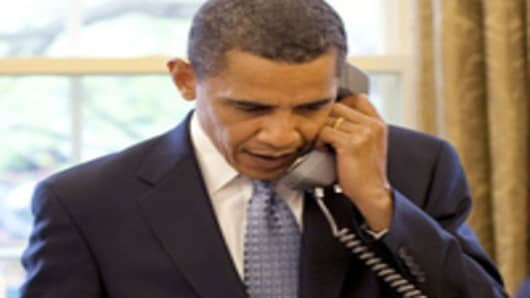
Photo by: Pete Souza President Barack Obama |
Also, the President proposes repealing the Bush tax cuts for families earning more than $250 thousand and using the money to forgive some payroll taxes for new hires by small businesses.
What the President does not reveal is his policy would hike to 50 percent the marginal tax rates on enterprises that account for more than half all small business profits—the very mom and pop enterprises he wants to hire the unemployed.
Restaurants and machine shops are not hiring, because they don’t have enough diners and factory orders. A modest hiring subsidy won’t solve that problem, but new taxes and health care mandates could persuade small businesses to close shop altogether.
The history of investment and employment tax credits is those only have modest immediate effects; then several months later, enterprises spend less—much like recent experience with cash for clunkers and auto sales, and tax credits for first time homebuyers.
In the end, businesses build and staff with workers only as much capacity as the demand for what they sell will justify.
Demand for what Americans make is tanking thanks to a growing trade deficit with China instigated by trade agreements negotiated by President Clinton, and fear instilled by the Pelosi-era Democratic Party’s obsession with taxes and regulations for businesses and personal behavior.
Peter Morici
Professor, Smith School of Business, University of Maryland
The President already has in place programs to help distressed homeowners behind on mortgages. Those aid too few families, because banks can’t rework mortgages for underemployed workers with low incomes and the federal bureaucracy is so ineffective at implementing presidential policy.
Now, the White House proposes that for homeowners, up-to-date on payments but whose mortgages exceed value of their homes, banks and investors forgive the equity gap and the Federal Housing Administration back up new mortgages on the market values of those homes.
Wisely, banks and investors are reluctant to write-off debt on performing loans—they may actually get out what they are owed in the long run. Banks are likely to hoist on to the FHA—and the taxpayer—homeowners they believe are likely to fall behind on payments soon.
It’s another election year ploy that will blow up later, because those new loans will fail and require much higher fees for honest FHA mortgages.
When Republicans point out the shortcomings of those proposed jobs and mortgage initiatives, President Obama will cast them as cynical defenders of the rich.
President Obama likes to claim conditions are better now than when he took over from President Bush but things are getting worse, and this November voters elect a Congress and Speaker not a President.
When Nancy Pelosi and Democrats took control in January 2007, the federal deficit was $161 billion and unemployment was 4.6 percent. Subsequently, Wall Street, with help from President Clinton’s repeal of Glass Steagall, threw the economy into the Great Recession, and Speaker Pelosi and President Obama have since spent and regulated recklessly with few positive results.
If President Obama insists on teaching Americans economic history, his syllabus should give adequate attention to all the contributors to the catastrophe we now endure.
_____________________
Peter Morici is a professor at the Smith School of Business, University of Maryland, and former Chief Economist at the U.S. International Trade Commission.


