Go Symbol Lookup
Loading...

The BP Well Is Dead, but Challenges Live On

 Text Size  
Published: Sunday, 19 Sep 2010 | 3:03 PM ET
By: AP
Getty Images
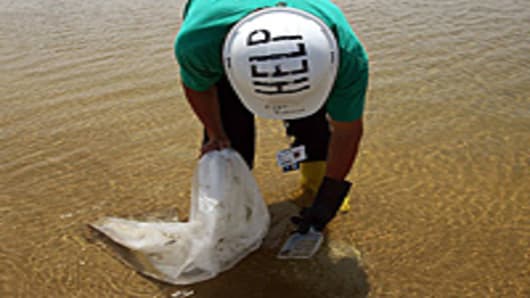
A contract worker patrol the beach to pick up oil that washed ashore on a public beach on June 2, 2010 in Dauphin Island, Alabama. Oil related to the Deepwater Horizon accident began to appear yesterday on the shores of Alabama.

Three weeks into the $20 billion oil spill claims process set up by BP and the Obama administration, tens of thousands of people are waiting much longer than promised for their money. And many are getting only a fraction of what they requested.

Claims administrator Ken Feinberg acknowledged in recent public appearances that there are "serious problems" with the payment of claims, which he initially said would take just 48 hours for individuals and seven days for businesses. Much of the delay involves lack of documentation and the unexpected complexity of many claims.

"We do not have the kind of results that we all want," Florida Attorney General Bill McCollum said after meeting with Feinberg. "People simply aren't getting their claims paid and they have urgent need for them."

As of Friday, about 26 percent of more than 68,000 claims had been paid for a total of $193.3 million. Loss of earnings or profits makes up the majority of claims, yet most of those paid so far involve $25,000 or less. Only one claim had been denied.

"Most of my clients who are getting paid are not getting the amount they requested," says attorney Rhon Jones, whose Montgomery, Ala., firm represents more than 1,000 people and businesses with oil-related claims, lawsuits, or both. "There is just lots and lots of frustration."

Florida and Louisiana account for nearly 60 percent of the claims submitted, followed by Alabama, Mississippi and Texas.

The claims being processed right now are interim, emergency payments. On Nov. 23, the Gulf Coast Claims Facility will begin working out larger, final settlements, the rules for which are expected to be released in about a month.

Feinberg has said those rules will include a requirement that claimants give up their right to sue BP — and possibly the other companies involved in the oil spill — in exchange for the final settlement. People and businesses will have three years to submit that final claim.

Meanwhile, in New Orleans, more than 300 spill-related lawsuits are being consolidated for pretrial rulings before U.S. District Judge Carl Barbier. BP is skirmishing with plaintiffs' lawyers over the timing of the release of evidence, preferring a slower pace that could force more people to make the tough decision about whether to accept a claim payment or pursue a lawsuit.

"The longer they string this out," says Jones, "the more people will be under financial duress and the more likely they will take a smaller number."

'I got my share of responsibilities."

Ousted BP CEO's Tony Hayward predicted a "very modest" environmental impact from the spill, and some observers say the relatively few dead sea animals found show he was right.

Getty Images
Shucking Louisiana oysters

Critics counter with questions: How many of the dead sank to the bottom and were not counted? How many of the sick and weakened will die prematurely?

Third-generation fisherman Byron Encalade is sick of body and of heart.

For the first season in as long as he can remember, the 56-year-old from Pointe A'La Hache, La., is not out shrimping. He's not out gathering oysters — they're all dead. All of the drivers for the Delta family's Encalade Trucking and Fisheries have moved on to new jobs elsewhere.

"Emotionally, I have family that depends on me," says Encalade, a proud member of this primarily African-American community. "I've got one boat working for BP, and I've got about six families we're trying to take care of off that one boat. I got my share of responsibilities."

While large areas of commercial fishing grounds have been reopened, demand for Gulf seafood has tanked, and prices have plummeted. Tourists have slowly begun returning to the Gulf's white-sand beaches, but a summer's revenues have been lost.

"You got to respect the resiliency of these people, but you have to feel for them...," says Adm. Allen, the government's point man. "This oil spill went beyond physical damage. We were threatening ways of life, how people had grown up, how they were raised, the watermen who operate down here. This is very traumatic to this area."

"I always came back to fishing. That is the one thing we have lived our lives knowing: Well, I always got my bayous and my swamps and my bays, and I can go make a living."

Fishing Guide

Mike Helmer

While many have stayed afloat with claims checks and spill-related work from BP, some have lost their homes or laid off workers in a bid to make it through the winter. Helmer, the fishing guide, refused to work for the company he blames for his predicament.

After years of working for others, Helmer picked this year to go into business for himself. Even with most of his competitors contracting with BP, paying charter bookings have been hard to come by.

"It'll be several years before I feel better," he says.

Like so many Gulf residents, Encalade spent some time in the oil industry. But he knew where he truly belonged.

"I always came back to fishing," he says. "That is the one thing we have lived our lives knowing: Well, I always got my bayous and my swamps and my bays, and I can go make a living."

The water, he says, was his "main source of independence." No longer.

"I can't even go catch myself a plate of food anymore."

As humans, particularly as Americans, we have a tendency to want quick answers and quicker fixes. But nature doesn't work that way.

After all, says Columbia University marine geologist Roger Anderson, this disaster was several ages in the making.

Many eons past, perhaps 40 million years ago, tiny plants and microorganisms died and were washed into the area that would one day be the Gulf of Mexico, says Anderson. Maybe 3 million years ago, a landslide occurred, covering the area with sand. Under the immense pressures of water and sediment, the dead plants and protozoans decayed and cooked.

As the continents shifted and the Gulf widened, fractures allowed the buoyant materials to migrate upward toward the bottom of what had become a great salt-water sea. Then, a few years ago, a blink in geologic time, humans first went after that brew.

And now, some of the marine life killed by the Macondo spill has already begun the process of becoming a future oil deposit, Anderson notes with a hint of irony in his voice.

"We're always burying new organisms to start the clock again," he says.

This particular well may have been declared dead, but the reservoir is still there. Anderson has no doubt that somebody will tap it someday.

"A little more carefully, we hope."

 Print
Federal officials declared Sunday that the well where the Deepwater Horizon rig exploded had finally been killed. The "nightmare well" is dead. But the Gulf coast's bad dream is far from over.
  Price   Change %Change
BP. ---
RIG ---

   
Comments


More Comments


Add Comments


Your Comments (Up to 1100 characters):

Remaining characters

Your comments have not been posted yet.

Please review your submission to make sure you are comfortable with your entry.

Your Comments: