

Crippling debts and deficits are about to make individual states the next casualty of the credit crisis, analyst Meredith Whitney told CNBC.
CNBC
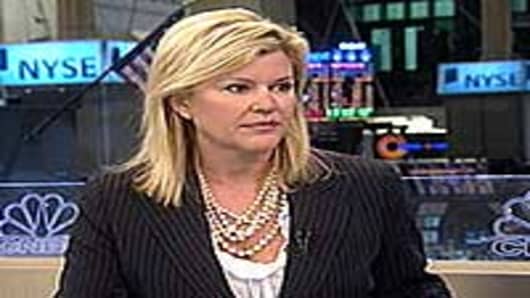
Meredith Whitney on Closing Bell
Speaking as her firm, Meredith Whitney Advisory Group, just released a lengthy report on the state of the states, the noted financial analyst compared the looming explosion to the collapse of the financial system in 2008 and 2009.
"The similarities between the states and the banks are extreme to the extent that states have been spending dramatically and are leveraged dramatically," she said. "Municipal debt has doubled since 2000, spending has grown way faster than revenues."
Whitney also offered another warning about banks, saying a sharp dropoff in trading revenue and a double-dip in housing would hammer at fourth-quarter earnings.
But she reserved her harshest words for the states. She said the paper released Tuesday was the culmination of two years' work by her firm and was made even more difficult by the lack of reliable data on state spending and debt.
"It reminded me so much of the banks pre-crisis that we just kept working at it," she said. "We couldn't find anything that gave us a clear story, we couldn't find any information that was transparent. So we did it ourselves."
There were some bright spots: Texas, Virginia and Nebraska were among states that have done a good job of controlling their finances over the years and aren't threatened as much.
But other states, such as California and Michigan, will burden the entire country should the federal government decide to step in with a bailout. States are required to balance their budgets, but massive debt-service payments could prevent that from happening in many states and necessitate the federal government to step in.
"You have to look at the states and the risk that the states pose, because the crisis with the states will result in an attempt at least for the third near-trillion-dollar bailout," Whitney said. "That has consequences on the dollar, that has consequences on just about everything. It certainly has consequences on the US recovery."
"Imagine you're conservative, fiscally sound Nebraska and you have to bail out California, or you're fiscally conservative Texas and now you have to bail out Michigan," she added.
On the banks, Whitney reiterated her call that some 80,000 financial services jobs will be lost this year, based on an expected 25 percent sequential decline in equity trading and "low single-digit" returns on equity.
On top of that, she said housing numbers will begin to worsen. The monthly Standard & Poor's/Case-Shiller housing report earlier in the day signaled that home prices were flattening but stabilizing; Whitney said that reading is going to get progressively worse.
"This quarter is going to be unique for the banks because this will be the last quarter when they can dodge the credit bullet," she said. "We think October, after the banks report, you'll see a really ugly Case-Shiller number, which means the fourth quarter is going to be very tough for banks."
