

Legendary investor Jeremy Grantham, Chief Investment Strategist of Grantham, Mayo, Van Otterloo sat down with Maria Bartiromo in an extremely rare interview.
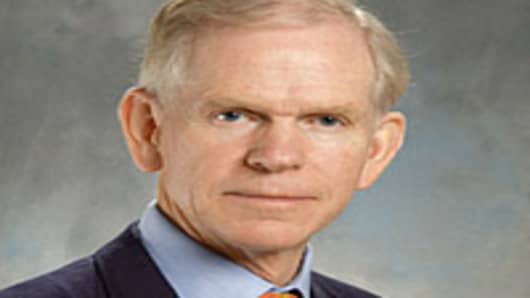
Jeremy Grantham
Grantham recommended institutional clients to sell into this rally. He is convinced that stocks are overpriced and cash is now the avenue for investors.
As an investment strategist for the past 30-years, Grantham has long been known for his timely calls.
In 1982, he said U.S. market was ripe for a "major rally."
And in 1989, he correctly called the top of the Japanese economy. In January 2000, he warned of an impending crash in tech stocks which took place two months later. And in April 2007, Grantham said we are now seeing the first worldwide bubble in history covering all asset classes.
When we sat down with Mr. Grantham earlier this week, he expressed worries about various pockets of the global markets, including emerging markets and U.S. stocks. Grantham is betting on a strong cash position and being patient about when to get back into the market.
Check out the complete transcript of Maria Bartiromo’s interview with Jeremy Grantham, or watch the complete interview here.
MARIA BARTIROMO: Great to have you on the program. Thanks so much for joining us.
JEREMY GRANTHAM: Very nice to be here.
BARTIROMO: Time and time again, your writings and your predictions have been right on in terms of investing and where we are in this market. From the tech bubble to beyond. Can you talk to us about where we are today in the stock market and what trends you see developing?
GRANTHAM: What I worry about most is the Fed's activity and — QE2 is just the latest demonstration of this. The Fed has spent most of the last 15, 20 years— manipulating the stock market whenever they feel the economy needs a bit of a kick. I think they know very well that what they do has no direct effect on the economy.
The only weapon they have is the so-called wealth effect. If you can drive the market up 50 percent, people feel richer. They feel a little more confident, and the academics reckon they spent about three percent of that. So, the market went up 80 percent last year. They should be spending 2.4 percent extra of— of the entire value of the stock market, which is about two percent of GDP. And that's a real kicker.
You don't see it because of the enormous counterdrag from the housing market— and— and its complete bust. But, it would have been worse with— without this. The problem is, they know very well how to stimulate the market. But, for whatever reason, they step away as the market gathers steam, and— and resign any responsibility for moderating— a bull market that may get out of control as we saw in '98 and '99 with Alan Greenspan, as we saw in the housing market.
And— I fear that the market will continue to rise. It will be continuously speculative. After all, when you can borrow at a rate that is negative after adjustment for inflation, it's not surprising that you would borrow a lot.
BARTIROMO: So, what are the implications of— of this constant easing and stimulation? You know, it— it seems the numbers are so mind boggling: $600 billion here.
GRANTHAM: They— they (CHUCKLE) are mind-boggling.
BARTIROMO: You know? (CHUCKLE) But, give us the—
GRANTHAM: The consequences are you get boom and bust. You— stimulate in '91. You let it get out of control. You have this colossal tech bubble in '99. Sixty-five times earnings for the— for the growth stocks. Then you have an epic bust. Then, of course, they're panic struck. They race back into battle with immense stimulus with negative real rates for three years.
"You can drive a market higher and eventually — of its sheer overpricing, it will eventually pop. And, typically, it seems to pop at the most inconvenient time.""
And you get another— rise of risk taking and everything risky— prospered in '03, '04, '05, '06, '07 until we had what I called the first truly global bubble. It was pretty well everywhere in everything. It was in real estate. Almost everywhere. It was in stocks absolutely everywhere. And— and it was in the bond market to some considerable degree.
And that, of course, broke. They all break. That's the one thing they can't control. You can drive a market higher and eventually — of its sheer overpricing, it will eventually pop. And, typically, it seems to pop at the most inconvenient time. So, we're going to drive this one up, and this time there isn't much ammunition. In 2000, the Fed had a good balance sheet. The government had a good balance sheet.
In '08, it was still semi respectable, and— and now it's not. It's not very respectable at all. So, what are they going to use as ammunition if they cause another bubble and it breaks, let's say, in a couple of years? Then we might have some real Japanese-type experiences.
GRANTHAM ON THE FEDERAL RESERVE
BARTIROMO: Where are the solutions then, if not this? What do you think ought to be done?
GRANTHAM: I think the Fed is not designed— to have effective tools to deal with the economy. It should settle for just controlling the money supply. And— if it insists, it can worry about inflation. The way you address a weak economy, particularly very substantial excess unemployment is through fiscal policy. You must either bribe man— manufacturers, corporations to hire people who have been unemployed, which they did in Germany. A lot of economists think that's perfectly effective.
Jeremy Grantham
Or you must go in there and hire people yourself as a government. Now, I— I believe in crowding out. So, I— I would never do it unless there was clearly quite a few million extra unemployed. I wouldn't go after too many skilled labor because there's never— enough of them to go around. And that does cause crowding out. I would go after the— what I called lightly-skilled workers.
The kind of people who were building the extra million-dollar— sorry— extra million houses in— in '05, '06 and '07. And find— and find jobs for them. We have an infrastructure that is decades behind schedule.
We could insulate every house in the Northeast. These are high-return projects, great— for society in general. And to— to allow people to sit there unemployed. Their skills are deteriorating. Their family morale goes to hell. And— it's a deadweight on society. And you have to remember when— when the government hires someone, he doesn't pay the full price like a corporation does.
He pays about half price because he pays a lot. He, the government— it, the government, pays a lot for someone sitting down unemployed. All the— all the many ways— that unemployed get— get helped plus— the government carries the atrophying of the skills. Society loses that, the longer they're unemployed.
BARTIROMO: So, what should the federal government be doing then? I mean, the housing industry, for example, missing in action. What is it going to take to get housing moving again? What is it gonna take to get businesses hiring again? If it's not the job of the Federal Reserve, what policy should we be seeing coming out of the government?
GRANTHAM: I think the Federal Reserve has— is in a very strong position to move against bubbles. Bubbles are the most dangerous thing— asset-class bubbles that come along. They're the most dangerous to investors. They're also the most dangerous to the economies of— as we have seen in Japan and in 1929 and now here. You've got to stop them.
The Fed has enormous power to move markets. And it— not necessarily immediately, but give them a year and they could bury a bull market. They could have headed off the great tech bubble. They could have headed off the housing bubble. They have other responsibilities— powers. They— they could have interfered with the quantity and quality of the sub-prime event. They chose not to.
In fact, Greenspan led the charge to deregulate this, deregulate that, deregulate everything, which was most— ill advised, and for which we have paid an enormous price. So, they can— they can stop bubbles, and— and they should. It's easy. It's a huge service. What you do now is— is— I like to say it's a bit like the Irish problem.
I wouldn't start the journey from here if I were you when you ask— the way. You— you really shouldn't allow the— situation to get into this shape. You should not have allowed the bubbles to form and to break. Digging out from a great bubble that has broken is so much harder than preventing it in the first place.
"Greenspan led the charge to deregulate this, deregulate that, deregulate everything, which was most— ill advised, and for which we have paid an enormous price.""
Japan has paid 20 years for the price of the greatest land— bubble and the greatest stock bubble in history. Far worse, in my opinion, than the South Sea bubble or the tulip bubble in many ways. The land under the Emperor's Palace really was worth the whole state of California, which is quite remarkable. But, we spent quite a few hours checking it, and it seemed to be true. And the price they paid— to dig out of that has, of course, been legendary.
And we better hope that we don't pay anything like that price. But, that is a risk. It's not— it's not certain that we will escape— without several years of— sub-average growth and— and stress to the system.
GRANTHAM ON CONGRESS & THE WHITE HOUSE
BARTIROMO: So, are there policies that the administration could be implementing?
GRANTHAM: It's really Congress. If Congress is bound and determined to— interfere with any proposed stimulus, then— we’re going to have a nice experiment and that is to see how the natural, recuperative powers of the economy stand up to this stress. I think it will probably muddle through. But, it won't be pretty. I— I don't think it will necessarily go backwards. But, it will go forward at a very sub-average rate. And I think that's the course that— would have to be recommended now is— it would be much better if Congress would shape up and— and do some sensible— stimulus program from here.
And it would be sensible if the Fed recognized it doesn't have that— that power, and— and get out of the way. Cranking out the printing pressirritates all the foreign countries. Why wouldn't it? It's manipulating the dollar downwards. It's causing inflationary fears.
Jeremy Grantham
It's causing— commodities to go through the roof. Not led by gold by the way. Gold has gone up almost exactly the same in the last year as all the other metals. Everything is up. The commodity index in a year is up 35 percent. A weighted average of everything. And that isn't oil because oil is slightly less than that.
But, it is— a very dangerous situation. And it risks currency wars. If we're seen to be pushing down the dollar, when on technical terms— and fundamental terms, I should say, the dollar looks already pretty cheap, and we're clearly driving it down by aiming to increase inflation and— and swamping the system with money, why wouldn't— emerging countries take defensive action? And all of them are.
So, we're already in— in a— in a currency war in a way. It's a mild one, and I hope it stays that way. But, a currency manipulation is exactly the same as tariffs. It's a bit easier to change, a bit easier to back off. But, it has the same effect on global economy if we get into a currency war as if we got into a tariff war, which characterized the period after 1930 when the Smoot-Hawley Tariff Bill was passed. And— and— and they're talking about that even as we speak in— in— in Congress.
"So, we're already in— in a— in a currency war in a way. It's a mild one, and I hope it stays that way.""
BARTIROMO: So, while so many people are talking about the Chinese as far as manipulating their currency, you say the Fed is manipulating these markets?
GRANTHAM: They are. And— and— and China is, of course, manipulating its currency. And it would make life easier for everybody if they would allow the currency to rise a— a little faster. But, it— it certainly weakens our hand enormously to go there and— and shout at them angrily when we're clearly doing the same thing. And this is what the— the German Finance Minister— the point he made two days ago.
BARTIROMO: Yeah. Let me ask you about emerging markets. You recommended an overweight position in emerging markets back in 2000 when not many people were talking about it. And, obviously, it was dead on, the right call as we've seen a huge move in the emerging markets. Do you think there's still room to run in the emerging markets? Or is that becoming a bubble?
GRANTHAM: Incidentally, the emerging market since— 2000 is 3.3 times the S&P. So, every $100 you have in the S&P, you would have had $330 starting from the same point in emerging. And after that incredible discrepancy, which by the way says the main event in investing should be getting the big picture right. It's nice to pick stocks. But, how many good stocks do you have to pick in a whole portfolio to equal that incredible move between the biggest asset class in the world, U.S. equities, and the third or fourth biggest asset class emerging markets?
It— it's these movements between the great asset classes that make you money. And I'm happy to say that that's the group that, GMO, I work with— asset allocation where we are students of bubbles. And— and— and, basically, financial history. It's a very entertaining job, I might say, which has made me forget the question.
BARTIROMO: The question is do you think that is now becoming overvalued? Is there still room to make money in emerging markets?
GRANTHAM: I'm pleased to say two and a half years ago, I did a quarterly letter called the Emerging Emerging Bubble, and I argued that in the following five years, the case for emerging would be seen as so crystal clear— that it could not possibly help but outperform and go to a premium PE. Now, up until then, they had always sold at a discount. Sometimes a substantial discount.
But, I — the case is this, they are growing at about six percent real. Six percent plus inflation. We are growing in the developed world at about two. Before '95, there was no difference. Before 1995. And now it's three to one. My argument two and a half years ago is what a simple bull case? You want to grow? Buy emerging.
You want to be conservative? Buy utility companiesor the blue chips of— of— of the developed world. If you're going to grow at six, you're— you're— it is very appealing that you would outperform a world growing at two percent. And the developed world is slowing down. I— I say it has an incurable case of middle-aged spread.
It's just been there, done that. It's a little old. It's a little pastured. Doesn't have the population profile. Emerging does. And they have the attitude, and they have good finances. And— and they're really showing— a— a clean pair of heels to the developed world.
Now, it turns out that you— it's a bit more complicated. You don't actually find a strong correlation between— top-line GDP growth and making money in the market. It— it seems like you should. The fastest-growing countries should give you the highest return. They simply don't. But, there's only four of us— that— that believe that story. Everyone else in the world believes that if you grow fast like China, you'll outperform in the stock market.
And so, I'm reasoning two and a half years ago, everybody will think this way pretty soon. And surely— emerging countries will go to a big premium on— every dollar of earnings that they make. And they're beginning to. But, I think they've got at least a few years left. The bad news for us, because we're fairly purest value managers for mainly institutional clients, is we don't like to play games with overpriced assets.
And that's the world that we're in now. The Fed is driving the S&P, which is overpriced— the Standard & Poor's 500— a broad measure of the U.S. market, is driving it from already substantially overpriced into what I would call dangerously overpriced.
This is about the boundary line. We expect on a seven-year horizon one percent only plus inflation from the U.S. market. And now, as you push it up another 20 percent perhaps in the next year, it becomes dangerously overpriced. A bubble territory and ready to inflate to considerable pain. That's what we have to worry about.
So, you're caught between, if you want to become conservative, you've got to start taking— counteraction now. If— if you want to go with the flow, don't fight the Fed as they say— you should be prepared to speculate on very nimble feet. It's not our style as a firm. But, I think it's— probably a game that you could play with a pretty good chance of winning for— for a few more quarters.
GRANTHAM ON SELLING INTO THE RALLY
BARTIROMO: A few more quarters. But, at some point— or is it today— would you be recommending selling into the rally?
GRANTHAM: Our institutional clients— sell very gracefully into this rally. We've already started to sell. We're not even— averagely weighted. We're modestly underweighted. And you must remember bonds are even worse than stocks on a seven-year forecast. So, you get caught in this paradox. It's very tempting— and this is what the Fed wants by the way.
Jeremy Grantham
It wants us to go out there and buy stocks, which are overpriced because bonds they have manipulated into being even less attractive. So, we’re being forced to choose between two overpriced assets. That is not always a terrific choice to make because there is a third choice, and that is don't play the game and hold money in cash.
And cash has a— a virtue that people don't appreciate fully. And that is its— its optionality. In other words, if anything crashes and burns in value— say the U.S. stock market, if you have no resources, it doesn't help you. If the bond market crashes, and you have no resources, it doesn't help you. And what cash is is an available resource. It buys you the right to buy the U.S. market if the S&P drops from 1,220 today to 900, which is what we think is fair value.
You then have some resources if you have some cash. There's another complexity and that is that we believe that the old-fashioned, super blue-chip franchise companies like Coca-Cola are also much cheaper than the rest of the market. So, if someone put a gun to my head and s— said, "I've got to buy stocks. What should I buy?" I'd say, "Buy two units of the Coca-Colas. They're the cheapest group in— in the equity world. Buttress it with a fairly large dose of emerging markets. They're a little overpriced. But, they've got potential. And— a lot more cash than normal for opportunities should the bubble blow up."
"I have an eccentric view on commodities not necessarily shared by my colleagues or by— almost anybody.""
BARTIROMO: What about commodities? I mean, clearly, the story of China and the demand coming out of China has boosted all sorts of commodities. Is that bull run still in place?
GRANTHAM: I have an eccentric view on commodities not necessarily shared by my colleagues or by— almost anybody. And that is we're running out of everything. I think it will become devastatingly clear to everybody. I— I think we went through a great paradigm shift about five years ago and— we'd spent a 100 years with almost all commodities declining. Perhaps oil was about flat in real terms, adjusted for inflation.
But, everything else was declining: copper, corn, and so on. And, now, you look back five years later, you can't see that clearly at all. A lot of them seem like they've been going up for 50 years, a 100 years: copper— iron ore— tin. But— and— and— and oil. Oil has clearly broken out.It spent a 100 years at $16 in— in our currency until 1974. And then it doubled when OPEC started and it's been 20 years trading around 35, plus or minus a lot.
And then I think it doubled it again, and I think the trend line is probably about 75. So, the world has changed. We're entering a period where we're running out of everything. The growth rate of China and India is simply— can't be borne by declining quality of— of resources. And— and I think we're in a period that I call a chain-linked— crisis in commodities.
So, it'll be a crisis in rice. It will triple and it'll come down. But, then— then it'll be followed by one in corn and— and barley and so on. And— and copper will go up a lot, and then that will come down. But, oil will be in crisis mode. From now on, we just better get used to it. So, if you're afraid of inflation, I think— and if you can bring yourself to have a long horizon— and when I say long, I mean ten to 20 years, not the usual ten to 20 weeks— that locking up resources in the ground is a terrific idea.
Or locking up— timber, agricultural land will do just fine. A great inflation hedge. You will win, in my opinion. Very high probability over a long horizon. Now, have these things gotten ahead of themselves in the short term? Quite possibly yes. And that— that's what makes investing so tricky. If they were to break for whatever reason at all in the next year, I— I would suggest that is a great buying opportunity.
BARTIROMO: And—
GRANTHAM: To— to buy here is to trade off the long-term high prospects of winning with quite a reasonable chance of— of— of buying at a— a— a short-term peak.
BARTIROMO: So, is there value in some of the commodities producers? The equities
GRANTHAM: If they have stuff in the ground. If they're just processors, forget them. Shoot them, in fact. Because they're the people who will pay the price of constantly having to raise their prices paying more for their raw materials. But— if they've got stuff in the ground. The oil industry since 2000 has doubled against the stock market. They didn't double because they got brilliant.
They doubled because oil in the ground became worth four times what it was. And that is a wonderful thing for an oil company with good reserves. But, the same if you had mineral reserve. That— that's the play, I think, on commodities.
BARTIROMO: It's extraordinary that people are putting so much money into such low-yielding, fixed income— products. And— ignoring dividend payers, which of course in equities are— are even more competitive than— than the yields that you're seeing. You're seeing no yield in— in fixed income. Is that a bubble?
GRANTHAM: I— I don't call it a bubble because it's not— it's not driven by huge animal stir— spirits. They're not doing it to sell it at a huge profit. They're doing it because they were severely frightened— in the great crunch. It was a devastating event. And it could have c— turned out much worse than it did. It— it should have frightened people. It did frighten people and they'll still frightened for quite a while.
And what the Fed is trying to do is to make cash so ugly that it will force you to take it out and basically speculate. And in that, it's very successful, of course, with the hedge funds. They're out there speculating. Finally, the ordinary individuals are beginning to get so fed up with having no return on their cash that they're beginning to do a little bit more purchasing of equities. And that's what the Fed wants.
It wants to have the stocks go up, to make you feel a bit richer so that you'll spend a little more and give a short-term kick to the economy. But, it— it's a pretty circular argument. For every dollar of wealth effect you get here, as stocks go from overpriced to worse, you will give back in a year or two. And you'll give it back like it— like it happened in— in '08 at the very worse time.
All of the kicker that Greenspan had engineered for the '02, '03, '04 recovery and so on was all given back with interest. The market overcorrected through fair value. The housing market that was a huge driver of economic strength and a— actually masked structural unemployment with all those extra, unnecessary houses being built. All of that was given back similarly at the same time. It couldn't have been worse.
BARTIROMO: What are you expecting from the economy in 2011?
GRANTHAM: (Sigh.) I'm expecting 2011, 2012 to— and— and 20 as far as I can see to be less handsome than it used to be. I think we— we're on a trend lying growth of about two percent. And— I think we'll muddle through— quite well. The problem is in the not too distant future, stocks will be too expensive and they'll crack again. Risky, fixed-income will be too expensive and that will crack again.
And unless we're lucky, we will have yet another crisis without being able to lower the rates 'cause they'll still be low, without being able to issue too much moral hazard promises from the Fed because people will begin to find it pretty hollow. Cycle after cycle, the Fed is making basically— is flagging the same intention. Don't worry, guys. Speculate. We'll help you if something goes wrong. And each time something does go wrong and it gets more and more painful.
And, eventually, even— even— fairly unintelligent investors might get the point that this is not a good game to play indefinitely. I am impressed, however, how eager we have been to return to the game. We got a— a practically mortal blow, and, yet, everyone was back in there swinging last year. It wasn't just that the S&P went up 80, which I did call by the way. I said it would race up to 1,100. And— but, it was speculative so the— the junky part of the market went up 120 percent. This is a formidable— recognition of what the Fed can do when it wants to.
GRANTHAM ON THE DOLLAR
BARTIROMO: What about the dollar? Where do you see it?
GRANTHAM: The dollar is on fundamental purchasing power— it's a— a fairly cheap currency. And— as long as there's QE three, four, five and six, you'd have to bet that it's more probable that it will go down. Now, if it stirs up— a currency war, all bets are off. We haven't had one since the 1930s. We— who knows how that will play out? That's one thing that can completely change the game, and— and— very hard for me or anyone to guess what that would do.
Jeremy Grantham
But, if we avoid that, I think you have to count on the dollar being at least irregularly weaker until we finish the Q game, which is ma— basically just running a printing press and using it to push down artificially— the bond rate. And let me point out that the Fed's actions are taking money away from retirees.
They're the guys, and near retirees, who want to part their money on something safe as they near retirement. And they're offered minus after-inflation adjustment. There's no return at all. And where does that money go? It goes to relate the banks so that they're well capitalized again. Even though they were the people who exacerbated our problems.
And, hopefully, the redeeming feature in that infamous trade is that your corporations go out there, borrow money, build factories, hire people, which they're not doing because consumption is weak and because they were also terrified by the crunch. I— I think, therefore, under these conditions, low rates is actually hurting the economy. It's taking more money away from people who would have spent it —retirees — than are being spent by passing it on to financial enterprises and being distributed as bonuses to people who are rich and, therefore, save more.
So, I think it's a— a— bad idea at any time and a particularly bad idea now.
BARTIROMO: So, final question here. What are you recommending to institutional clients today? How— how should they be investing?
GRANTHAM: We recommend a very heavy overweight in— in the great franchise companies: the Coca-Cola’s , Johnson and Johnson's. I'm not recommending those two names. They're just examples. We're recommending a modest overweight in emerging, an underweight— in everything else. Extra cash reserves and— patience. But, I think if you're willing to speculate, you might find that this is an interesting one more year to speculate.
"The trouble with bubbles is when they go, it's very hard to know how painful it will be.""
BARTIROMO: And—
GRANTHAM: But, be aware the ice is thin. It's overpriced. It's a dangerous game. Don't believe that it's somehow justified. It is not justified by anything except the crazy behavior of the Fed.
BARTIROMO: You said, "The ice is thin." In terms of these cracks, how significant a crack would you expect when, in fact, we do see a crack?
GRANTHAM: The trouble with bubbles is when they go, it's very hard to know how painful it will be. But, typically, they go racing back to fair value. So, if this market goes to 1,500 in a couple of years, by then, fair value might be at 950— 950 is painfully below 1,500. And by the time it gets there, the mysteries of momentum in— in the market— everyone likes to go in the same direction, and they shout, "Fire."
It— it's— usually the case that it doesn't stop at fair value— 950. So, it might go to 700. And— and you're talking another market that halves. It halved in 2000, and we thought it would by the way. We predicted a 50 percent decline. It halved this time in— in '08, '09. And I think it might very well halve again if it gets back to 1500.
_____________________________
_____________________________
Questions? Comments? Write toinvestoragenda@cnbc.com