Pres. BUSH: Yeah, of course there was that discussion, and I--and sometimes I led it. On the other hand, when you're the president of the United States or the secretary of the Treasury or members of the White House staff and it looks as if this economy is going to crater, because the crater markets were frozen, you don't have--there's not a lot of time for theoretical debate.
KUDLOW: Mm-hmm.
Pres. BUSH: And I was deeply concerned about the very people you mentioned, how would they, you know, how they--aren't they going to be confused about the decisions made? My judgment was, at the time, had we not moved, those very people that were questioning the decision would be harmed by, you know, the economic disaster. And, you know, that's the nature of the presidency, and that's what I try to describe in the book. I want to put you in my place. And I'm confident there are Americans say, `I wouldn't have done it, what George W. Bush did,' and that's to be fully expected.
KUDLOW: Well, you say--it's interesting, in that chapter, the last chapter, six, seven times, you basically say, you know, `I didn't want to do this. I'm a free market guy.' One of the quotes is, "I had to abandon free market principles in order to save the free market system."
Pres. BUSH: That's right.
KUDLOW: And you also...
Pres. BUSH: And I also said that publicly in a speech in the Rose Garden.
KUDLOW: All right. What message are you sending here? Because a lot of people believe the genie is out of the bottle...
Pres. BUSH: Yeah.
KUDLOW: ...that this kind of government bailout during emergencies will become commonplace, that the United States looks more like Italy and France...
Pres. BUSH: Yeah.
KUDLOW: ...and Western Europe. We're losing our competitive edge. We may not be number one anymore around the world...
Pres. BUSH: Yeah.
KUDLOW: ...that something very major has changed. How do you react to that?
Pres. BUSH: I hope the lesson is, during a major crisis that the government's capable of acting to prevent a depression. But I hope it's not a precedent. I mean, obviously I don't want government to be controlling industry and government to be involved in the--totally immersed in our capitalist system, and that's why I put in the book it's important for government to unwind its positions. It--my hope, of course, is that this is a, you know, a one-time major occurrence. There's going to be recessions...
KUDLOW: Mm-hmm.
Pres. BUSH: ...and there's going to be up and downs, I just hope we don't have this same confluence of event...
KUDLOW: But in the next recession...
Pres. BUSH: Let me finish--confluence of events that created this enormous house of cards that caught a lot of people by surprise, and I suspect even you, otherwise you'd been on the phone to your old buddy saying, `Here comes the biggest crisis we've had since the Depression.'
KUDLOW: Listen, I think every--I won't say everybody, but most people were caught with their pants down on this. It's the reaction and the response. I mean, look at--what I've never understood, and I'm not disagreeing that you did the right thing. I probably not--history will judge all of this...
Pres. BUSH: That's right.
KUDLOW: ...as you wrote eloquently in your book. But look it, capitalism without failure is like religion without sin.
Pres. BUSH: I agree.
KUDLOW: I mean, you cannot have capitalism without failure. So when you say the next recession...
Pres. BUSH: I agree.
KUDLOW: ...are we going to knee jerk go back to too big to fail government bailouts?
Pres. BUSH: I would certainly hope not, but this was not a normal recession. That's what I'm trying to explain to you. If I thought this was going to be a normal recession, like the one that happened in the beginning of my presidency, I, you know, firms would have failed. And as a matter of fact, a firm did fail, Lehman Brothers, and there's been a lot of critics saying we should not have let Lehman Brothers fail, and I explain the book why that happened. I--this is an extraordinary event, and it's one that required extraordinary measures. And now it's important for the government to unwind its positions.
KUDLOW: But do you believe going--looking ahead down the road--and I'm not asking about this current administration, I'm asking about the next 50 years of American economic policy...
Pres. BUSH: Yeah.
KUDLOW: ...do we have to have room for failure if our system is to work to maximize its efficiency?
Pres. BUSH: No question. No, that's what I just said. No question about it. Had this been a normal recession in which the lives of our ordinary citizens were not going to be jeopardized, the economic lives, in a major way, firms should have failed. And I still believe the market is the best way to delegate goods and resources. I have just described, in this book, an extraordinary set of circumstances that created a cataclysmic moment for the US economic scene.
KUDLOW: All right, couple of other points, and I appreciate your patience very much. Down through the years, you and I have talked about the US dollar. It's not one of your favorite subjects. On your watch, the dollar fell by about 35 percent.
Pres. BUSH: Yeah.
KUDLOW: Gold price soared. The Federal Reserve had very easy monetary policy. Now, a lot of people think that's what caused the bubble in housing, the bubble in gold, the $150 oil which was so damaging to the economy. Why did you let the dollar devalue so much? Really, no president in the war except for you and Richard Nixon were in that dollar decline mode.
Pres. BUSH: Yeah.
KUDLOW: Why did you let that happen?
Pres. BUSH: You might remember during my administration I constantly articulated a strong dollar policy. Secondly, I believe that the best way to enable currency to move up or down is to have a strong economy, was it—the currency reflects the relative strength of--relative to other economies. And we had a position that, where the government wasn't going to decide the value of the currency, but the government could decide policies that would strengthen the economy. And my big concern about, going forward, is whether the world becomes protectionist...
KUDLOW: Mm-hmm.
Pres. BUSH: ...which will affect currencies, and I would hope Congress passes the free trade agreements with Colombia, South Korea and Panama.
KUDLOW: But is your man...
Pres. BUSH: Beyond that, I'm not really going to spend time talking about monetary policy because monetary policy ought to be independent from politics.
KUDLOW: Yeah, but dollar policy is a constitutional prerogative of the Congress, and you have the play, as the Treasury Department is in the executive branch. The World Bank appointment, World Bank president, Bob Zoellick, says we should think about a better system, a steadier system, maybe using gold as a reference point.
Pres. BUSH: Could be.
KUDLOW: The whole Republican Party right now is up in arms against Ben Bernanke's $600 billion pump rising.
Pres. BUSH: Yeah, well...
KUDLOW: The whole Republican Party, from Sarah Palin on down.
Pres. BUSH: You're right. You're trying to get me to con--you're trying to get me to comment on something I just told you I wasn't going to comment about, one, current affairs, and two, the Fed. The Fed is independent. I—in my book, I make it clear that I respected the judgment of Ben Bernanke. I think he's a very deliberate, thoughtful man, and appreciated his service during my time in the White House, as well as his service as the chairman of the Fed.
KUDLOW: You don't want to comment on this GOP revolt against Bernanke?
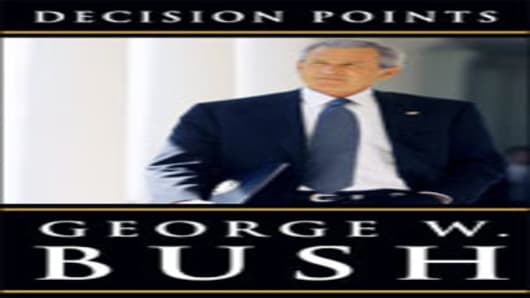
Pres. BUSH: No, you're--you see, Larry, I can't make it more clear to people that I am out of politics. I have had my time in the arena. I'm in the process of convincing people to buy my book just so they have a better understanding of the nature of my presidency. Your questions about my decisions during the financial crisis at the end of my presidency are very legitimate questions, and I would direct people to the last chapter of my book to have a more full understanding as to why I think the crisis happened in the first place. But beyond that, I really don't feel comfortable commenting about the issue of the day. And there's others who could come on this show and be much more articulate about what's taking place.
KUDLOW: They're not as expert as you are, not as expert as you are.
Pres. BUSH: Well, I don't know about that, but thank you.