

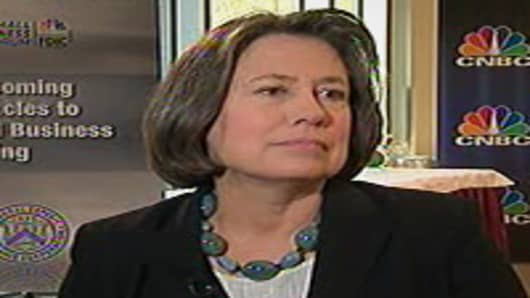
Even with the Republicans in control of the House, major changes in the Dodd-Frank financial overhaul law are unlikely and it's time for the country "to get on with it," Sheila Bair, chairwoman of the Federal Deposit Insurance Corporation, told CNBC Thursday.
CNBC
Sheila Bair
“Dodd-Frank gives the regulators a lot of tools to implement them [changes], and we are doing that in a balanced way,” said Bair, speaking from the Small Business Forum in Washington DC, a co-partnership between CNBC and the FDIC.
“Oversight, accountability is good but major changes, I don’t think that will happen," she said. "To some extent, it would create more uncertainty, not less.”
Bair said that the financial world has “made peace” with what she called a “landmark” law.
“It wasn’t a perfect bill, but it’s a good bill,” she added, “and we’re much better having it than not having it.”
"We need to implement it and get on with it," she said.
Republicans have sharply criticized Dodd-Frank, which was passed in response to the 2008 financial crisis, and have vowed to make major changes in the law or curb its effectiveness by cutting funding for regulatory agencies.
In the CNBC interview, Bair also said that she expects the Federal Reserve to take a "very measured and prudent" approach in determining which large banks can raise their dividend payments.
"There are still some uncertainties out there with the housing market, with servicing," she said. "I think we need to get clarity on the range of losses out there."
Banks that accepted bailout money under TARP, including the nation's largest financial institutions, were forced to eliminate or sharply reduce their dividends in order to conserve cash and raise capital. Now that many of them have repaid the TARP money, they are seeking to restore or raise their dividends.
"Clearly the capital base of those large institutions is something that’s very important to the FDIC," Bair said. "We’ll take a conservative view in our consultations, but it is the Fed’s decision on this, and I have confidence that they’ll make the right decision."
Bair also said that regulators likely will force banks to defer some of their executives' compensation as part of a proposal to curb risky pay practices. The FDIC board will meet Jan. 18 to consider the proposal.
Dodd-Frank requires regulators to make a rule that bans incentive-based pay practices that encourage "inappropriate risks" by employees at banks and other financial companies.
"I think you will see required deferrals for executive management," she said.
The provision was added to the law in response to complaints that financial institutions were paying executives based on short-term profit gains and without thinking about the long-term implications for the companies and markets.
—Reuters contributed to this report