

Oil prices are finally retreating from two-and-half year highs but the market is bracing for more volatility as anti-government protests threaten to spread beyond the borders of Libya towards the world's top exporter Saudi Arabia.
AP
U.S. crude futures on Wednesday dropped for a second day, offering some relief to global equity markets. Prices dipped below $105 after reassurances from OPEC members of ample spare capacity eased anxiety about export losses from Libya, Africa's third-largest oil producer. As of 1000 a.m. Singapore time, contracts for April delivery fell 61 cents to $104.41 a barrel. Brent crude fell for a third day to below $113 a barrel in early trade.
The message for oil markets this week is unequivocal: watch Saudi Arabia. Inspired by the unfolding 'Arab Spring', there have been Shi'ite marches in the past few days in the Kingdom's oil-rich east. Websites have called for a nationwide "Day of Rage" on March 11 and March 20 despite a move by King Abdullah to pre-empt popular unrest by boosting spending on housing, social welfare and education.
The Saudi government has been releasing Shi'tes detained last week according to activists quoted by Reuters. The move could be aimed at heading off the protests. The government has also warned it will clamp down on any dissent and one source indicated the protests could be called off.
But the markets continue to be jittery about the prospects of turmoil in the Kingdom. A CNBC poll of analysts and traders expect prices to end this week higher overall. Nine out of 10 respondents expect oil prices to rise this week while just one respondent said prices would drop, the survey showed. CNBC's poll correctly forecast the direction of oil prices last week.
"It's fear -- short-term fear of supply disruption," said John Vautrain, a senior vice president of the oil consultant Purvin and Gertz in Singapore, characterizing the current market mindset. "People are not worried that there's no oil in the tank. They're worried that there'll be no oil coming out of the Middle East. For the fear to go away, the revolutions must end."
Worst Case Scenario
Describing it as an "most extreme, worst case scenario" for the oil markets, Societe Generale said Brent crude could rise as high as $200 a barrel should serious unrest spread to swing producer Saudi Arabia.
"In this case, it does not really matter if Libya or any other producers are shut down or not. Saudi Arabia is OPEC's biggest producer and the world's biggest current holder of spare capacity," wrote Michael Wittner, head of oil research at Scociete Generale. "If production and exports are affected, or even perceived to be seriously threatened, the impact on the oil markets would be dramatic, to say the least."
The resulting surge in the price of oil would hold dire consequences for the global economy, triggering a release of emergency stockpiles, Wittner said. "There would be large downgrades to global GDP growth and large downgrades to global oil demand growth. In this scenario, there is an absolute certainty of a release of IEA emergency strategic reserves."
Wall Street oil bulls Goldman Sachs this week raised its forecast for Brent crude oil futures in the second quarter of 2011 by $4.50 to $105 a barrel as OPEC's spare capacity shrinks amid Libya output disruptions.
Libyan tanks and warplanes intensified their offensive against rebels this week, as the United States stressed that any no-fly zone to hobble Muammar Gaddafi's forces had to have global backing.
Libya's drifts towards full-blown civil war is raising fears of a prolonged supply disruption from Africa's third-largest oil producer.
"The market is quickly shifting focus from Libya's oil production, which is down by roughly 800,000 to 1 million barrels a day, to Libya's future ability to export the crude it produces," said JPMorgan energy analysts led by Lawrence Eagles. "Frankly, prospects are not promising. Coordination with ports is difficult, tankers are reluctant to load, U.S. financial sanctions deter potential off-takers and there is the lingering question of who do you pay for the crude?"
Until these issues are resolved, the market must adjust to an export shortfall about 1 million barrels "for the foreseeable future," JPMorgan said.
Overbought
Linda Rafield, Senior Oil Analyst at Platts, expects the price of oil to continue retreating this week though she didn't expect an imminent price collapse.
"The market feels a bit overbought here," Rafield said. "Non-commercials are holding a record long position in crude and given the jump in open interest, they probably added to that position. Open interest is at an all-time high right now in NYMEX crude. That is a lot of longs who probably came into the market at pricey levels, leaving the market vulnerable to a sell-off."
As my colleague Jeff Cox wrote earlier this week, traders without a commercial interest in oil held 430,118 contracts as of March 1, a surge of more than 25 percent since the revolt in Libya began capturing global headlines in mid-February.
That's put oil market speculators once again in the firing line. Consumer advocates blame market speculators for artificially pushing global oil prices higher, creating a 'fear premium' that distorts the value of gasoline at the pump at a time when Main Street is continues to struggle.
Three House Democrats urged President Obama late last month to tap the nation's 727-million barrel Strategic Petroleum Reserve as prices topped $100 a barrel. In a letter to Obama, Massachusetts Representative Edward Markey, Connecticut Representative Rosa DeLauro, and Vermont's Peter Welch said soaring energy prices stemming from supply disruptions and rampant speculation in the oil markets are making it hard on American consumers and businesses.
White House chief of staff William Daley said a release is being considered. "I think ... all matters have to be on the table when you ... see the difficulty coming out of this economic crisis we're in and the fragility of it," Daley said on 'Meet The Press' last Sunday.
The SPR and OPEC
The Federal government last released SPR oil during the first Persian Gulf war and after Hurricane Katrina shut down Gulf of Mexico oil production in 2005.
"The most likely short-term outcome is that the Obama administration will keep its powder dry, refraining from making a decision to release the SPR this week, and hoping that by mid-March there will be evidence of additional supplies becoming apparent in the Saudi tanker loading schedule," wrote Eurasia Group's Global Oil Analyst Greg Priddy.
"Further sharp escalation in crude prices, additional output disruptions, or any indication that the anticipated Saudi barrels might not materialize would alter this calculus, and increase pressures for a decision," he said.
Staying on the topic of supply side responses, markets are looking for more clarity from the Organization of Petroleum Exporting Countries after Kuwait's oil minister said OPEC was considering whether to hold an emergency meeting to decide whether more oil needed to be brought to the market to compensate for lost Libyan barrels.
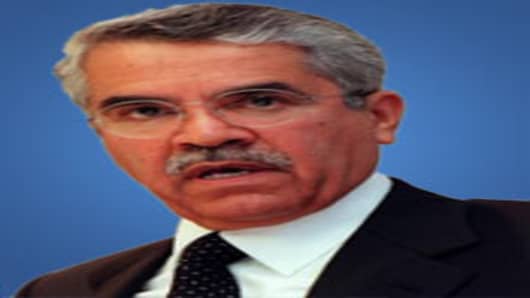
Ali Al-Naimi, Saudi Oil Minister
"We are in consultations about a potential output increase," Kuwait's Sheikh Ahmad al-Abdullah al-Sabah told reporters this week, Reuters reported. But he added that the group had taken no decision yet to produce above existing output targets.
Saudi oil minister Ali Al-Naimi and others in OPEC said world oil markets were sufficiently supplied. Naimi said the kingdom held 3.5 million barrels a day of spare production capacity to meet any shortages. Algeria's oil minister said he sees no supply deficits and Iran's OPEC governor downplayed the discussions, saying consumer worries were mostly "psychological."
Though not a pressing matter immediately, markets will be watching developments in Nigeria. Africa's largest oil producer holds elections next month and should electoral violence spill over to the oil-rich Niger Delta that may add to an already sizeable fear premium. Nigeria's light sweet crude are increasingly sought after by refiners to replace comparable Libyan crude displaced by the unrest.
"There's been surprisingly little attention paid to major oil exporter Nigeria, where the run-up to April presidential elections has been pretty calm," wrote Ian Bremmer, Eurasia Group President and Founder. "That's not likely to stay the case, especially given a major petroleum law presently being debated that will increase the share of revenues kept by a restive Niger Delta."
Bremmer noted militants typically tend to escalate attacks on energy facilities "before any major change in government or relevant legislation, essentially their most effective way of bargaining before a deal."
He added: "There's no reason to believe that won't be true this time around, which means there's a good chance we see more oil off the market in the coming months."