

The glimmer of hope that housing would stage a sustainable comeback this spring has melted with the winter snow.
Ariel Skelley | Getty Images
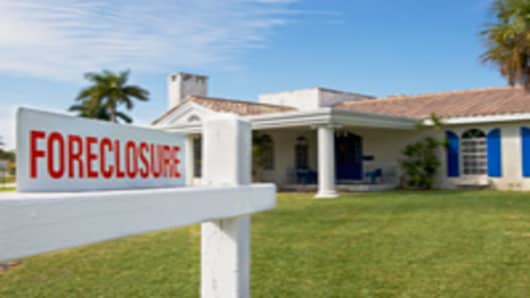
Foreclosed Home
Even as many await the traditional surge of buyers and sellers in the warmer months, analysts say it will be a year before there's any solid improvement in housing.
"We are going to be disappointed the rest of 2011," says Paul Dales, senior US economist at Capital Economics. "There's still weak demand, too many houses on the market. Things won't get better until 2012."
"2011 will be a real challenge, just like 2010," says Bob Walters, chief economist and vice president at QuickenLoans.com. "The key reason is that the jobs picture is still not bright enough. Plus, more foreclosures are coming. Many homes are still 'under water' or worth less than the loans, so it's going to be rough."
What caused a short-term bounce for housing—and talk of a possible turnaround in 2011—were better numbers for building permits, housing starts and existing home sales for the last months of 2010. Existing home sales were up 5.3 percent overall in 2010, according to the National Association of Realtors.
But new home sales and building permits have recently reversed themselves or remain in a downward trend. In fact, new home sales reached a record 47-year low this past year, with an annual decrease of 14 percent, according to the Department of Housing.
And Mortgage applications continue to fall, even as rates hover around the historic lows of 5 percent.
In spite of improving bread and butter conditions—like declining job losses and increased business activity —the housing market is standing still.
"There are too many vacant homes and excess inventory in the system now to create a stronger housing market," says Lawrence Yun, chief economist at the National Association of Realtors.
According to RealtyTrac, there werea record 2.9 million foreclosures in 2010 An estimated 50,000 new foreclosure actions are initiated every week, according to the Center for Responsible Lending.
And some 2.2 million homes are delinquent in mortgage payments and could be additional victims of the foreclosure mess.
"When realtors sit down and talk, foreclosures are on our mind," says Johnny Martinelli, the broker/owner of LevyMart Real Estate Sales and Investments in Norman, Oklahoma. "We are seeing more of them. People are scared."
Adding to the fears of realtors is a lack of confidence among consumers, says Michael Freed, a managing partner and real estate lawyer in the firm Brennan, Manna & Diamond.
"You see people in the malls and restaurants, but when it comes to a big purchase like a home, there's not much confidence," Freed explains. "Add that with the dynamics of tougher lending restrictions and higher down payments, and homes are not going to sell."
The lack of sales pretty much covers all income brackets, adds Freed. "It is a buyer's market if you have the money," he says.
It's money—specifically cash—that's keeping housing from sinking even lower, says Julie Reynolds, a vice president at Move, Inc., an online real estate resource.
Cash buyers and investors have driven 70 percent of the increase in existing home sales seen since last July, while first-time buyers have been responsible for just 6 percent, according to Capital Economics.
"Investors who are cash rich are snapping up affordably priced properties," Reynolds says. "They are critical in areas like California, Arizona and Florida that are having problems with distressed homes."
The cash has a foreign flavor, with international buyers from Western Europe, Asia and the Middle East, adds Reynolds.
Those who still need a loan continue to face tougher lending standards—fallout from the housing crash—and gum up the works, say analysts.
"Banks are a problem with the scrutiny for applications," Johnny Martinelli says. "It's slowing up the process. There are a lot of people who can make payments but can't qualify."
Another wrinkle comes at the end of June. A little known portion of the Dodd-Frank financial reform bill ends the so-called 'teaser rates' that misled buyers into deals that turned sour with higher payments. The change, however, may have negative unintended consequences, say experts.
"Starting in April, loan officers won't be paid by the terms of the loan and will get less money," explains real estate attorney Neil Garfinkel of the New York based law firm AGMB. "That might mean they move around looking for better pay. It could also mean fewer loan officers to handle applications."
"Whenever we get momentum something pushes us back," says Alan Rosenbaum, CEO of GuardHill Financial, a mortgage banking and brokerage firm. "The government [with Dodd-Frank] is telling the industry what it can pay and that makes it more expensive for consumers."
Another effect from the housing collapse—and a possible sea change—is a different mind set about how people live, says Freed.
"Americans aren't looking to move like they used to," Freed contends. "It's not necessarily that we've lost our love of owning a home, but I think people are looking at the market differently because of the crash. They're renting, and focusing on a life style they can afford."
So with all the doom and gloom, what will change in 2012 to make housing any better?
"I got a price I finally liked," says a New Jersey homeowner
"By next year I think you will see stronger demand," says Dale. "The number of foreclosures should peek this year as they flush through the system. I also think the job situation will improve in 2012."
Also helping the market—a wave of refinancing in the adjustable-rate mortgage area, averting additional foreclosures in some cases. About 20 percent of ARMs holders have taken advantage of lower interest rates to refinance; others have been able to pay them them off completely, according to the Mortgage Bankers Assocation.
"I think we are headed in the right direction for next year on inventory and prices," says Walters.
For all the tumult and uncertainty, one thing hasn't changed about the real estate market. Location is key, and parts of the country are having a better 2011 than 2010.
After taking their house off the market last spring, Maria and Michael Treiber of Morris Township, New Jersey sold their three-bedroom, split-level this February after prices had finally climbed to an acceptable level.
"It was much better for us," says Treiber, a local policeman who plans to rent while looking for another home. "There weren't that many homes on the market this time, so that helped."
Some areas are even seeing an uptick in new construction.
"There's some new construction, and some people are buying homes," Martinelli says of Norman, Okla. "They're downsizing, but at least there's some activity. It's not as bad as it was last year."
Wall Street bonuses are moving some buyers and renters back to the high-end Hamptons section of Long Island, N.Y.
"Fundamentals are improving if not significantly," says Rosenbaum. "People still need to move, whether for a job or bigger home."
And longtime depressed areas are also seeing daylight.
"Areas like Chicago, Detroit, Las Vegas that have a lot of foreclosures are on an upswing with interest in home buying," says Reynolds. "That interest is better than a year ago."
Above all, there's an acceptance of the new normal in housing, says Jim Gillespie, CEO of real estate firm Caldwell Banker.
"Happiness is a new base, but we are going up," Gillespie says. "At the worst, things will stay the same; at best, we'll have a slow recovery. I don't think Americans have lost their love of owning a home. We're just obviously going through a tough time."
