

Farmers markets—those tented outposts that sell products directly to customers—are popping up across the U.S. as often as a new crop of corn.
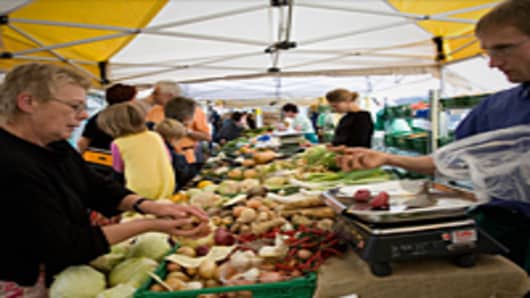
Richard Ross | The Image Bank | Getty Images
But making a profit—for themselves and their suppliers—is a growing concern.
"Currently we operate at a deficit," says Robert LaValva, director of the non-profit New Amsterdam Market in Manhattan. "To meet our costs we hold fundraisers and seek donations, and rely on volunteers and a minimally paid staff."
LaValva turned a one-day food event in 2005 into the New Amsterdam, which now averages about 1,000 customers a week with some 70 vendors during its summer-fall season.
"This is not uncommon what we do to survive," LaValva says. "That's because markets take time to grow and become self sufficient."
Local fresh food markets in the U.S. are multiplying. According to the Agriculture Department, there were just 1,755 farmers markets in 1994. Now, there are about 6,100—mainly due to the increased demand for fresher foods. California has the most markets—580—with its year- round mild weather and abundant farm land.
But analysts say the growing numbers don't reflect the effort needed to make a fresh food market economically viable.
"Just to get a market going is a major undertaking," says Dan'l Mackey Almy, founder of the Fresh Produce Organization, a group that focuses on raising the profile of fresh food.
"A successful market requires good foot traffic, decent weather and an abundance of available products," Almy explains. "It can be a challenge to find areas that are equipped with this perfect combination."
Most markets are on their own financially. The federal government has provided funding to help expand and improve farmers' markets and roadside stands since 1976, with the intent of helping the farming community and to get Americans "access to locally grown fresh food," according to the department's web site.
But the amount from the department has always been small and remains so—$10 million for the next two years. Local governments, even in tough budgetary times, might be more willing to help, say industry members.
"We were awarded $25,000 last year from the New York City council for some specific programs, and this helped cover some of our costs," LaValva says. "But we have high rent and the market costs more to produce than what we earn in stall fees from vendors."
Farmers, too, find dollars difficult to cultivate at local markets, according to analysts.
"There's a limited number of farmers who can take their produce, meat and dairy products to market efficiently and make a profit," says Gene Grabowski, an executive at Levick Strategic Communications and a former vice president of the Grocery Manufacturers of America. "The average amount spent by a consumer at a market is just $17.50."
Farmers that make up the 'fresh food' movement face higher costs because they avoid cheaper commercial fertilizers and pesticides and use more labor intensive harvesting measures.
Add transportation costs, fees for market space, and permits, and it can get expensive to be part of the 'buy local' movement.
"Farmers get good profit margins because they deliver directly to the consumers," says Pat Conroy, Vice Chairman and U.S. Consumer products leader at the consulting firm Deloitte. "But they don't see a lot of profits overall because of the small scale they sell at. They need $600 a day to make it viable. That's not easy."

Food Economics - A CNBC Special Report
Small farmers—the largest group of producers for local markets—average only $49,000 a year in income, according to the Department of Agriculture. And most have other ways to make money besides farming.
The latest U.S.D.A. statistics show that vendors—those who sell at local markets—have average sales of just $1,070 a month.
That means a good business sense is as necessary as a green thumb, says Karen Karp, of Karp Resources, a consulting firm to the food and restaurant industries.
"It takes a certain kind of farmer to succeed at local market selling," Karp argues. "Beyond being good growers, they have to be good merchandisers and innovators."
And they are forced to deal with a certain amount of red tape, Karp adds.
"One New York inspection agency required that cheese at a market be pre-packaged before being sold even though there was no incident of food safety," Karp explains. "One farmer found that to pre-cut the cheese into smaller amounts cut down on his profits to a certain percentage of customers."

Courtesy of Phil Jones
Phil Jones has been a farmer for ovr 20 years.
For 63-year-old Phil Jones, the fresh food movement is more a labor of love.
"Local markets and farming? It's not a great way to make money," says Jones, who has a 13-acre farm in Chelmsford, Mass., and travels to four farmers markets a week.
Jones and his family switched to food production five years ago after growing flowers for two decades.
Besides the local markets, Jones shops his lettuce, tomaotes and cabbage to other venues, like the local Hilton Hotel restaurant. He's also digging into savings to keep farming.
Jones is focusing on new bio-nutrient dense type of crops— crops that have a higher ratio of nutrients to calories and harvesting them with a method that replaces nutrients taken out of the soil in traditional farming. He hopes this new 'wave' of food will be less costly than organic growing.
"With organic fertilizers and weed control, doing organic food is expensive. Once the bio-nutrient dense way is refined, it should be cheaper. The plants would be able to take more frost then they do now," Jones says. "But until then, we're still looking to become profitable."
Farmers markets grow beyond elitist label
If profits are spread so thin, why do markets keep sprouting? That's simple, say the experts—demand keeps growing.
"Like many people, I enjoy the freshness and variety of fruits and vegetables I get at local markets," says Ron Hansen, senior associate dean at the Simon School of Business at the University of Rochester. "That love of fresh food is what's helping to drive up the number."
More fresh food markets show people are serious about changing their eating habits, says Robert LaValva.
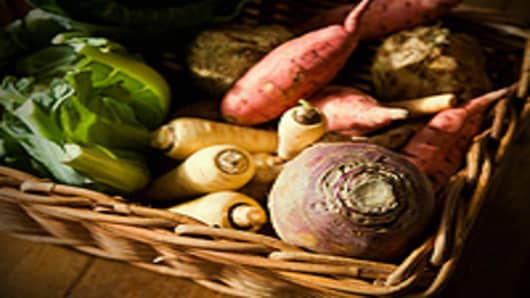
Grady Coppell | Digital Vision | Getty Images
"The growth in local markets seems to be a sign of a steady shift in the way people think about food," LaValva adds. "People come to prefer specific products sold by certain vendors."
The markets have also gone beyond the hippie label as wellas the stigma of being only high end, says Karp, who helps New York City schools acquire local grown foods.
"There are many farmers markets thriving in inner cities, in communities with the least access to fresh fruits and vegetables," Karp says. "They afford low-income residents the freshest food for eating healthy."
The increase in local markets has caught the attention of major food-store chains, according to Pat Conroy.
"We're seeing stores like Whole Foods and even Wal-Mart copy some of the best parts of local food markets," Conroy adds.
"And food store chains are buying more local produce. Heinz is even working on a sweeter tomato so they don't have to add sweeteners. This is because of the demand for good fresh food."
For farmers, the value of a local market is not just dollars and cents.
It's critical to the world and nation to have better food," says Phil Jones. "Local farmers and markets are part of that."
Food Economics - A CNBC Special Report
In the end, analysts say local farmers markets and their suppliers face an uneven future.
"They may slow down in numbers if the economy goes down and food prices go up," says Grabowski. "Those factors tend to drive shoppers to supermarkets and warehouse stores."
"I think markets will keep growing in numbers," says Steve Ford, an associate professor at the University of the South in Sewanee, Tenn., and a small farmer himself.
"We always shopped at food and vegetable stands when I was a kid. Now, more people than ever want good fresh food," Ford says. "The question is can someone make a living at this."
