

Fed officials have been singing different tunes about monetary policy recently, but one voice has risen above the rest to boost the dollar and pressure Treasury bonds.
It may be that he has had the most appearances in the last several days, but the hawkish words of St. Louis Fed President James Bullard are being heeded more than usual by the foreign exchangeand Treasury markets.
On Tuesday, Bullard was even more strident in his comments against the Fed's quantitative easing program, saying the economy is strong enough for the Fed to stop $100 billion short of its planned $600 billion Treasury purchase program.
"We think that there are legitimate and justified concerns on the part of a number of FOMC (Federal Open Market Committee) members about the medium-term impact of the expanded balance sheet on inflation," said Robert Sinche, chief currency strategist at RBS. "I think any number of them are highlighting the risk of higher inflation and are doing it at a time when it looks like the trough in core inflation is behind us."
The stock market, a beneficiary of the Fed's quantitative easing program, has shrugged off the Fed speak and was sharply higher Tuesday. Stock traders are mostly dismissing Bullard because he currently is a not a voting member of the FOMC and often questions the Fed's easy money program.
"I did see Bullard's comments, and they're irrelevant. He has very little influence as a non-voter. The only person who can shift the mindset of QE magic is the chairman himself," said Todd Schoenberger at LandColt Trading, referring to Ben Bernanke.
Bullard, speaking in Prague, said deflation is less of a risk and the Fed needs to be careful about inflation.
"I think it's still reasonable to review QE2 in the coming meeting, especially this April meeting, and to see if we want to decide to finish the program or to stop a little bit short."
"I think it's still reasonable to review QE2 in the coming meeting, especially this April meeting, and to see if we want to decide to finish the program or to stop a little bit short," Bullard said.
The Fed's next meeting is April 26 and 27, and Bernanke will hold the first of four newly announced annual media briefings following the meeting.
The St. Louis Fed president also said the Fed needs to start reducing the balance sheet and then hike rates. "We're still buying Treasurys. We're feeding the fire at this moment," he told reporters.
While this view is not new, Bullard's comments come when markets are becoming increasingly concerned about inflation and the approaching end of the Fed bond purchase program.
His view was countered by other Fed speakers, such as Chicago Fed President Charles Evans who said Monday that the purchase of $600 billion in securities is "just about the right number" and it would have to be a high hurdle of economic improvement for him to believe the Fed should end the program before June, as currently scheduled.
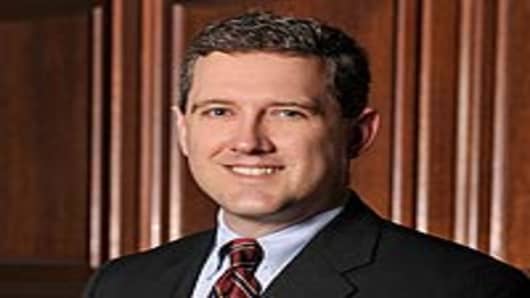
James Bullard
Traders, meanwhile, are waiting to hear from New York Fed President William Dudley, who speaks Friday. Dudley is considered a voice of the Fed leadership.
Fed speak has been especially loud since Friday, when known hawk Philadelphia Fed President Charles Plosser said the Fed would soon have to turn to raising rates and removing the assets from its balance sheet.
"The market is very desperate here to target a sense of how soon the end of the Fed cycle will be, and we know it is going to be there someday, probably less than a year and so we're looking for hints," said David Ader, chief Treasury strategist at CRT Capital.
Bullard over the weekend had said that lengthening the "extended period" of low interest rates could create a liquidity trap.
Ader said the market was taking a directional cue from Bullard even though Evans signaled the Fed would not end its program and he is a voting member.
"I think a lot of people in the market are looking for the next big directional trade, which probably is going to be a flattening trade as we get closer to the end of QE2. Bullard, I think, hits a nerve," he said.
Treasurys were weaker, which pushed yields higher. The 2-year yield was at 0.805 in late trading, up from 0.773 Monday, and the 10-year was yielding 3.48 percent.
In the current flattening trade, the yield at the short end (2 year) has moved higher faster than the longer end of the curve. The 2-year is at a 6-week high yield, and the 10-year is at a 3-week high.
The dollar was higher against the euro after Bullard's comments Monday but since fluctuated. The talk about the end of Fed easing comes at an important time for the euro, since it has been supported against the dollar by talk that the European Central Bank could raise rates next week.
Dollar yen was stronger too, with the yen at its lowest level since the concerted G-7 intervention against the yen March 18. Dollar yen was at 82.46 at the highs of the day and was later at 82.39.
Sinche said he thinks the Fed will continue QE2 as planned, but the discussion is showing that another round of easing is less likely. This week's jobs report may also show that the unemployment rate continues to hold under 9 percent, which would be a signal that the Fed easing could begin to come to an end.
"There are a number of FOMC members who feel this is the right time to start highlighting the medium-term risk of Fed policy," Sinche said. "Do I think it's important? Yes. People better be more concerned about the reality of the data than who is voting and who is not voting.
"I think one of our concerns is that while the Fed continues to focus on the domestic output gap they probably aren't paying enough attention to the global output gap, which has virtually disappeared," he added.
After a long period where import prices helped restrain U.S. inflation, the situation has changed.
"The cushion we used to get from the international sector is no longer a cushion and actually looks like its adding some upside pressure to domestic inflation," Sinche said.
Questions? Comments? Email us at marketinsider@cnbc.com
