

After laying out the strengths of the U.S. and reasons why it is maintainiing the country's highest "AAA" rating, the first reason presented in Standard & Poor’s market-pummeling note for its change to a negative outlook for the country is the financial crisis.
Jaap Steinvoorte
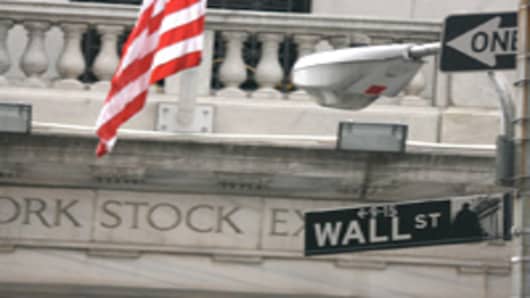
Wall Street
“We note the U.S.'s fiscal profile has deteriorated steadily during the past decade and, in our view, has worsened further as a result of the recent financial crisis and ensuing recession,” said Nikola Swann, in the fourth paragraph of the S&P note. “Moreover, more than two years after the beginning of the recent crisis, U.S. policymakers have still not agreed on a strategy to reverse recent fiscal deterioration or address longer-term fiscal pressures.”
Many investors found the statement ironic, because they believe S&P’s triple-A credit ratings on mortgage-backed securities were a key factor in allowing the investment banks to propel the housing bubble into the stratosphere on the back of bad loans disguised as good credit. It is the housing crash that is the number one reason for the budget shortfalls the country faces today.
“The emperor is naked, but he’s been so for years,” said Patty Edwards of Trutina Financial. “I’m struck by the irony that it is the tailor who sold the emperor the non-existent suit who is now pointing fingers.”
Reports from the Financial Crisis Inquiry Commission and the Senate Permanent Subcommittee on Investigations both asserted that S&P and Moody’s were reluctant to downgrade mortgage securities they knew might sour because of the disruption it would cause with the Wall Street clients that were paying them to rate them, thus setting up the housing house of cards.
“The ‘negative outlook’ of U.S. debt has come about because of the inability of Standard & Poor’s to have performed their jobs rating mortgage backed securities,” said Barry Ritholtz on his Big Picture blog Monday. “Ultimately, this enabled the entire crisis, financial collapse, enormous budget deficit and now political [battle] over the debt ceiling.”
"If ever there was an organization more corrupt, incompetent, and less capable of issuing an intelligent analysis on debt than S&P, I am unaware of them," Ritholtz said.
The financial markets did not seem to believe that the S&P change to a negative outlook—which means a one-in-three chance of a debt downgrade within two years—was particularly revelatory. Treasurys actually increased, along with the U.S. dollar.
“I truly find it beyond comprehension that their opinion can move markets when they have done nothing to earn that power,” said Stephen Weiss of Short Hills Capital. “Their most important role is that of insurance policies for portfolio managers who do not have the capability or desire to do their own analysis.”
Shares of McGraw-Hill—the parent of Standard & Poor’s—have almost doubled from their post-credit crisis low as the ratings agency has, for the most part, skirted any significant fines or sanctions from the SEC or state attorneys general.
“S&P simply does not have the integrity to honestly rate U.S. debt,” said Peter Schiff, CEO of Euro Pacific Capital, in a note Monday. “In fact, given the culpability of the rating agencies in the financial crisis, it may well be a quid pro quo that as long as the U.S.' AAA rating is maintained, the rating agencies will continue to enjoy their government sanctioned monopolies, and that no criminal or civil charges will be filed related to inappropriately rated mortgage-backed securities.”
S&P did not return a call for comment on these remarks. The agency has maintained all along that it regrets not foreseeing the financial crisis and that it was not alone in that regard. Still, whether the firm was complicit or just incompetent, investors fear that the ratings agency model largely hasn’t changed, even with the new financial regulations being instituted.
“Whether you like it or not, the ratings agencies control much of the economy by the simple fact that with a swipe of a pen entire asset classes can be rendered investable or un-investable,” said Brian Kelly of Brian Kelly Capital. “We all understand the game and until it changes the ratings agencies will be influential.”
For the best market insight, catch 'Fast Money' each night at 5pm ET, and the ‘Halftime Report’ each afternoon at 12:30 ET on CNBC.
______________________________________________________
Got something to say? Send us an e-mail at fastmoney-web@cnbc.com and your comment might be posted on the Rapid Recap! If you'd prefer to make a comment, but not have it published on our Web site, send your message to fastmoney@cnbc.com.
