![]()
- Spain to Go to Market to Fund Banks, Regions
- JPMorgan Sells Good Assets to Offset 'London Whale'
- Euro Zone Bank Safety Net Leaves Holes Unplugged
- State Fund Rejects ‘Unaccountable’ Chesapeake Board
- Madoff Case Is Paying Off for Trustee ($850 an Hour)
- Cool Jobs: From Gold Stacker to Bed Tester
- Roubini’s Das: Spain Needs a Bailout ‘Sooner or Later’
- Trump Presses Obama to Release College Transcripts

- Ackman: JCPenney's Latest Sales Plunge Is a 'Bottom'

- Option Bulls Dig Into Ivanhoe Near Lows
- Facebook: The Song — Yes, We're Serious
- A New Look at the ‘New Poor’
- Six Pack: Beer Buzz of the Week
- Greek Exit Could Trigger 50% Fall in Euro Stocks: Analyst
- Under Pressure, FHA Skews to Wealthier Home Buyers
- Big Stock Upside for Hudson City Deal: Analyst
- 5 High-Yield Stocks Ready to Boost Dividends
- Yoshikami: Four Things You Need to Know About Gold Now
MOST SHARED
- Facebook Could Pay Over $1 Billion for Opera: Analysts
- Vertex Corrects Cystic Fibrosis Data; Shares Tumble
- Spreading Around Your Retirement Wealth Tax Free
- Roubini’s Das: Spain Needs a Bailout ‘Sooner or Later’
- Homes Prices Drop 2% to Post-Crisis Lows: Case-Shiller
- Stocks to Watch: JCP, VRTX, CHK, FB & More
- Buffett-Backed BYD Defends Electric Car After Accident
- CNBC Poll: What's a Fair Inheritance Tax
- Euro Sinks, China Talks Tough, Dollar Gets a Lift
- Which Policies Could Hold Back US Growth?
MOST POPULAR
HOT ON FACEBOOK
Does the Solar Industry Have a PR Problem?
It’s considered the greenest of green technologies, completely renewable and the perfect solution to the threat of climate change. It helps alleviate fears about the dangers of nuclear energy, and there’s evidence that it increases home values. Oh, and the business is booming.
So, what's not to like about solar technology and why hasn't it been adopted by the masses? Is there something wrong with the technology, or does solar just suffer from bad PR?
A recent survey (by solar industry advocate SolarTech and San Jose State University) suggests the latter. A perfect target demographic for solar power — well-off residents of California’s Silicon Valley — have a rather sour perspective on the industry.
According to the survey, only 39 percent of those surveyed saw solar energy as ‘reliable’, and only another 11 percent see it as affordable.
"A lot of advertising dollars are not reaching consumers' ears,” says David McFeely, a director at SolarTech.
![]() |
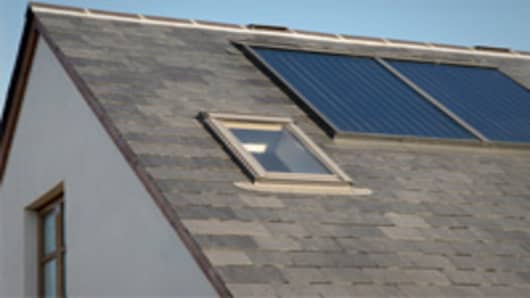
Peter Anderson | Dorling Kindersley | Getty Images Solar Panels on a residential roof. |
The problem, says Nelson, is that solar is generally still not price competitive with fossil fuels for energy generation, says Nelson. Paradoxically, government efforts to subsidize the purchase of solar panels actually slow down the adoption of innovation that should ultimately make renewable energy more affordable.
By encouraging consumers to buy immature and inferior solar technology right now, government subsidies risk locking people into solar systems that are inefficient, expensive, and may or may not ultimately pay off to the consumer. “They’re encouraging people to use things that don’t work,” he says.
At current kilowatt-per-hour rates, solar energy costs about 4 times more than power drawn from the grid, says Nelson. (Energy Secretary Steven Chu aims to bring down the cost by 70 percent to 75 percent by 2020.)
Reduce that by another quarter, and solar becomes attractive for both residential and industrial customers. (10 cents a kilowatt hour is the average cost of electricity in the U.S.)
Long term costs — or what long-term costs are perceived to be — can also turn away otherwise sympathetic potential customers.
Tim Young, CEO of solar cell manufacturer HyperSolar, says that a household solar installation using photovaltic, PV, cells — wherein light is converted into electricity be displacing electrons in silicon cells — typically needs 10 years to pay for itself, and after 20 years those cells will have substantially degraded.
For people who are either very well-off, very passionate about green energy, or both, that could be a fine trade-off. But for the mass consumer — or for that matter for power-supplying utilities — that’s a big negative for now.
“We want to make it a no-brainer for people,” says Young.
While cost and engineering obstacles are real, solar’s perception problems are also a matter of poor salesmanship, says Solartech's McFeely.
McFeely cites two significant obstacles: many municipal codes make building or implementing solar technologies costly or difficult, and some banks view solar as sufficiently risky to be wary of financing it.
That makes it a tough sell, even in those parts of the country — California, for instance — where the kilowatt-per-hour cost is getting competitive.
Possible solutions? McFeely says the solar industry needs an "advertising and research council" much like certain agricultural associations. Such a council would promote solar energy as a generic option rather than the service of specific companies.
![]() |
Danny Kennedy, founder of solar energy company Sungevity, says many people see switching to solar as a "hassle" — getting financing, dealing with municipal codes, applying for tax subsidies and the like —so those who would otherwise be interested never look into it.
His company, which leases solar panels to residential customers for either 10- or 20-year periods, aims to make that process much easier, and thereby change perception. (At least 60 percent of Sungevity's roughly 1,700 customers save 10 percent on their utility bills, according to Kennedy.)
Kennedy's model for mass marketing and delivery is the computer company Dell. What the company discovered is that mass adoption of new technologies generally happens once shopping and installation is made easy for people.
"Innovation is not just about the gadget," says Kennedy.
- Critical elections are scheduled for Greece in June. Here are some of the players and their roles.
- Our financial system is still not designed to meet the needs of poor families, says this author.
- Take a look at the most luxurious golf homes currently for sale... and see if they fit your budget.
- Even with many people still unemployed there are some jobs that can’t be filled. Take a look.
- Looking for a very unusual dining experience? You might even be taken to another planet to eat.
- People who travel a lot are often at higher risk of getting sick. Here are some tips to stay healthy.