

When a country registers a 15 percent growth rate, as Singapore did last year, there is bound to be a spill-over wealth effect. Singapore’s housing market has been cashing in on this big time - prices have rebounded 50 percent in just two years, according to the Urban Redevelopment Authority, and cooling measures by the government have done little to calm them.
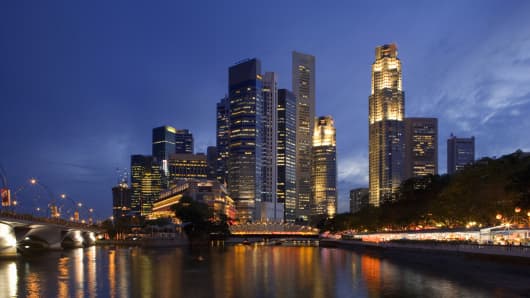
Stephen Studd | Photographer's Choice | Getty Images
At a recent real estate conference organized by the National University of Singapore, which explored the theme “Will the boom never end,” Chua Chor Hoon, Head of South East Asia Research at property consultancy DTZ, said the Singapore residential market is not likely to decline much because of strong economic growth. But, she also outlined a worst-case scenario, which could unfold as early as 2013-2014. "If all the ingredients come together it will make a perfect storm," she told the audience.
These ingredients include falling demand, more supply and higher interest rates all kicking in together.
Interest rates in Singapore are currently at record lows because lending rates in the city-state track U.S. monetary policy. That’s allowed some homebuyers to pay less than one percent in the first year of their loans, says Chua. Most analysts, however, expect interest rates to begin moving higher later this year.
Second, in 2014 an unprecedented number of housing units are expected to enter the market. According to the URA’s latest quarterly report, 32,359 units will be completed over 2013 and 2014 that is 85 percent more than the 17,501 units expected over 2011 and 2012.
Add to this the fact that Singapore’s price-to-rent ratio has increased from 20 in 2009, during the financial crisis, to 25 currently, according to URA and DTZ research. That means it will take 25 years for a homebuyer to recover, through rents, what he paid for the house. As a result, Chua says, people investing in this market often have a short-term view looking to “flip” the property for capital gains.
Foreign buyers are also helping boost Singapore’s property market, especially at the high end. According to DTZ’s latest report, foreign buyers of private homes in the first quarter of 2011 touched a record high of 16 percent. But Chua points out that this could drop, if the government further tightens immigration rules.
“Local concerns about high housing prices and the influx of foreigners that were magnified during the recent General Election will be a catalyst for the review of immigration and housing policies, which could dampen demand in the residential market in the coming months, ” Chua wrote in a report.
While growth forecasts for Singapore over the next five years at 4-6 percent will support the property market says Chua, one cannot rule out another unforeseen external crisis like the financial meltdown, which could also lead to a market crash. While the bulls might find it hard to believe that something like that can happen again, another speaker at the same conference had this to say: “We always think this time it will be different, but it never is.”