Net
- The Buckaroo and the Demand for Money
- College Flunks Four Times; Eliminates Tuition
- ECB May Be Willing to Take a Haircut on Greek Bonds
- College Flunks Four Times; Eliminates Tuition
- New York Housing Market Could Still Collapse: Analyst
- Ouch! UBS's Bonus Pool Got Whacked
- Banks Already Slipping Through New Capital Requirements
- Greek Default: Why Now May Be Best Time to Do It
- What Germans Really Think About the Greeks
- Why the Social Security Tax Fight Is Stupid
- Stuff We Missed: Wednesday, February 22
- Chart of the Day: Europe and U.S. Decoupling
- Will Greek Credit Default Swaps Fall Short?
- Kevin Book: Beware the Downside Potential In Oil Prices
- Stuff We Missed: Tuesday, February 21st
- Modern Monetary Theory’s Big Weekend: The Problem with Surpluses
- ‘Greece Fatigue’: Market Hopes Bailout Plan Will Work
- Sallie Krawcheck: The Euro Is “Fundamentally Flawed”
- Compensation Clawbacks: Bad for Banks, Bad for Shareholders
- Get Ready for Gas Prices to Hit $5 by Summer
- Playing the Banker/Lawyer Game at Stone Rose Lounge
- Memo From the Big Board: Monday Is Not President’s Day
- Government Critic John Kinnucan Arrested for Insider Trading
- Weather Service In Eye of Budget Cut Storm
- Colbert Report Suspends Production
- The Trend Initiation Test for New York Fashion Week
Call: 201-735-4638
Text Message: 917-740-8477
- RBS Hurt by Greek Charges But Pays Bonuses
- More Asset-Buying Depends on Economy: BOE
- Stocks Sputter as Investors Seek Next Catalyst
- T-Mobile USA Wants to Grow Again
- Nissan to Recall 250,000 Cars Globally
- Winners and Losers in Obama's Corporate Tax Plan
- Santorum Takes Heavy Fire in Arizona Republican Debate
- Volcker Rule Threatens Recovery: Finance Ministers
- Next Bank of England Governor: The Race is On
- Peugeot Citroen in Talks With General Motors

Here's What Jamie Dimon Is Really Worried About
Senior Editor, CNBC.com
![]() |
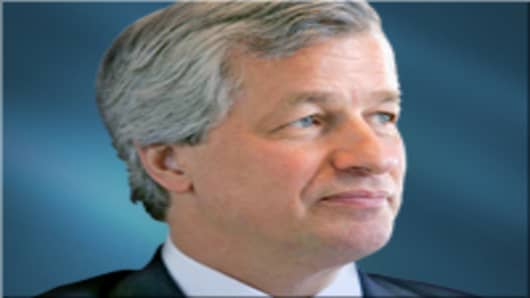
CNBC.com Jamie Dimon |
Jamie Dimon’s confrontation with Ben Bernanke was notable because we rarely see corporate chiefs so publicly confront their primary regulators.
JP Morgan Chase Chief Dimon can have a meeting with Federal Reserve Chair Bernanke any time he wants. There’s no need to take the microphone at a public Q&A to question regulatory reforms.
The confrontation is being interpreted in two contradictory ways. On the one hand, some say it is a sign that Bernanke has lost the confidence of the country’s top bankers—something that could be a serious impediment to effective monetary policy. If Bernanke cannot command the support of bankers, he may be at the end of his tenure as an effective central banker.
On the other hand, some say that Dimon more or less threw a fit, lashing out publicly because he has lost an important argument behind closed doors. In other words, rather than showing Bernanke's weakness, the confrontation was a sign of Dimon's weakness.
In either case, it seems that what provoked Dimon were recent signals from a Fed governor that the largest banks might face an additional capital surcharge, above and beyond the new capital and liquidity requirements agreed to last year in Basel.
At Basel, regulators agreed to more than double the minimum common equity requirement for banks to 4.5 percent from 2 percent, with an added liquidity buffer of 2.5 percent. That means banks will have to have total risk reserves of 7% of weighted assets. Regulators did not reach a consensus on proposals for an additional buffer—or "surcharge"— for "systemically important financial institutions"—which is regulator speak for Too Big To Fail.
Many of the largest European and American banks have been lobbying hard against the new surcharge, but these efforts appear to be failing.
In a speech last week, Fed Governor Daniel Tarullo said additional capital requirements are needed to prevent systemwide financial instability that could be caused by the failure of one of the world’s biggest or most interconnected banks. Tarullo, who is the Fed's point man on bank regulation reform, said the Fed was considering capital requirements that could amount to between 20 percent to more than 100 percent over the Basel III requirements.
There’s a growing consensus the regulators will likely propose a uniform surcharge of 3 percent on the biggest banks. Another alternative would be to have a sliding scale surcharge that would grow with the size of the bank. Some have suggested a surcharge that could be moved counter-cyclically, requiring more capital in good times and allowing banks to operate with thinner capital when the economy needs more lending.
The Dodd-Frank law requires regulators to impose tougher capital requirements—but punts on the exact shape of those regulations.
Tarullo has said he favors the sliding scale version of the surcharge that would rise according to the "expected impact" of a bank's failure on the financial system.
Earlier this week, Dallas Fed President Richard Fisher said that the "top 10" banks in the U.S. should be subject to stricter requirements than smaller banks.
"Enhanced supervision can be implemented on a graduated scale, based on the extent of assets beyond $50 billion and possibly other factors," Fisher said. "Let us do that fully, then, applying these measures along a highly graduated scale, with only minimal added mandates directed at mid-tier banking organizations."
The views of Tarullo and Fisher obviously would impose disadvantages on banks that grow as large as JPMorgan Chase [JPM
Loading...
()
]. This is probably no accident. In the past, Fisher has said that he favors breaking up the biggest banks.
___________________________________________
Questions? Comments? Email us at
Follow John on Twitter @ twitter.com/Carney
Follow NetNet on Twitter @ twitter.com/CNBCnetnet
Facebook us @ www.facebook.com/NetNetCNBC