

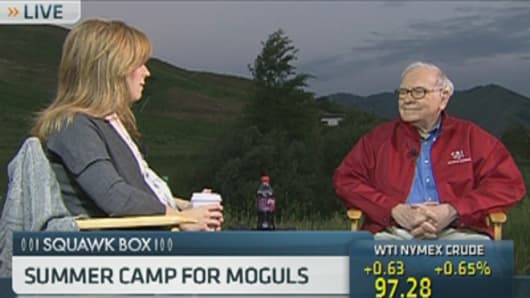
This is a transcript of Warren Buffett's live interview with Becky Quick on CNBC's Squawk Box, Thursday, July 7, 2011.
The transcript is also available here for downloadas a PDF.
CARL QUINTANILLA: We want to go live to Becky in Sun Valley, Idaho, who joins us this morning with a very special guest. Becky, still dark there? Good morning to you. —
BECKY QUICK: Good morning, Carl. Good morning, Joe. It's great to see you guys and we do have a very special guest who's joining us this morning. Warren Buffett, who's the chairman and CEO of Berkshire Hathaway has climbed up the mountain to join us this morning and talk a little bit about a lot of the issues that we've been discussing for weeks, if not months at this point. In fact, we were just listening in to what some of what Eric Cantor had to say.
And Warren, probably the best place to start this conversation is what's happening in Washington right now. These discussions over the debt ceiling seem to be front and center, not only for Washington, but for Wall Street as well. How big of an issue is this and how dangerous is it— how dangerous is it really if they don't raise the debt ceiling?
WARREN BUFFETT (Berkshire Hathaway Chairman & CEO): Well, we don't know exactly what'll happen. I mean, but if you gave me a six shooter and stuck a gun in— a bullet in one chamber and said spin it and five times out of six nothing bad's going to happen, but we haven't done this before, so we're not sure what's going to happen if the sixth one's pulled. It's just silly to do and we raised the debt ceiling seven times during the Bush administration and now in this administration, they're using it as a hostage and you really don't have any business by playing Russian roulette to get your way in some other matter. We should be more grown up than that.
BECKY: Although the argument is at this point we're at a very different level. We are facing some massive deficits. We've taken off on some spending in incredibly high amounts over the last couple of years. And if you can take a phrase from Rahm Emanuel, why put a crisis— why waste a good crisis if you can actually get something done that could be, in the longer term, good for the economy?
BUFFETT: Well, whether it would be good for the economy to have— to have policy...
BECKY: Or the nation, I should say.
BUFFETT: ...under conditions like this is another question. I mean, when you have somebody with a gun to your head, you know, do you really come out with the greatest— the most properly reasoned solution to something? And we had— we had— we had debt at 120 percent of GDP, far higher than this after World War II and no one went around threatening we're going to ruin the credit of the United States or something in order to get a better balance of debt to GDP. We just went about our business and people did it in a cooperative way, but they didn't do it by sticking guns at each other's heads.
BECKY: What do you think would happen if we get past this August 2nd deadline or a date when the Treasury really has run out of money? What happens?
BUFFETT: Yeah. And Becky, nobody knows.
BECKY: Yeah.
BUFFETT: I mean, the odds are very good that people would assume we get things straightened out within a few days and that nothing dramatic would happen. On the other hand, you're playing with fire when you don't need to play with fire. And we don't need to tell the rest of the world that any time people in Congress start throwing a tantrum that we're not going to pay our bills. But we're going to pay our bills in the end. Now you've got two ways of paying your bills. You can pay your bills on time and not make a big fuss of it, and you'll have the world regard you on way. And you can pay your bills only at the threat of a gun and the world is going to regard you differently. So it is not— it is not a great pattern to project to the rest of the world.
BECKY: Republicans have argued, a great number of them have argued, that even if we get to that point, the Treasury could decide which bills to pay and which not to pay, that they could go ahead and pay off those who own Treasuries, pay off the bond holders, and find cuts in the government to make sure that they're still, technically, not in default. Is that a proper solution?
BUFFETT: Well, if they don't get an increase in the authorization, they're going to have to spend $4 billion a day less than is coming in. Now who makes that decision as to what 4 billion doesn't get paid, but I will tell you when you don't spend $4 billion a day that you promised to pay, it'll be noticeable. And you'll have— you'll have enormous disruption. I mean, you can pay the interest on the debt and not pay Social Security. You could pay Social Security and not pay the interest on the debt. There's a lot of options, but you are in this country spending about 3.7 trillion a year and you're raising about 2.3 trillion a year and there is no magic that keeps a lot of people from looking for checks in the mail the next day when you've— when you face up to that and can't borrow.
BECKY: I saw something like three million checks go out every day from the US government.
BUFFETT: Yeah.
BECKY: And that even trying to stop the— they'd have to rewrite all the computer code to try to come up with a way to not send out that much money every day.
BUFFETT: Yeah. Well, I hope that they decide to cut Social Security, they pay it alphabetically.
BECKY: Well, there are a lot of people who say that's the problem, though. Why is Social Security not means tested? Why is Medicare not means tested? Why aren't we doing something to solve some of these long-term problems at this point?
BUFFETT: And that's a real question and the question is whether you're better off making decisions on those things at the point of a gun or whether there's enough maturity in a Congress that they face this, just like they faced 120 percent debt of GDP back after World War II. You know, we've got...
BECKY: But these problems— these problems aren't new. These problems aren't problems that have built up over decades and there hasn't been a Congress that's been mature enough or a president that's been mature enough to take this head on.
BUFFETT: I can— I can— I can end the deficit in five minutes.
BECKY: How?
BUFFETT: You just pass a law that says that any time there's a deficit of more than 3 percent of GDP, all sitting members of Congress are ineligible for re-election. Yeah. Yeah. Now you've got the incentives in the right place, right? So it's capable of being done. And they're trying to use the incentive now we're going to blow your brains out, America, you know, in terms of your— of your— in terms of your debt worthiness over time, and that's being used as a threat. A more effective threat would be just to say if you guys can't get it done, we'll get some other guys to get it down. And incidentally, we had— we had Simpson-Bowles, you know, almost eight or 10 months ago.
BECKY: Right.
BUFFETT: It's a perfectly rational start and you had 11 out of 18 sign onto it and then this Congress that seems so concerned about things now, totally ignored that situation, you know.
BECKY: All this people will say it was the president's commission and he ignored it, too, and he went with a plan that handed more money to constituencies to make everybody happy.
BUFFETT: Well, there's plenty of blame to go around.
BECKY: Is there anything that corporate America can do or should be doing to help out?
BUFFETT: Well, I think that corporate American probably should convey the same message I'm conveying, that shame on all of you. I mean, I'm not talking about Republicans or Democrats, that the idea that the credit worthiness of the United States, sure, we'd pay the bills later on and everything. But somebody that's disrupted payment has a different payment history than somebody that's always paid on time. And you know, if you have a habit of paying all your bills late, you know, that will have an effect on how people regard you in the credit market later on. So...
BECKY: Even if it's not— even if it's not the bond holders who are getting the short end of the stick, even if it's other areas of government, whether it be veterans or Social Security?
BUFFETT: I think if you have it— if you're the secretary of the Treasury and you have a choice the day after August 2nd of shorting somebody 4 billion each day and one of the choices is to not send out Social Security checks and the other checks, the other choice is not to make a big payment to the Federal Reserve, which owns a whole bunch of bonds, I think the checks will go to the Social Security people. That's who I would send them to.
BECKY: Why?
BUFFETT: Oh, because I would just figure that those people are more vulnerable than the— if the Federal Reserve, which owns 2 1/2 trillion of federal obligations now does not get a check tomorrow, they can handle it.
BECKY: Mm-hmm.
BUFFETT: They just print more money. But if people all over the country, they spend their Social Security check sometimes, you know, within hours of when they get it. And they're living hand to mouth, don't get it, there's no question in my mind who I'd send the checks to.
BECKY: Although isn't that part of the catastrophic concerns that if you miss a payment to the bond holders, to the Treasury, that you automatically trigger a downgrade? And that's the unknown. If the United States is no longer at a AAA, no argument that Social Security...
BUFFETT: No.
BECKY: The retirees who are waiting on their checks who need this money need this money. But if you trigger a downgrade, that that has all kinds of unforeseen consequences, that that's the big concern?
BUFFETT: That has implications, but I would say if you don't send out Social Security checks, I would— I would hate to think about the credit meeting at S&P and Moody's the next morning.
BECKY: Right.
BUFFETT: You are not AAA— if you're not paying millions and millions and millions of people that range in age from 65 on up, money you promised them, you are not a AAA.
DEFENDING TAX BREAKS FOR CORP JETS
PART TWO - DEFENDING TAX BREAKS FOR CORPORATE JETS
BECKY: You mentioned something at a dinner the other night that you could see if there was almost a deal in place as you get up to August 2nd. What could you do?
BUFFETT: Well, you could have corporations like Berkshire Hathaway voluntarily prepay some of the corporate tax they're going to owe in a few months anyway and if you really knew that was the case, that you just had a one-day gap or a two-day gap, you'd have to be fairly sure of it. I mean, we're going to be paying a lot of taxes, I think, on September 15th and January 15th or December 15th. And individuals are, too, but that's— that'd be too hard to organize. But it would now be— I don't think there'd be a problem in getting a number of corporations to prepay a couple of their quarterly payments if they— if they tell they're doing something patriotic and they really felt that the crisis would be over in a few days, that would be something that would be sensible to do.
BECKY: You'd do that, though?
BUFFETT: Yeah. Berkshire Hathaway would do it and I'd make a few phone calls.
BECKY: To?
BUFFETT: It wouldn't be to you. Don't worry.
BECKY: But that— I mean, what kind of money are we talking? What did Berkshire Hathaway pay in taxes last year?
BUFFETT: Well, oh, we perhaps paid $3 billion last year or something like that. But you could do it for a few days. But it would be kind of crazy. On the other hand, it might— it might actually— I'm not suggesting this at all, but it might actually be— have a positive implication for, you know, how corporate America felt about the credit of the United States.
BECKY: Right. There had been some talk last night from Senator Kyl's office, was the word, and from Eric Cantor's office again that the Republicans were potentially looking at the idea of some revenue raisers coming into this equation. At this point, it's been the Republicans saying absolutely no taxes, it's been the Democrats saying no way we're looking at the long-term problems of Medicare and dealing with it at this point. What do you think the most reasonable solution is?
BUFFETT: Well, the most reasonable solution, you have to start with one factor, though. What we have now, we are deficit running 10 percent of GDP. We have an enormous stimulus plan going on. We don't call it stimulus but this is Keynesian stimulus by any definition.
BECKY: Yeah.
BUFFETT: So we are talking about cutting stimulus. That may be quite appropriate in— where this recovery is now but you should realize we're cutting a stimulus plan, not the one that was enacted back then. But we're cutting stimulus when we close the gap, and I think that's due now. But it's— but it is something to consider. But the— in the end it's going to take— it's going to take activity on both sides. There is plenty of room on the— on the revenue side with wealthy people like me. We've never had it so good. I mean, our tax rates have never been lower than this, and we've had it for 10 years, and it's shown in the great disparity of wealth that's occurred in the last decade or so. So that doesn't solve the problem, but it does raise revenue. People say, well, that won't solve it if you just tax the rich. Of course it won't solve it. But nothing by itself is going to solve it. It's going to take a number of steps. And it's going to take steps in terms of changing the terms of Social Security over time and means testing it and doing various things. It's going to require— the biggest thing it's going to require is an attack on medical costs. Not on Medicare. I mean, Medicare is part of it. But we have a system that's taking 2.7 trillion out of the economy, and the very nature of medical costs is the government's going to participate one way or another in a big way. So if our medical costs are 17 percent of GDP, and other countries are 10 percent, that is the biggest problem we have.
BECKY: Warren, when you say tax on the rich, I mean, that's the argument, too. Who's rich? Is it $250,000, as the Obama...
BUFFETT: No, 250— 250,000 isn't rich. But I'm rich.
BECKY: So where do you draw the line? Where would you draw the line?
BUFFETT: Oh, I would— well, you certainly change it on capital gains and dividends. I mean, if you take the 400 richest Americans and the 400 people who paid the greatest income tax— the Treasury's been putting those figures out for 15 years or so. If you go back 15 years, the average income of the 400 top people— the 400 top people's around 45 million. They paid about 27 percent. Now it grew, the most recent figures, to 350 million. That is incredible. And that's nothing like's happened to the rest of the world. The tax then was 16.6. So while they've gotten ungodly richer, the rate has come down 11 points. Now, that is a big tilt in the world. And I would go after the very rich.
BECKY: All right. Joe and Carl I think are back in studio, and Joe has a question too.
JOE: Yeah, it's interesting, Warren, yeah, and you're talking capital gains and dividends. That is a— that's an interesting notion.
I want to go back to when you were talking about corporate taxes and Berkshire, and it made me think, you've got so many different businesses at Berkshire, and there must be so many of the loopholes that either insurance or depreciation for a lot of the companies that you own. I'm wondering if you would be all right, and whether you think it's a good idea to get rid of all loopholes and go to 25 percent. Is that what we should do?
BUFFETT: Well, we certainly should do something that brings the tax rate of the big corporations in America to a— to more of a parity. Now, you know, we pay a fairly high rate compared to most corporations, higher than most. Wal-Mart pays a higher rate than Berkshire does. You know, we pay a higher rate than a good many other companies do, some of whom we own stock in. But the— if you look at what Berkshire gets a benefit from, currently you have— in the current year you have 100 percent depreciation being allowed on capital investment, and that reduces our tax bill in this year quite substantially. Now, we don't have the depreciation in future years. It doesn't change the eventual tax we pay on the— on those assets, but it does— it— or on income that— where we would get depreciation to offset income. It doesn't change that over time, but it does give it to us all up front, which makes a real difference because money— there's a time value to money.
We also get the benefit of owning some tax-exempt bonds and some dividend-paying stocks, and there's a tax— there's a tax differential for income received from corporate dividends because it's already been taxed by the corporations. But the tax law has been shaped not by logic, but by— but by K Street. I mean, over time the...
JOE: Yeah.
BUFFETT: ...the best invest— the best investment most companies could make is not in a bunch of railroad equipment, you know, or a bunch of aircraft...
JOE: Right.
BUFFETT: ...or a bunch of plants. The best investment is obviously in —
BECKY: That was part of the stimulus package.
BUFFETT: Now, that means you don't get a write-off later. Pardon me?
BECKY: That was part of the stimulus plan at that point.
BUFFETT: Yeah, it was— it was— it was— it was a follow on. Yeah, that was— that was a first act back in the stimulus plan.
BECKY: Right.
BUFFETT: But that's the law now. We are going to spend, at Berkshire, $7 billion this year, practically all in the United States, on plant equipment, productive equipment.
BECKY: Mm-hmm.
BUFFETT: And we will get to write off 100 percent— a very high percentage of that. There's a few exemptions for things, but overwhelmingly. So I don't really see where a business aircraft is different than a business locomotive.
BECKY: Yeah, that makes sense. You know, Warren, it's 10 after right now.
JOE: Yeah, so— oh, I'm sorry. Sorry, Beck. I...
BECKY: No, go ahead.
JOE: I was just trying to— so what— I'm trying to figure out, then, Warren, what are you saying, that this is— this is just political theater, that the— I mean, you're discounting it, you don't think it's a good thing to be bringing up the— to continually be throwing in Republicans' faces about the corporate jets, it's just political theater?
BUFFETT: I think— I know what you're trying to get me to say, Joe. But I...
JOE: Well, you already said it.
BUFFETT: I think— I think— I— well, you're trying to get me to repeat it, then. But...
JOE: Well, yeah, no. Actually, what was I was just going to...
BUFFETT: I would say— I would...
JOE: Go ahead.
CARL: Repeat after Joe.
BUFFETT: I would say this. I would say this. The capital gains rate at 15 percent, the— if you buy a future, S&P future in Chicago and it goes up 10 seconds later, you resell it, it's 60 percent long-term capital gain and 40 percent short-term gain. Now, I'm not sure, you know, how anybody can come up with the logic of that.
JOE: Yeah.
BUFFETT: But I certainly know who's in favor of it.
JOE: No, but I...
BUFFETT: I would...
JOE: Actually, I was just leading into because you are a big— you know, you own NetJets, obviously, and you have a— obviously, a horse in the game. But also, I have a lighter thing to just show you, the way you're doing your product placements. I don't know if you've— if you know that part of this, but that's a NetJet. Apparently Vinnie— can you see that, Carl?
CARL: Yes.
JOE:: Vinnie buys a quarter share of a NetJet, Vinnie Chase on "Entourage." And you've got your NetJets in this season's "Entourage," Warren. And I wondered, did you do— how did— how did you swing that?
BUFFETT: No, Joe. Actually, what I've been working on, I've been reading about how successful your daughter is with her book. And I've had no luck with you, but I have a very little starter kit for your daughter because she's going to be rolling in money with these royalties. And if I could just— if you would just give me her phone number, you know, you could ride in her jet.
JOE: Oh, great. Yeah, that's— so we don't have a Squawk jet, but— now, you're going to charge her for the jet, too, for the quarter— what, I got to talk to Dictor about this?
BUFFETT: I'll give— I'll give her a demo ride myself.
JOE: All right.
BECKY: Hey, Warren, we are just two minutes away from ADP, so we're going to have to go to that number when we get it. But very quickly before we do, is the Greek situation solved, or is this just a Band-Aid, the situation we saw last week?
BUFFETT: No, the Greek situation and I would say the European situation is not solved. I mean— and they wouldn't say it's solved. There is a— they've got real problems in Europe. That doesn't mean they can't surmount them. But just yesterday with Portugal, you know, I think— I think their spread's widened out a couple hundred basis points. When you have 17 countries that all have the same currency, and the yields on their bonds are dramatically different, the situation is not solved.
BECKY: What does it mean for the future of the euro?
BUFFETT: It means that they got a lot of work today. And how it comes out is anybody's guess. They linked 17 countries together. It's like 17 people holding hands, and they start walking toward a cliff and some guy on the end is going to go over the cliff and he said it won't make any difference because this guy's going to keep holding my hand. And then you got two of them over the cliff. And the real question is whether the guy in the center, the big heavyweight, decides, you know, that— whether he wants to keep holding hands with this group.
BECKY: You know, you're always risk averse. That's why you did so well during the financial crisis, is you believe in this heavy moat that you built around Berkshire. Do you have exposure to any of the sovereign bonds in Europe?
BUFFETT: Well, we don't have any direct exposure, no. We've written no credit default swaps. We sold— we sold over a billion dollars worth of bonds a year ago in some of these countries abroad because— that's the problem with sovereign bonds. Nobody has to own bonds. And the reason you own them usually is you think they're risk-free. And now people have found out they're not risk-free, and so then they're starting to question whether the second guy in the line or the third guy in the line is also risk-free, and it— contagion's a real problem.
BECKY: A year ago, though, Berkshire sold out of some of these European sovereign bonds as a result of what you saw coming?
BUFFETT: Yes.
BECKY: OK.
We have a number coming up right now. Carl, we'll send it back over to you for ADP.
CARL: All right, thank you very much, Beck. We're going to take a quick break from our conversation with Warren to bring you the release of the ADP number.
WHY CONSTRUCTION IS THE KEY TO RECOVERY
PART THREE: WHY CONSTRUCTION IS THE KEY TO RECOVERY
CARL: So we'll see how the market digests that number, and in the meantime we'll get back our conversation with you and Warren in Sun Valley.
BECKY: All right, Carl, thank you very much. And, Warren, you heard these numbers. It was a better than expected ADP report and the futures are turning a little bit stronger this morning based on this. What do you think's happening in the jobs market right now?
BUFFETT: Well, what's happening in the whole economic picture, and it's been happening since the fall of 2009, is business has been getting better consistently in every area except construction. And some of our businesses are getting better at a really rapid rate and others are at a slow rate. But with 70-some businesses every business except the ones that are connected to retail can— to home construction are getting better. I think people vastly underestimate the amount of unemployment that is attached to these very subnormal construction— home construction figures and I think when home construction moves up you will be amazed at how fast employment will improve and how fast the unemployment rate will drop. But I'm not surprised by the— figures are getting better. I mean, we see it in every business we're in. We have more people working for Berkshire Hathaway than we had two months ago, four months ago, six months ago. But not in home construction. And when that comes back, and it will come back— I may be— I predicted by the end of this year you'd start seeing it.
BECKY: OK.
BUFFETT: I don't know whether that's going to be true or not. I know it's going to come back. You're not going to have 500,000 housing starts a year for a lot of years in the United States. We're growing faster than that. But we had way, way too many houses in the— I can't measure exactly when that inflection point will be hit where it'll turn up. I said by the end of the year and I wouldn't be surprised if it's by the end of the year.
BECKY: How much more hiring has Berkshire done percentagewise over the last two or four or six months?
BUFFETT: It moves at all of the companies except for the six or eight that are connected to home construction.
BECKY: Are we talking 2 percent increases or are we...
BUFFETT: Well I would say since the start of the year, yeah, maybe a couple of percent. And if— but if— it would— it would take a real jump if home construction started moving up. And I think that'll happen. Like I say, I actually think it'll happen by the end of the year, but I mean I could well be wrong on that.
BECKY: But it's not just home construction and those related areas where we've seen some concern, it's also small businesses. And if you talk to anybody who's on the president's council on jobs and competitiveness they will tell you what they've heard from small businesses time and time again is that they can't get access to some of the lending and that's where the real pressure points come down.
BUFFETT: Well, I'm part of something called 10,000 Small Businesses...
BECKY: Right.
BUFFETT: ...and we check with our graduates. We had 30 graduates or so down in New Orleans the other day and we had 23 up in New York last fall. It's— and overwhelmingly their businesses are improving and they're adding people. And in terms of lending, the banks I know of are dying to get more money out. I mean, they're sitting with a trillion...
BECKY: Well, big banks are. I mean, what I've heard is that the community banks are sitting under a lot more pressure perhaps because they have a lot of real estate loans that are sitting on books, too.
BUFFETT: It's— if the bank is in bad shape, they're not going to be good on lending. I mean, you want to do business with a bank that's in good shape. But there are all kinds of banks in good shape. Now, no, you do not want to go onto a bank that's teetering itself and expect them to be open-handed with you. But if you've— Wells would love to have 100 billion more of loans out. I just can tell you that. It's costing them a lot of money in income to not have that money out because they get a quarter of 1 percent at the Fed and there is no money in lending at a quarter of 1 percent. US Bank is the same thing, M&T Bank. So there are— there is money to lend. What the Fed has found out is they've been pushing on a string, you know.
BECKY: Yeah, and that the banks are keeping all the money at the Federal Reserve waiting.
BUFFETT: But only because they loan demand isn't there. And one good indication of that, Becky, is that there are all kinds of banks with lines outstanding. I mean, all the big banks have lines outstanding. Line usage is— and those loans are already approved. I mean— and line usage is right toward rock bottom.
BECKY: Mm-hmm. You know, we've got a number— another number that's going to be coming up on the jobs situation, jobless claims, the weekly jobless claims is coming out. And the huge concern is that that number's been building. The jobs report that we'll get tomorrow from the government has not shown the growth needed. And I think the number that went around yesterday was that was that you would need 217,000 jobs created every month between now and the election in order to get that number below 8 1/2 or 8 percent unemployment rate. How likely do you think it is that when we get to the election next year we'll be looking at unemployment below 8 percent?
BUFFETT: I've got a bet with a fellow that it will be. And he's a very smart fellow, so he— if you asked any economist who you should bet on they would bet on the other fellow. But I've got— I've got a bet with a fellow that— it's only for $1— I've got a bet with him that it'll be below that figure. But I— that's because I think housing will come back before that. If I'm wrong about housing, I lose the bet.
BECKY: Who's the guy?
BUFFETT: Peter Orszag.
BECKY: OK. So he thinks it's going to be above 8 percent, you think it's going to be below?
BUFFETT: Well, I didn't give you the exact figure.
BECKY: OK.
BUFFETT: But the figure that we used is one below 8 percent.
BECKY: OK.
BUFFETT: It's quite a bit below 8 percent. He's a— he's probably a favorite to win now, but if we get the bounce in housing I think we will get— but I could well be wrong on timing on that. I won't be wrong about whether it happens.
BECKY: Carl has a question for you, too. CARL:
CARL: Yeah, I— just to follow on that, Warren, we had— we had John Rogers on the show from Ariel the other day, he's buying some housing stocks. Some have talked about the way rents have gone, rental prices have gone in this country.
BUFFETT: Yeah.
CARL: Maybe it's pushing some people into buying because they simply can't justify the cost of renting. You look at what starts have done, kind of jittery here and there, prices a little bit the same way. But I don't know, you could argue— you could easily argue that your bet on a housing recovery may be sooner than a lot of people think.
BUFFETT: Yeah. Well, it is sort of the most— my bet is sooner than most people think and I would say this. I really— it's not that I have some ax to grind in this. If I love the dollar I'll lose the dollar. But the— I think it— I personally think if you know where you're going to live and you have a family and you can afford a reasonable down payment that this— and you find a house that you like— I mean, the mortgage terms you can get now you may not see mortgage terms like this three years from now or five years from now. And you change interest rates by a few hundred basis points and that changes the cost of a house to you by a dramatic amount for— if you're going to pay out— pay for it over 30 years. So I personally think that in most parts of the country, not all parts of the country, but in most parts of the country that if I were— if I were looking to buy a house, if I were renting now and I had the down payment and I had a job I was comfortable with, I would buy a house in a minute, I'd get a 30-year loan.
BECKY: Those are a lot of ifs, though. Especially if you're uncomfortable...
BUFFETT: Yeah, they are a lot of ifs.
BECKY: ...that you're going to have your job a year from now.
BUFFETT: Yeah. Well, I would say this, that virtually everybody— we got 216,000-plus people working at Berkshire Hathaway. I would say that virtually every one of those is going to have a job a year from now or three years from now. I mean, we are not going down in employment at Berkshire. We'll be going up.
BECKY: Well, let me ask you this. Did you hear yesterday that the president did something of a Twitter town hall where people tweeted questions that he was answering?
BUFFETT: No, I didn't hear— anything connected with Twitter, my mind shuts off. I...
BECKY: Well, OK, then you're going to be in for a shocker because we did go to Twitter ourselves and we asked people to write in questions that they might have for you. And I've got a couple of those questions. One that I want to take is right now. It's question number two for the control room. This comes from @roger_meyers. He's got a question related to his housing situation. He says, "What's the current capacity utilization and growth trend at Acme Brick? Direct barometer for housing." And he's very curious about this, too.
BUFFETT: Yeah. Yeah, Acme Brick, Johns Manville Insulation, carpet, Shaw Carpet, but we'll take Acme Brick. Acme Brick is turning out— we bought a brick company in Alabama...
BECKY: Mm-hmm.
BUFFETT: ...but our like for like basis we're turning out 40 million brick a month. We were turning out 100 million brick a month three years ago. There has been no bounce in brick whether it's the new operation we bought in Alabama, whether it's our present operation. No one's going to buy brick until they need it. You don't— you don't need to speculate in brick, I can tell you that. So when the— when the demand comes for new construction we will sell brick and the demand has not come. On the other hand, we happen to be down in Texas. Texas is growing, the Southeast is growing, they've built too many houses, but the household formations are taking place and it will come. I don't have— I don't have any worries about that at all. I can't predict the exact time I said in the annual report. By the end of the year, I think it will probably be by then. But I can tell you that our brick people sometimes argue with me.
BECKY: OK, so that's where you're watching the situation right now. Let me slide in more quick Twitter question for you. This is question number one. It comes from @bjbolduk, I guess is how you pronounce it. He wants to know "Did you get the job to replace Michael Scott on the office?"
BUFFETT: I think I asked for too much money. I wanted a 27-cent a mile car allowance and they balked over that.
BECKY: OK. And, guys, I know we only have a few minutes before the jobless claims come up. Is there another question that you wanted to ask before we get to that number?
JOE: Just an off the subject question real quick. Is that a golf course— is that— is that a bunker I see behind you, Becky?
BECKY: It is. It is.
JOE: That's the— that is the...
BECKY: There's a golf course this direction.
JOE: ...that's the Dick Fuld Lehman Outing Sun Valley Golf Course, I think right there where old Dick Fuld used to play on those fairways all the time. I don't think he does anymore.
BUFFETT: Joe, just hop in your NetJet and come out and we'll play this afternoon.
JOE: You know what? You're the one that controls that. You've controlled that for years and years and you know what I have? I have a brick. I have an Acme brick. That's all you've ever sent me is a brick. A brick with my name on it.
BUFFETT: But it's...
JOE: So I can't— I can't ride the brick out there.
BUFFETT: No one else has a brick like that, though. That is your personal brick.
CARL: Well, actually I have a brick that's very similar.
JOE: Yeah, actually Carl does have one that's like that. It's not— and so does Becky. So it's not even unique.
BECKY: Yeah, but ours doesn't say Joe on it.
JOE: That's right. No, but...
BUFFETT: Well...
JOE: ...Warren do you think— I did have a question earlier. I was saying, Paulson— Jim Paulson made the point that to really cut back on spending right now is the same, you know, that the Republicans argue, we can't raise taxes in a— in a— in a weakened economy, to cut back that much on spending is not exactly stimulative to an economy. You don't worry about that? You said there's room because we have, you know, so much.
BUFFETT: Well, I wrote an article in the summer of 2009 and said that stimulus then was perfectly proper, but you would have to wean yourself off of it at some point. But weaning off of it, it's both uncomfortable and perhaps dangerous. I mean, we are— we have an economy now that is being stimulated by 10 percent of GDP, by government spending in excess of revenues. That's a huge stimulus. It's never happened in the United States except during wartime. And we may get surprised if we— if we reduce the deficit dramatically in our— I mean, that is a— it's a removal of stimulus, there's no question about it.
BECKY: Is higher taxes at the same threat right now?
BUFFETT: They— anything that reduces the deficit is reducing the stimulus that goes in— I don't know how effective that is. I mean, you get all kinds of arguments about that. I mean, people that are not— Keynesians might say that there's none whatsoever, that all you're doing is taxing them here instead— I mean borrowing here, the money that you'd otherwise tax. But I would say that most economists believe that stimulus is helpful to the economy. If they're right and we cut spending a lot we are taking away one prong from the economy. I think the economy can take that, incidentally. I mean, we've got to do that over time and I think we are far enough along in the healing process that can be done now. But that is a gamble of a sort.
BECKY: But you think it's something that has to be gradual, not necessarily what they're doing in England, or what they have been doing in England?
BUFFETT: Well, I don't know the English situation perfectly. I know what I read about it. But I think that's risking— that's what people say Hoover did. Hoover raised taxes and— as we know in the Great Depression and we did not have this same theory then and people believe in Keynesian theory would say that to remove a dramatic amount of stimulus in a hurry while the economy's still healing could be a big mistake.
BECKY: All right. Joe, we're going to get back to you. I know we have another number coming out.
PART FOUR: COKE'S CEO ON THE ECONOMY
JOE: Anyway, we'll get back. We've got another special guest out there as well, now, Becky, in Sun Valley.
BECKY: We do, indeed, Joe. Joining us right now is Muhtar Kent, he is the head of Coca-Cola and right now between Warren Buffett and Muhtar Kent, we have two people who probably are some of the best people in the globe who can talk to us about what's happening right now in the economy. And Muhtar, thank you very much for joining us this morning.
MUHTAR KENT (Coca-Cola Chairman and CEO): Thank you. My pleasure, thank you.
BECKY: We've been talking about a lot of different things, but the economy, obviously, is front and center for the markets. We've got these two big jobs numbers that have come in; we have another one that's coming tomorrow. And we're just trying to get a handle on what the economy looks like here in the United States and around the globe. What do you see from where you sit?
KENT: Certainly, a lot better than 18 months ago. There's a lot more understanding of what's happening. The consumers have settled, but it's mixed. There's no question. It's mixed. The recovery is as mixed here in the United States, the recovery is mixed in Europe and Japan, particularly in the Western world. And then you've got those that have just whizzed past like the emerging markets of China, India. Latin America is doing very well, Eurasia. Africa's doing exceedingly well. All African economies are growing. So it's a— it's a mixed environment out there. The consumer is still a little confused. And small things like the rise in the price of gasoline, two, three months, four months ago, it impacts the consumers in a much more stronger way, in a negative way in this case, in the case of the gasoline prices. So then there's some time that passes that— and time is the best medicine, and consumers get used to it. And then, again, businesses are investing. We see that. We're investing in the United States, in the Western world, as well as the emerging world. And investment invariably always leads to jobs.
BECKY: Where are you investing in the United States? And how?
KENT: Across everywhere. We build new facilities, we renew facilities, we reinvent distribution systems. That requires investment. We invest in our brands, in marketing. We invest in infrastructure. And we're building facilities as we speak. And, again, there's a lot of responsibility, I think, on governors, you know, to attract investment, to provide the level— the playing field and the right incentives and the right atmosphere in that state for pulling investments in. And Texas is a great example...
BECKY: I was going to say, what states are doing the best job?
KENT: Texas is a great state. New Jersey, we're just building a major facility and— which will keep another thousand jobs in New Jersey and grow those jobs over time as a result of some of the progressive policies of the governor and also of the state, so. But the key is in this mixed environment, it is incumbent on business, on business leaders to find the code for growth.
BECKY: Mm-hmm.
KENT: How do you find that code for growth? Through new ways of doing business, through new networks, through a new way of engaging with your stakeholders, through innovation and through reinvention. How do you find that code for growth? Because you can't stay where you are. You either go down or you grow.
BECKY: So when you talk about hiring being on an increase, Warren's already told us in the last half-hour that Berkshire probably since the beginning of the year has increased jobs by about 2 percent of the company. Where does Coca-Cola stand?
KENT: In terms of?
BECKY: In terms of job hire, in terms of hiring, I guess on a global basis and on a basis of the United States.
KENT: Well, Coca-Cola globally is definitely hiring. every— all the time. Last— when 2009 ended, we were about 700,000 global employees as a system. Probably in the first top 10 private employers in the world, and when this year finishes, we'll be about 770,000.
BECKY: OK.
KENT: So Coca-Cola is definitely hiring at a big pace.
BECKY: That...
KENT: But also hiring in the Western world.
BECKY: That's a fast...
KENT: I have to make sure that I say that.
BECKY: OK.
KENT: Because you— we're investing in the Western world, in the emerging world. Growth rates are different, but the key is to be able to grow on a balanced way, in the West as well as in the emerging world, and that's what we're doing. And that's— the investments are paying off, and the investments are leading to jobs.
BECKY: I mean, that's a massive growth. That's 10 percent growth that you're looking at worldwide.
KENT: Globally, yeah.
BECKY: Globally. But how much would you say in the United States?
KENT: I'd say a moderate probably in the couple of thousands in the United States over that same period of time, 18 months or so.
BECKY: OK. And, Warren, obviously Coca-Cola is one of your major investments.
BUFFETT: Yeah. When Muhtar feels good, I feel good.
KENT: Well, thanks for bringing me together here on this beautiful mountain top, Becky, with our largest shareholder.
BECKY: Yeah, no, it's great to have you here too. But one of the things you mentioned is innovation, and that's been a key. Finding that recipe for growth, what do you think it is when you start looking around?
KENT: I think it is first having a real good long-term vision of where the world is heading. In our case, no matter what happens, there's ups and downs, but in the next 10 years, this— end of this decade, 2020, there's going to be a billion new people coming into the middle class. Middle class in this case is defined as people that can own things— cars, houses, durable consumer goods. That— those billion new consumers are going to have an increased demand for ready-to-drink, non-alcoholic beverages, which is our business. And in addition to that, we're going to see a massive urbanization still taking place. Probably another 800 million coming in to the cities. Those new urban lifestyles lead to more demand. So once you have that vision and— then you have— you put together your template for growth with your stakeholders, in our case, with our wonderful 300 bottling partners around the world, local— the fusion of the local and the global brands.
BECKY: Mm-hmm. You know, Warren, that's a pretty optimistic outlook and, obviously, Coca-Cola is one of the companies you pay a lot of attention to. You're also a major stakeholder in Procter & Gamble, Johnson & Johnson, American Express. You own Burlington Northern, so you see a lot of different inputs to the economy.
BUFFETT: I do.
BECKY: There was another question that came in on the Twitter feed.
And guys, if you can call up the question number three.
This is from @vikramsingh. He says, `Does Buffett agree with Pimco's "new normal" characterization for the U.S. economy?' Is this going to be problems with the consumer, very slow growth? Or do you think we actually start to see a better rebound?
BUFFETT: I think— I think you actually may see, when residential construction comes back, I think you may see a spurt. No, I— there's always a new normal. I mean, if the normal of my youth is gone now, in terms of the economy. So that the world is evolving all the time. I think it's evolving at a very positive way. I think the luckiest person around is the baby that's born in the United States today. I don't think there's any question about it. I mean, I— it— that person is going, on average, to enjoy a far better life, you know, than John D. Rockefeller had many years ago or that I have now. I mean, just look at— just look at the improvements in the last 15 or 20 years, you know, in terms of what people have.
You mentioned Twitter, you know, for example. I didn't know what the word meant. But there's all kinds of things have come along. I, you know, if I didn't have any money, I would live better than John D. Rockefeller lived. I mean, I can— I can watch the Super Bowl brought to me by, you know, Coca-Cola or something. It's what— the world gets better, and so I think if there's a new normal, it will be a higher normal in terms of the average person of how they lived 20 years from now and 50 years from now.
BECKY: And yet, when you look at unemployment at above 9 percent and you look at the number of workers who have been out of work for over a year and you look at the pushback when it comes to people who are concerned about having their entitlements cut, who are worried about health care and different issues, what do you— what do you tell people that— how do explain that disparity?
KENT: I couldn't agree with Warren— I couldn't agree with Warren more because I think the United States should not be discounted as a— as a growth environment going— looking into the future. You know, we've gotten— first, we have a growing demographic. We have a young population. By 2040, in terms of the number of people over 60, the United States is going to be a lower percentage than China or certainly Japan and Western Europe. We have a young population.
We've got a very enterprising demographic and population, diverse, multicultural, more than 50 percent of the educated immigrants around the world are coming to the United States. Innovative, you know, we've got— we register more than 50 percent of the patents around the world. The women entrepreneurs in the United States account for $4 trillion. That's the same economy— size as the Chinese economy.
And then we're a giving nation. You know, $300 billion of giving takes place in the United States, by far the biggest in the world. That— those are the, actually, pretty good foundations for a great society, good society. And we see the United States as a growth market. We see that, obviously, it's not going to be the same growth as Vietnam or Indonesia or Africa or other places, but it is going to be a growth market. Now, the short-term issues because there's, for the first time, I guess, divergence between growth and jobs, this never happened before. All the time the regression analysis was a perfect one. Growth leads to jobs. Now there's a divergence. We've got to solve that through innovative policies. I just recently wrote an op-ed with Ram Charan about the role that states can play here.
BECKY: Right.
KENT: There's a huge role and there's— you don't need to reinvent the wheel. Texas is a great example, you know, of small- and medium-size enterprises, the way that those should be linked to larger businesses and also to the world through a bridge mechanism of integration of networking and so that they can export. I mean, small- and medium-size enterprises export $70 billion worth of goods out of Texas. That's the total exports of a major— of a pretty big country.
BUFFETT: When has it made sense to bet against America? Yeah. I mean, it's looked dimmed, I mean, Civil War, Pearl Harbor, the Great Depression and all that. And we've come through a— an enormous financial and economic panic a few years ago. But look how far we've come since then. To expect a cure in a week or a month is just unrealistic. When we rebuilt the country after World War II, it took— it took a long time. But this country, the ingredients that have led to, you know, a Sun Valley or whatever, maybe— just look around you. The ingredients that have led— I mean, look at the— look at the machinery and the trucks and everything here. It's extraordinary. And we haven't used up our potential.
BECKY: Is that an argument for going long the dollar and short the euro? Because I've been shocked at how strong the euro has been in the face of everything.
BUFFETT: Well, dollars are different things. Dollars— you print enough dollars, it could do a lot of things to them. No, it's— for going long America, but, you know, the dollar— the dollar's going to get worth less over time.
BECKY: Not worthless. Those were two separate words.
BUFFETT: No. Not worthless. We've gone through that. Is going— but the fate of paper money, generally speaking, is to bet— become less valuable over time.
BECKY: Carl's back in the studio, and he has a question for you as well. Carl.
CARL: Warren, I mean, obviously Joe and I are listening to what you're saying about the country and nodding in approval. I mean, it's a great message. It's a true message, I think, we can probably agree. But you started the interview by saying just because you put five bullets in a— you play Russian roulette five times doesn't mean the sixth time is going to go your way. How do you know that the cynics, the bears on America, on global markets, those who are really betting on a new normal are wrong? Just because you...
BUFFETT: Well...
CARL: ...you've never seen a black swan, doesn't mean that black swans don't exist.
BUFFETT: Oh, and we will have black swans, but we'll overcome black swans. The— Carl, I was born in August of 1930. You know, if a genie had come to me and said, `Warren, in the next— in the next two years, the Dow is going to go from 180 down to 40, there's going to be 4,000 banks close. You know, there's going to be a dust bowl in Nebraska where you live, and farm prices are going to go to hell, and in another 10 years we're going to have a surprise attack by an enemy that looks like it's going to win the war for a while, we're going to have nuclear bombs, you know, I'm not sure I would have come out, you know? But the truth was that America, in the 80 years since I've been born, the average person lives six times better than when I was born. It's unbelievable what this country delivers. And we haven't— we haven't lost the magic potion at all. If anything, we've got more opportunity now than we've ever had.
JOE: Hm. That— so yeah, I...
BECKY: You talk...
BUFFETT: Yeah.
JOE: Yeah, I love listening to— I know, America— and truly, truly, American exceptionalism is alive and well, and it's— you know, you could— so many cliches, Warren, but it's always morning in America, and it will always be like a shining city on a hill, I think. And what you...
BUFFETT: And, Joe...
JOE: Yeah, what you said about the Rockefellers, the— an average guy is— can go down and be in St. Lucia or whatever it is, drinking bottled water, walking along the beach with his wife. The Rockefellers didn't live like this and the guy's got an iPhone and he's watching, you know, an NBC show.
BUFFETT: Yeah.
JOE: Yeah.
BUFFETT: And then you watch the Super Bowl and everything. You know, you've got that young daughter that's written this brilliant bookthat you're riding along on her coattails, and— but you wouldn't have her being raised in any other country in the world, or at any other time.
JOE: And that's why I decided to even do is to let her know that what she has and not take it for granted. I don't think she's hearing it enough. And also, I've put in a few things about a profit incentive not being a dirty word, and thanks for bringing it up. I only have one other— are you going out to dinner tonight, Becky? Are you staying there?
BECKY: Yeah, I am staying here.
JOE: Have you been to the Pio yet? Are you going to go? Did you take Buffett there?
BECKY: No, I haven't been to the Pioneer yet. I've been there in years past, it's been a little crazy, but it's on my list. I will get there.
JOE: Say hi to Duffy. And look at— Western stuff, a big bear with a head his big. I mean, that was my— that was my...
BECKY: I will.
JOE: That was only my last plug. That's all I want to get in because I wish I were...
BECKY: I'm on my way.
JOE: I wish I was there. Well, bring Buffett and let him pick up the tab, although I'll bet you got to turn him upside down and shake him to get him to pick up the tab, I think.
BUFFETT: Yeah. We waited two hours the other day for me to pick up a check.
PART FIVE: BUFFETT'S TAX CODE PRESCRIPTION
BECKY: Well, on this— on this theme, though, of where America's going, the two of you sitting down sound incredibly optimistic in the face of a lot of bad headline news that we've seen over the last couple of months.
KENT: Look, there's going to be head— those kind of headline news and there's going to be ups and downs. Let's not think that this is one straight line.
BECKY: Sure.
KENT: And then there's going to be a lot of experiments, new experiments. I mean, the Chinese experiment of creating, you know, three-, 400 middle class in a decade is a huge experiment. It's never been done before. And there's always going to be learning, correcting, reinventing going forward. The European experiment, you know, where you have economic integration but no political integration...
BECKY: Right.
KENT: ...is a huge experiment that is, you know, going to have to adjust, fine-tune and go forward because, you know, one— some— one of the issues in Europe today is that you've got economic integration that in some parts went awry and didn't go right without the political integration. So there's adjustments that are taking place, indigestion right now taking place. And that's what we're seeing. But again, you know, at the last minute Greece did get the loan, and they're free from— pretty much from default until two— 2014, and that period is going to be a period where they need some oxygen to make the necessary changes and go forward. There'll be experiments here.
BECKY: But we talked— we talked about that in the last half-hour with Warren, and his concern is that this is a Band-Aid and it's still not a full-time fix, and you still, as you mentioned, have some serious concerns when you have this monetary system built up without the political system to back it up.
KENT: Sure, sure. And you've got, you know, tax policies, policy policies all in the hands of individual governments, and then a lot of stuff that is outsourced to the European commission. And there— but that's an experiment. Had it ever happened before? No. Europe actually has an overpopulation not in people, but in the number of states per square kilometer, rich states. And that's a— that's a fairly new experiment.
BECKY: Let me ask you about something else we talked about in the last half-hour, the idea of the taxation considerations in Washington right now. One idea that's been floated is allowing major global companies to repatriate money and bring it back to the United States. Are— what do you think about that? Because Coca-Cola obviously has huge profits that it makes overseas.
KENT: Sure, sure. Well, I think that would be another Band-Aid. I think the real necessity right now is to reform tax altogether in the United States so that the US corporations small, medium-sized and large can have a level playing field. You know, today if we— if I invest and create a business in a— in a foreign land and the taxation there is 30 percent, I pay that— or 25 percent, I pay that— I make profit, I pay the tax. And if I want to bring that money back here, I have to pay substantial amount of more tax compared to my competitors in other parts of the world that have a territorial tax system. I think it is long due to have tax reform in the United States. And so whilst I think that would be a good thing in a very short period of time, it would— we need to really solve the— from the long-term perspective, a tax reform that keeps the United States competitive, the US corporations on a level playing field with their competitors around the world. And I believe that's what's needed.
BECKY: What corporate tax rate did Coca-Cola pay last year in America?
KENT: Roughly in the mid-20s.
BECKY: OK. So when you hear arguments of lowering the tax rate to let's say 22, 23 percent and getting rid of loopholes and deductions, is that something that you'd go along with?
KENT: I would because there— you know, you've got— you've got a book that thick about all the different ways of interpretation and all the different exceptions to the tax code today. You've— we've— the future of the world belongs to simplification. We have to simplify bureaucracy, we have to make life less cumbersome and business less cumbersome so that it can be competitive.
BECKY: You know, Warren, I talk to CEOs, I've talked to some here, and anybody who's paying in the mid 20s or higher thinks that we need to reform the tax code.
BUFFETT: That's the problem.
BECKY: My— because my thought is that any corporation that paid less than 20 percent last year is going to fight this tooth and nail...
BUFFETT: Absolutely.
BECKY: ...and send the lobbyists to go try and change anything from getting done in Washington.
BUFFETT: Well, you majored in political science, as I remember. And, you know, we give you an A on that one.
BECKY: So is there a real opportunity for change, or is this something that is going to get held hostage by lobbyists in Washington?
BUFFETT: It takes a combination of leadership and outrage, and whether we've arrived at sufficient quantities of both to get— a major revision of the tax code means hurting a lot of people from their present situation. It also means helping a lot. It means hopefully that going more toward fairness and something that makes the economy work better. But the effort...
KENT: And with simplification.
BUFFETT: Yeah. And— but the effort is huge to do that because every line in the tax code has a protector to whom it's enormously important, and that protector hires lobbyists. And the other side is diffused, you know. The people that care about having stock futures held 10 seconds straight at 60— treated 60 percent long-term gains, believe me, they will care about that sentence to an extreme degree. The people that are actually where that revenue's being diverted, and they pay a little more because they're not getting it in that area, their interest is totally diffused. They don't— they don't— they're not going to organize a group, you know, to change the tax law in stock futures or something of this sort. So it's a terrific problem, it requires a lot of will, a lot of leadership and a lot of outrage. And maybe we're at that point.
BECKY: Well, it's one— it's one thing to try and attack the corporate tax law. That's going to be difficult enough. Trying to change the personal tax laws and get to a situation where people think it's equitable, the rich are paying their fair share, but at this point you also have about half of Americans who aren't paying any national...
BUFFETT: Well, they're paying— they're paying payroll taxes.
BECKY: They're paying payroll taxes, but they're not paying the national income tax.
BUFFETT: No. But payroll taxes are 40 percent of— 40 percent of the revenue in the United States comes from payroll taxes, 40 percent. And they're being— my cleaning lady is being charged a payroll tax. Her payroll tax, counting the portion her employer pays, is higher than my capital gains tax.
BECKY: So that's your argument for capital gains, why it needs to be— the rates there need to be raised.
BUFFETT: Oh, yeah. I mean, I am treated like I am— I am, you know, the bald eagle or something, that I have to be protected at all costs, you know, and they— I'm nurtured. I am paying— that's the reason that the 400 largest incomes in the United States paid an average of 16.6 percent last year, and they did not pay much payroll tax, I mean, just by the nature of it. That is so out of whack with our past history that, you know, it's no wonder that people get upset.
BECKY: You know, every time you say this on our air we have people who write in and say if you're so outraged about your tax rate, why don't you just pay more instead of giving your money to charities?
BUFFETT: Yeah. Well— yeah. Well, in the end, I just looked it up the other day, you can— you can check how much is voluntarily given to the United States every year by people, and that number in the last 15 years has ranged from $700,000 a year to $3 million a year.
BECKY: In total?
BUFFETT: In total, the whole...
BECKY: From everybody?
BUFFETT: The whole United States. You can look it up. And the highest year's been $3 million, the lowest year's been 700,000. So I would say that anybody that's advocating a tax system based on volunteerism is living in Never Never Land.
BECKY: Again, Muhtar, if you were asked, what's the most important thing that could make Coca-Cola and other major corporations create jobs right here right now, what would you tell them?
KENT: I would say we need a closer networking and collaboration with government, business and civil society than we have today. We need— I don't think that we often think that it's all resting with federal government; state and local governments have a huge role to play. And I do believe that we have the low-hanging fruit in terms of what still can be done for small and medium-size enterprises which is really the backbone, you know. Three out of— two out of three jobs in the United States has been created by companies that— small companies that have not been around for the last— you know, are only five years and younger, in the last sort of two, three years.
BECKY: Hm.
KENT: So I think much more can be done there. And large companies like mine have a very close relationship with their supply chain, and there's a multiplier effect. When we create one job, usually there's about 10 jobs created down the supply chain in advertising, in manufacturing refrigerators, in manufacturing racks, in components for our plants, in the building that goes on, etc., etc. So that— there's a— we need to make sure that that multiplier effect is much stronger than it is.
BECKY: Mm-hmm.
KENT: And a lot still can be done, I believe, with governors and states promoting a closer relationship between large corporations. And then allowing— making sure that the networks are there for small companies to export out of the United States. And that's what Germany did. The fact that Germany's— Germany is the second largest exporting company today, it's all about the middle...(unintelligible)...and it's all back to the courageous policies that were taken— decision that were taken by Schroeder back in two— five years ago when he had the agenda 2010 program that he implemented, and then he lost the election, of course.
BUFFETT: Becky, you can cut my tax rate to zero and I'll still drink five of these a day. But...
JOE: Hey, Beck...
BUFFETT: But if you cut my— if you get— if you cut my cleaning lady's rate on payroll taxes, she can drink one of these that she couldn't afford now.
BECKY: Oh.
JOE: All right, Becky...
BECKY:JOE:
JOE: Yeah, one more time— one more time, Warren. All right, just because nobody else does it and it's only 700,000 or 3 million, that's not stopping you from doing it. Now, you could easily write a check...
BUFFETT: Yeah.
JOE: ...you could write a check for a billion dollars a year easily to the government, but you have chosen to give it to charity. Do you— does that at least indicate that you think the dollars will be better spent by charity, because it's a better way to do it, than the inefficient government, or is there another reason...
BUFFETT: I think...
JOE: ...or is there another— do you like the deductions that you get to not pay taxes? I mean, I still don't know why you don't do it.
BUFFETT: No, the deductions I get— incidentally, I just— yesterday, I just gave— I made my annual gifts of, I don't know, a billion-seven or something of Berkshire stock. I've got a $10 billion charitable contribution carry forward. I've used 1/10th of 1 percent of all I've given as a deduction.
JOE: OK.
BUFFETT: So the deductions don't amount to anything.
JOE: Then that's not it.
BUFFETT: I do think there's something— I do think there are things that— in terms of medicine, in terms of all kinds of things, education, that certainly new ideas can be brought in in the— in the— through philanthropic organizations that are unlikely to get done through government.
JOE: Yeah, I agree. Agreed.
BUFFETT: But I think that the idea of saying we should do something on a voluntary basis is crazy. I mean, it isn't going to happen. A tax system is based on having a law and having some guys come around saying if you don't pay your taxes you go to jail.
JOE: Right.
BECKY: Carl, you have a question, too.
CARL: Yeah. Muhtar, I've got one last question here. We've talked about so many big things. The kind of question that Warren hates to answer because it's short-sighted and superficial. Do you think, if you were looking at North America, you could, at this point, declare an end, for at least for now, to the soft patch that we saw this spring?
KENT: I'm sorry? I couldn't hear the last part.
CARL: Do you think we could call an end to the soft patch we saw this spring, at least for now, in North America?
KENT: I think probably. I would say yes to that. I think that generally speaking, I would agree with that.
CARL: That's...
BECKY: And Muhtar, I know you mentioned at the beginning that when your consumers that you see here in America, they react very quickly to rises in gas prices. As gas prices have come back down, have they responded as quickly to that are they more hesitant?
KENT: I don't think they've come back down to where they were before the increase. I think it's a question of adjustment, getting used to things. They've come down a little bit. But as I said, the recovery is mixed. The consumer is still a little confused.
BECKY: Mm-hmm.
KENT: Fragile is a good word. But certainly as everyone— every segment of society currently looks into the future, they don't see as bleak a picture as they did 18 months ago. And I think that is really important from the point of view of the mind-set, also from the point of view of investment in the United States that will continue to create jobs. So businesses need to be— when they look into the tunnel, they need to see something that makes them invest and believe in the future. And I think that's coming— beginning to come back.
BECKY: And, Carl, I'm sorry, did you have a follow-up that you were asking on that?
CARL: No, no, no. Other than to say what a great hour it's been. A SQUAWK for the ages, as I think Joe would agree.
JOE: Mm-hmm. Absolutely.
CARL: Great work.
BECKY: They were. Gentlemen, thank you very much for joining us here this this morning.
KENT: You bet. Thanks.
BECKY: Again, Muhtar Kent and Warren Buffett. And we really appreciate your time. And guys, I miss both of you and we'll see you back there very soon.
----
Current Berkshire stock prices:
Class B:
Class A:
For more Buffett Watch updates follow alexcrippen on Twitter.
Email comments to buffettwatch@cnbc.com


