

The U.S. Federal Reserve managed to spark a stock rally on Tuesday, but some economists are now left wondering if it will take tax cuts to inject real life into the broader US economy.
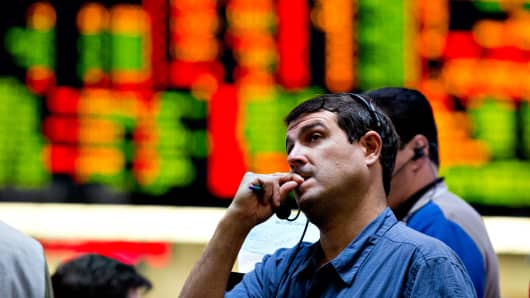
Daniel Acker | Bloomberg | Getty Images
Traders work in the ten-year U.S. Treasury Note options pit at the Chicago Board of Trade in Chicago, Illinois, U.S.
The Fedtold investors it will keep rates at zero until 2013, and said it would consider further moves to boost growth. Following the news, stocks on Wall Street surged higher and ended the session up more than 4 percent, helping to erase some of the losses made over the last 7 days.
Despite the rally, the Fed’s statement did not reflect well on the health of the economy. Growth is weaker than expected, and unemployment is set to remain stubbornly high. The fact that the Fed will keep rates at zero for another two years is hardly a vote of confidence.
So what to do? Among many economists, there remain big doubts over the effectiveness of further quantitative easing (QE) .
“QE pumps money into the system and helps the economy via the wealth effect, but you need something to push demand,” Hans Redeker, the global head of foreign exchange strategy at Morgan Stanley, told CNBC on Wednesday.
Demand was underpinned by fiscal policy after the 2008 financial crisis, but Redeker said that government debt in the US and Europe have removed fiscal policy as a viable option now.
Ian Shepherdson, chief US economist at High Frequency Economics, sees no way that governments will be able to spend their way out of broad economic malaise.
“On the fiscal front, it is clear that the chance of stimulus via government spending is nil,” Shepherdson said.
“But on the other side of the accounts, things are different," he said. "We wonder if President Obama might be bold enough to propose that taxes be cut substantially for a while. It seems to us that Mr. Obama has a prime opportunity to call the Republicans' bluff,” Shepherdson said.
“They say they want tax cuts, Republicans exist to cut taxes, so why not offer them tax cuts and dare the GOP to vote against them?” he asked.
Redeker does not agree that tax cuts would be the only option on the table to boost demand, but thinks instead that the answer lies with the G20.
“The G7 is not going to boost demand via fiscal policy. The only countries that can are China" and elsewhere in Asia, said Redeker, who believes a deal could be in the cards in which the U.S. rules out further QE in return for Chinaand others to use their fiscal muscle to boost global demand.
The big effect from the Fed’s statement was on the bond market, according to Dennis Gartman, the Founder of The Gartman Letter. He told CNBC that Bernanke had effectively restructured the bond market, making 2-year paper into an overnight lending facility with very low yields.
“He made the world say I might as well own Johnson & Johnson , as the yields in the bond market are so low,” Gartman told CNBC.
Seeing nothing that would point to a prolonged appetite for risk among investors, Redeker said the Fed meeting had at least turned around the conversation.
“A few weeks ago if you got weak data, it meant 'risk off.' Following the last few days, if we get weak data, it will be 'risk on' as we get closer to a tipping point on QE3,” Redeker said.
