

German Chancellor Angela Merkel and French President Nicolas Sarkozy have both said that Greece will not leave the euro, but the "unthinkable" is now being seriously considered at all levels. Just who gets to make that call, and whether sticking or twisting would be the more painful option, is being hotly debated.
Aris Messinis | AFP | Getty Images
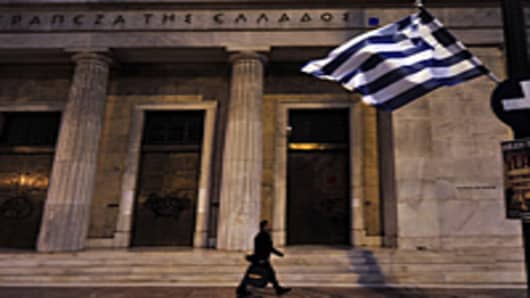
A man walks outside the Bank of Greece headquarters during a demonstation against government's austerity measures in central Athens.
A Greek exit from the euro would be unprecedented, and some analysts have seen it as an irreversible step towards a breakup of the single currency in its current form. Others say that the country is a "diseased limb" that needs to be excised to protect the remaining countries and save the euro zone.
Saving Greece introduces issues of moral hazard, but letting it fail and fall away seems to run counter to the European vision of mutual support and solidarity.
Letting Greece stay in shows the solidity of the euro zone, and the commitment of the whole to its member states, political analysts say. But it could also tell markets that Brussels is incapable of taking the tough decisions needed to make the union viable economically.
A report, released on Tuesday by Citigroup economist Willem Buiter, said that while Greece leaving the single currency looks more likely than ever, it would have very limited benefits for the country or the euro area as a whole, and that it would have large direct and indirect negative effects on both.
Citi believes that Greek government debt will reach 167 percent of gross domestic product (GDP) by the end of 2011. Slippage in the reform and privatization program as well as worse-than-expected growth figures have blown the country's attempts to rein in its unsustainable debt.
"Structural reforms are going nowhere and the lack of realism in the forecast of the proceeds from privatization is becoming clear," Buiter wrote. "Austerity fatigue in Greece is visible and audible, and so is bailout fatigue in the core euro area member states."
'Reform Fatigue'
Speaking on Thursday evening, Christine Lagarde, the new head of the IMF, said that Greece was suffering from "reform fatigue".
Practically, what does that mean?
First, Greece will probably default at some stage. The timing and nature of that default depend on a number of factors, not least the appetite among the more developed member states to keep throwing money at the problem while other vulnerable economies make good their own structural reforms.
The ability of the Greek government to continue with its cutbacks despite opposition from its own population is also critical. Should the "Troika" of the International Monetary Fund (IMF), European Union and European Central Bank (ECB) determine that the country is "willfully non-compliant" with its conditional structural reforms, financing could be withheld and the country would almost inevitably default.
The ECB would no longer accept Greek government debt as collateral when lending to the country's banks, and the emergency liquidity assistance (ELA) offered by the ECB would not be forthcoming. This, Buiter said, could push Greece to leave the euro of its own volition.
"If you want the euro zone to survive, you have to find a way to force the vast majority, if not all, the states that are participating in it, to be fiscally responsible according to German rules. That is something that is physically impossible for Greece to do. If you take steps to keep Greece in the union, you actively encourage everyone else to act like Greece."
"Faced with the disappearance (as far as Greek banks and sovereign are concerned) of the euro area lender of last resort, Greece could blunder into exiting from the euro area. It is the denial of access for banks to ECB/Eurosystem funding and to the ELA facility that would be the defining moment for Greece in our view," Buiter wrote.
In this scenario, Greece would be unlikely to pay back most of its international creditors, except for the IMF, Buiter said.
So why not leave? After all, competitive devaluation of currencies against the deutschmark was key to the performance of Southern European economies pre-euro. As Buiter explained, a reincarnated drachma would instantly lose value – he estimates as much as 40 percent. As soon as a euro exit appeared inevitable, there would be a run on the banks.
"The Greek banking system would be destroyed even before Greece had left the euro area," Buiter said.
Institutions holding drachma instruments, and those still denominated in euros would see huge imbalances develop in their portfolio. Corporates exposed in this way, and any remaining banks, would have a high chance of following the sovereign and defaulting.
The competitive benefits of devaluation, Buiter noted, would be short-lived without the same structural reforms to the economy and labor market that the Troika has prescribed. Leaving the euro, he concluded, would lead to a financial collapse and a deeper recession than it is currently suffering from.
Should Greece Leave the Euro?
UBS economists Stephane Deo and Paul Donovan have estimated that the cost of a weak member leaving the single currency would be between 9,500 and 11,500 euros ($13,100 – $15,900) per person during the first year, and between 3,000 and 4,000 euros per person over subsequent years. For Greece, this would represent half or more of its GDP per capita of around $27,700.
Louisa Gouliamaki | AFP | Getty Images
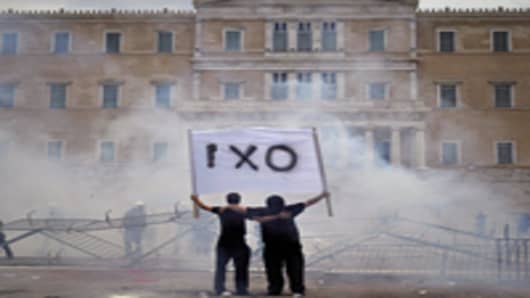
Amid tear gas, demonstrators hold a banner reading 'NO' during clashes with riot police in front of the Greek Parliament.
Greece stands to gain little from leaving the single currency.
So, then, should Germany – increasingly the dominant force in European policymaking - cut the umbilical cord and let Greece suffer?
"Greece is not a sustainable economy in the modern sense, without a continual infusion of subsidised capital," Peter Zeihan, lead Europe analyst at political forecasting firm Stratfor told CNBC.com.
During the 1980s and 1990s, Greece benefitted from joining the European community and taking transfer funds from Brussels to develop its economy. In the early part of the 2000s, having joined the euro, they gained a further advantage and inflow of relatively cheap funds.
"Now that era is over, it's doubtful even without any debt they could maintain that position. With the government debt load they have, it's flat out impossible," Zeihan said. "The only way that they could continue to remain in the euro zone is if the Germans directly or indirectly subsidize them forever."
"If the Germans do that, they will have to do it for Portugal and for Spain and for Ireland and for Italy, and let's be perfectly honest here, for France. Unless the Germans are willing to come to that conclusion, Greece has got to go," he added.
"If you want the euro zone to survive, you have to find a way to force the vast majority, if not all, the states that are participating in it, to be fiscally responsible according to German rules," Zeihan said. "That is something that is physically impossible for Greece to do. If you take steps to keep Greece in the union, you actively encourage everyone else to act like Greece."
A Greek exit would cause an almost immediate default, and a banking crisis across Europe. A reformed, expanded European Financial Stability Facility – currently being voted on in parliaments across the euro zone – would help to prepare the remaining members to save their banking systems in the face of the widespread shortage of credit that would result from a Greek exit and subsequent market panic, Zeihan said.
"That's the only plan forward, in my opinion, that could save the euro zone," he said.
'Break the Taboo'?
That plan would devastate Greece, Zeihan admitted, and see the end of an expansionary Europe.
Others, including Buiter at Citi, say that the stakes are too high for this, not least because it would "break the taboo" that no country leaves the euro zone, and shift pressure from the markets onto other economies. The exit could, in this instance, cause the rest of the single currency to shake itself apart.
"The economic cost is, in many ways, the least of the concerns investors should have about a breakup," Deo and Donovan wrote in a research report on September 6. "Fragmentation of the Euro would incur political costs. Europe's 'soft power' influence internationally would cease (as the concept of 'Europe' as an integrated polity becomes meaningless). It is also worth observing that almost no modern fiat currency monetary unions have broken up without some form of authoritarian or military government, or civil war."
As Germany – and other European powers – have tended to see Europe as their main outlet to express their global ambitions and further their ideals on a world stage, this loss would severely curtail their ability to project power and influence.
On a technical point, the legalities have not been tested, but it seems unlikely that countries can actually be expelled from the euro zone anyway – they must choose to secede. Pressure would have to be put on Greece to jump, but it could be that no one could push it.
That decision might be the last agency that Greece has, and a change of government or circumstances could trigger dramatic actions, particularly as austerity continues to bite down on the population, analysts have said. However, most believe that the government will stumble through the next round of financing and buy – or borrow – itself a little time.
"A default scenario is not imminent but the risk of an accident is rising as Greece's political and social backdrop remains precarious while the country is on the brink of running out of cash," Wolfgango Piccoli, head of the European practice at Eurasia Group, wrote in a note on Wednesday night.
Should the next tranche pass, the Greek government would at least be able to fund itself through to December, which would be the next opportunity for the Troika to withhold funding.
With little certainty over political motivations, brinkmanship at all levels and an absence of a clear voice in Europe steadying investors' nerves, strategists and political analysts expect the rumor tail to keep wagging the market's dog until then.