

It has been called the largest airborne transfer of currency in the history of the world. But finding out what happened to all the money involved has become one of the biggest financial mysteries of all time.
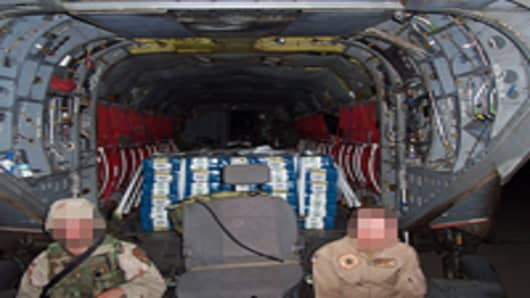
Source: CNBC Sources
US troops get ready to unload cash transported inside Iraq by helicopter.
Beginning in the very earliest days of the war in Iraq, the New York Federal Reserve shipped billions of dollars in physical cash to Baghdad to pay for the reopening of the government and restoration of basic services.
The money was packed onto pallets inside a heavily guarded New York Federal Reserve compound in East Rutherford, New Jersey, trucked to Andrews Air Force Base outside of Washington, and flown by military aircraft to Baghdad International Airport.
By one account, the New York Fed shipped about $40 billion in cash between 2003 and 2008. In just the first two years, the shipments included more than 281 million individual bills weighing a total of 363 tons. But soon after the money arrived in the chaos of war-torn Baghdad, the paper trail documenting who controlled it all began to go cold.
Since then, investigators have spent years trying to trace what happened to the enormous amount of money shipped in the frantic days of the occupation of Iraq. Although there have been hundreds of pages of reports, Congressional hearings, and inquiries from Washington to Baghdad, no one in Congress, a special inspector general’s office, the Department of Defense or the Iraqi government itself can say with certainty what exactly happened to all of that money.
Much of it may have been spent on the things it was intended for—but billions of dollars may have simply been stolen. The thefts likely ranged from complicated contracting schemes to brazen appropriations of billions in cash still in their New York Fed plastic wrappers.

Source: CNBC Sources
US military officers in front of billions of dollars in cash inside the vault of the Central Bank of Iraq.
To find out what happened, a special inspector general for Iraq reconstruction has focused on the chain of custody—who was responsible for the money, minute by minute, as it made its way to Baghdad.
And although the money was handled by a variety of trained American officials and military officers in the first legs of its trip halfway around the world, CNBC has learned that something unusual happened on the Baghdad side of the transaction: Each of the money flights to Baghdad was met at the airport in Iraq by the same man.
The previously unknown Coalition Provisional Authority (CPA) official was tasked with picking up the bales of billions as they were unloaded from C-17s and arranging for them to get to the Central Bank of Iraq in downtown Baghdad. It was a perilous journey of about seven miles over a road the U.S. military called “Route Irish” through territory often controlled by insurgents. Travelers faced the threat of rocket propelled grenades, mortars, car bombs and IEDs.
Transit was so dangerous that returning American GI’s often posted YouTube videos of their trips on Route Irish, just for the bragging rights of having been there.
The CPA official was a stocky, middle-aged naturalized American citizen of Lebanese descent who was born in Saudi Arabia. His first name is Basel. At his request, CNBC has agreed to withhold his last name from this story. Basel ferried cash in Baghdad for the CPA and the American embassy from 2003 until 2008—all told handling, he said, about $40 billion in cash.
His job made him the very last American to see that money before it disappeared into the vaults at the Central Bank of Iraq. And it may have made him the only person in the history of the world to oversee the movement of $40 billion in a combat zone.
It doesn’t seem that anyone in the US government planned ahead of time to put so much responsibility—and temptation—into the hands of just one man. Former Republican Connecticut Congressman Christopher Shays co-chaired the Commission on Wartime Contracting, digging into waste, fraud and abuse in Iraq. He has traveled to Iraq scores of times to oversee US efforts there. Shays did a double take when CNBC told him how much money Basel said he handled in Iraq.
“Wait, one person?” Shays asked. “One person received $40 billion?”
Asked what he thinks about that, Shays said, “It just blows you away.”
Moving Billions Began In The Federal Reserve Compund, East Rutherford, NJ
The enormous undertaking of moving the billions began in the heavily guarded Federal Reserve compound on 100 Orchard Street in East Rutherford, NJ. There, carefully screened employees loaded pallets of cash into tractor-trailers for their journey down I-95 toward Washington, DC. The money came from an account held at the New York Fed called the “Development Fund for Iraq” which was made up of billions of dollars in Saddam Hussein’s financial assets that had been frozen under various US and global sanctions regimes. They weren’t taxpayer dollars, but the US government was responsible for making sure they got where they were going.

Source: CNBC Sources
Aircraft unloading bales of cash slated for transfer to the Central Bank of Iraq
A typical pallet held 640 bundles, which the handlers called “bricks,” with a thousand bills in each bundle. Each pallet weighed 1,500 pounds, and they were separated by color. Gold seals were used for $100 bills, brown seals held $50 bills, purple seals $20, and so on.
The operation was handled with the utmost secrecy—just imagine what could have happened if the mafia found out which trucks held the money. The chain of custody of the cash was rigorously documented as it left the custody of the New York Fed and was signed over to Air Force officers, who oversaw the loading of C-17 transport planes and flew with the bales of money on the long flight to Baghdad. When the cargo holds were unloaded in Baghdad, Basel was there. But his presence on the receiving end of the largest airborne currency transfer in history began almost entirely by accident.
As a fluent speaker of multiple Arabic dialects, Basel had come to Iraq as a civilian with the American military. Both he and his former boss say Basel was sitting in a waiting area in Saddam Hussein’s palace in early 2003, waiting for his first assignment. While he was waiting, a US Treasury official burst into the room, looking for a translator.
“I have a situation here,” the official said. Basel raised his hand to help.
Soon he found himself wrangling with a crew of Iraqi truck drivers who had been told to make a delivery to the Central Bank of Iraq. But the bank was closed for the night, and they did not understand the instructions their American overseers were trying to impart about where to store their trucks. Basel intervened, untangling the confusion.
Impressed, the Treasury official, David Nummy, recruited Basel on the spot. Nummy said he soon put Basel in charge of meeting the cash flights from Washington at Baghdad airport, largely because he found Basel to be trustworthy. “He proved himself to be very reliable,” Nummy said of Basel in an interview with CNBC. “Very competent. Very committed and he performed a great service during the time that I was there.”
“I'm not surprised that he turned out as good as he did,” Nummy said. “I think its … one of many examples we hear of people being in the right place at the right time and find their calling really by circumstance.”
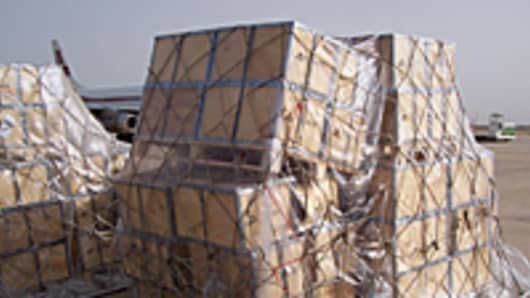
Source: CNBC Sources
Pallets of cash unloaded on to the tarmac at Baghdad International Airport.
Basel said he brought two senior Iraqi government officials with him to the airport for each flight, and those people signed receipts presented by the Air Force officials for the money, witnessing each other’s signature. It was for the government’s protection—and his own. Basel wanted to be able to prove that he had turned over the money as promised. But in the chaos of war planning, no one seems to have thought about paperwork. Basel said the CPA didn’t give him any forms or documents with which to record the transfer of the billions. So he wrote up his own, using Microsoft Word.
One document Basel showed CNBC was a one-page receipt of shipment for a billion-dollar delivery in April of 2006. Basel typed it up himself. It read, in part: “This is to testify that we, the undersigned, have received in our custody from [Basel’s full name] … the total amount of USD 1,000,000,000.00 (United States Dollars One Billion Only).” At the bottom were the hastily scrawled signatures of two officials of the Central Bank of Iraq.
“Its my neck on the line,” Basel said. “I documented the hell out of this.” With the Iraqi government signatures in place, the money was in legal custody of the government of Iraq from the instant it was unloaded from the C-17s. It was Basel’s job to make sure it stayed that way, at least until it got to the vaults of the Central Bank of Iraq.
Though he said he had no formal security training, Basel demonstrated a flair for subterfuge. Knowing a successful heist of the cash would be a momentum-shifting bonanza for the growing Iraqi insurgency, Basel rolled out a variety of tricks to keep the insurgents from figuring out just how much cash was moving right past them. He didn’t repeat the same configuration of trucks and cars to carry the money, so any watching insurgents or criminals wouldn’t be able to pin down a pattern of which vehicles carried cash. On some of the most dangerous missions, he eschewed the bristling military security convoys that would be a sure sign that something important was being shipped.

Source: CNBC Sources
Iraqi couriers make a dangerous transfer of cash on the open road.
He worked on scheduling the timing of the flights, so they wouldn’t arrive in Baghdad at a dangerous moment. He hired scouts to park on overpasses and drive the route ahead of the convoy to report on suspicious activity. And he used jammers to block the cell phone signals of any insurgents who tried to call in details of the convoy’s movement or trigger a bomb in the roadway.
On one billion-dollar run, Basel used garbage trucks to throw the insurgents off the trail. “I hired garbage trucks, and in the back of the garbage truck you had $1 billion dollars.” Basel said. “And I was in the front with a gun pointed at the driver. I said to him, ‘don't try anything funny. If everything goes well, you'll make $1,000. If you make a move, I'll kill you right here and drive the rest of the way myself.’”
He said the drivers he hired were thrilled to get $1,000, and that none ever tried to steal a single bill. It helped, he said, that he never used the same driver twice.
And he was not averse to using force. “I am willing and able to engage any entity,” said. “I will open fire first and ask questions later.” He held a firm belief in overwhelming firepower. “If you want to mess with a .50 cal (machine gun), go ahead and be my guest. You will lose every time.”
Basel’s Baghdad job came with enormous risks. At one point, the insurgents placed a million-dollar bounty on his head. At another, the Iraqi government issued a warrant for his arrest. Basel laughs off both incidents, saying the bounty should have been higher, and that the arrest warrant was a political trap designed to damage his credibility.
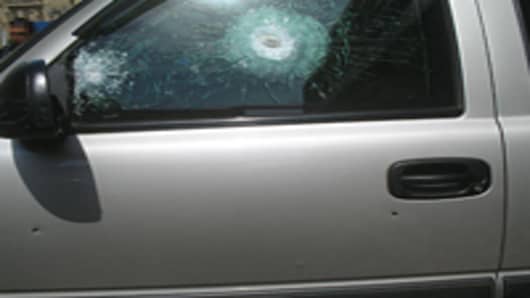
Source: CNBC Sources
Insurgents often attacked convoy on "Route Irish" whether they knew the contents onboard or not.
He said through all that, he never lost a shipment. “My record shows, you give Basel $10 billion to deliver, and Basel delivers $10 billion plus $400,” he said. “I delivered more money than I received.” That was possible, he explained, because the U.S. military came to him with any cash they found during nighttime raids on insurgent hideouts. Figuring that money rightly belonged to the Iraqi government, Basel said he delivered it to the Central Bank along with the pallets of cash from the New York Fed.
Basel said he didn’t steal any of the Baghdad billions, but he knows who stole at least some of it.
Asked whether he thinks any of the money he delivered was stolen or misappropriated, Basel said, “absolutely, without a doubt.” But asked who stole it, he said, “I’m sure I have an idea, but I can’t name names.” That’s because, he explained quietly, “I have a wife and family to worry about.”
High-Alert Security In East Rutherford
When CNBC showed up in front of the East Rutherford Operations Center of the New York Fed to record a video segment for this story, police officers working for the Fed shooed our camera crew off the driveway and onto a small strip of public land that abuts the facility. Later, when we returned to our cars in the parking lot of a nearby convenience store, three police cars— including an unmarked car—blocked our exit. A local police officer politely asked us who we were and why we were taking pictures of the Fed. Satisfied that we were who we said we were, he let us go.
Such high-alert security is understandable, given the huge amounts of currency processed at the sleek modern facility, which was opened in 1992. The accounts held there for the Iraqi government alone are enormous. Despite the $40 billion Basel said he has distributed to the Central Bank of Iraq over the years, the value of the accounts at the New York Fed haven’t gone down—they’ve gone up.
That’s because the government of Iraq continues to pour the proceeds of its newly refurbished oil industry into its accounts at the Fed in New York. In April, the Iraqi government informed the UN security council that it was going to open a new account at the Fed to replace the Development Fund for Iraq account that had been established years earlier. Baghdad will continue to operate a second account, called the “Oil Proceeds Receipts Account” that serves as a cash reserve for the Iraqi Central Bank, supporting the Iraqi currency.
The New York Fed is experienced at this sort of thing—it also holds billions in reserves for a slew of other countries around the world. The New York Fed’s website explains that it offers custodial accounts for foreign government cash and “vault services” services for their gold. The Fed invests the money in “overnight repurchase agreements, or U.S. Treasury and agency securities. The Federal Reserve does not give investment advice.”
Officials at the Fed declined to comment for this story, even to confirm the existence of Iraqi accounts it holds. But publicly, the Fed says that taken together, its gold holdings “constitute the world's largest concentration of monetary gold; the U.S. Treasury's depository at Fort Knox, Kentucky, is the second largest.”
To this day, say several sources, the New York Fed is still rolling trucks filled with bills to Baghdad. According to one source familiar with the Central Bank of Iraq, the amounts are much smaller now than they were in the early days of the war.
Many people in Iraq like to hold dollars instead of dinars. And the Central Bank sells dollars for Iraqi dinars at a fixed exchange rate in auctions it holds on most business days. According to the Central Bank of Iraq, for example, on September 12th 2011, it sold $12.3 million in cash at auction.
As for Basel, his experiences in Iraq opened up huge new opportunities for him around the world. Before the war, he lived in a modest townhouse in suburban Centreville, VA, outside of Washington, DC. But Basel didn’t return to the United States after his time in Baghdad. Instead, he set himself up as one of the world’s leading experts in transporting cash in war zones, operating a business out of his new home of Dubai, in the United Arab Emirates, where we sat down with him for an interview.
Today, Basel says he is planning a trip to Sudan, and is negotiating for a contract to transport billions of dollars in cash into newly liberated Libya.
The man who escorted $40 billion says he still needs to earn a living.
On Wednesday: A new report from the Special Inspector General for Iraq Reconstruction has followed the money trail in Baghdad farther than ever before. Eamon Javers will look at his findings, and where the money may have gone.
Follow Eamon Javers on Twitter: @EamonJavers and Facebook
