

ROCHESTER, Mich. — High unemployment, a teetering economy, and Europe on the brink sets a daunting backdrop for Wednesday's debate for a Republican presidential field without a clear leader.
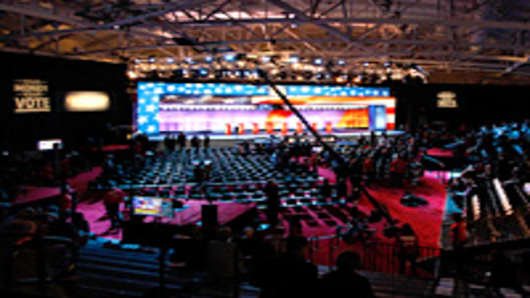
Photo: Rick Osentoski for CNBC.com
CNBC GOP Debate
Oh, and throw in some saucy allegations of sexual misconduct against one of the leading candidates and it adds up to what should be an eventful night.
The GOP race thus far has amounted to a carousel of flavors-of-the-week, with voters unsure whether to pick quick-witted businessmen, dapper ex-governors, or darlings of the Tea Party right.
CNBC is moderating the debate at Oakland University, which is nestled in a tony suburb that both supported President Obama in 2008 and, two years later, Republican Gov. Rick Snyder, who has waged war with the state's labor unions.
The debates have become fairly pedestrian affairs as of late, but as many as five sexual harassment allegations against front-runner Herman Caincould change that.
For those on campus, the battle is an important one with the future both of the country and the 40,000 students on campus in the balance.
"It's a very important event for our campus," says Theresa Rowe, chief information officer at the university. "This campus is heavily oriented toward the sciences. We're very interested to hear what the candidates have to say about supporting this area."
Among the students, though, there's high anticipation and anxiety over what the Republicans can tell them about their future, which includes questions over the economy at home and abroad, where European debt turmoilserves as a daily reminder about how uncertain conditions are ahead.
College campuses are often considered bastions of liberalism. At Oakland, however, the student population seems to reflect the surrounding community — which is to say just the types of swing voters the candidates will need to upset the incumbent.
"That's pretty huge that they picked Oakland University more than any other university in the country" for the debate site, says Devon Ancell, a freshman who leans Democrat, but thinks Michigan native and former Massachusetts Gov. Mitt Romneyis "the most professional" among the GOP choices.
"Most people tend to look at parties and that's the way they go," Ancell adds. "That can really lead you in the wrong direction."
Students like Ancell and most of the others tending to their business on campus during an overcast, windy day reflect the prevailing view that the candidate who best articulates an economic blueprint will carry the day.

Total Cost: $58,065Tuition: $43,840Room & Board: $13,980Fees: $245Claremont McKenna, located near downtown Los Angeles, accepted only 12.4 percent of its applicants for the class of 2016, a rate that admissions counselor Brandon Gonzalez said ensures that students here will be going to school only with other top students.�The class of 2016 will be one of the most talented groups of students we have ever seen,� The school will charge these students a tuition of $21,920 per semester, or $43,840 for the entire academic year, incurring a total cost of
Each candidate has asserted superiority on that area, but all of their plans have several common denominators.
Simplifying the tax code and broadening the tax base — meaning, getting more people to pay — has been the cornerstone, with many advocating a flat tax that eliminates the myriad loopholes that have made generating revenue an increasingly difficult proposition for the debt-laden federal government.
Cain, who joins Romney atop the field in most polls, has managed to capture the attention of many Republican voters in this regard.
His "9-9-9" tax plan — which opponents deride as sounding like a weekday night pizza special at Cain's former company, Godfather's Pizza — would implement an across-the-board levy on sales, income, and business revenues. The plan's benefits are that it simplifies the tax system and tosses aside most of the tax code's byzantine structure that allows the rich to avoid paying their fair share.
Critics, though, suggest that 9-9-9 actually would raise taxes on poor people. His most severe detractors allege that Cain himself doesn't fully understand how the plan works.
Texas Gov. Rick Perry, too, has proposed a flat tax, but his plan has met with skeptics over the option for taxpayers to choose his plan or stick with the old tax code.
"Their ideas don't work," complains junior biology major Lauren Lingeman, who says the government "can't keep lowering" taxes and expect to balance the books.
Indeed, one of the other main topics is how to cope with the nation's $15 trillion national debt and $1.3 trillion deficit while trying to help an economy that grew at just 2 percent in the last quarter.
Raising taxes is anathema, though, to the Republican base, so the candidates have tried to sell their tax plans as both growth-friendly and less burdensome on those suffering most during the downturn.
"We're looking for a person to win this nomination and show a consolidated, reliable resolve to reduce and focus on a small government, on the essential task of government, while engaging in the policies that encourage growth in the private sector," Dick Armey, former House Republican majority leader and Tea Party organizer, told CNBC.
Voters have been fickle about who they see as most able to accomplish those goals.
Polling in recent weeks showed a two-man matchup between Cain and Romney.

Photo: Mark Koba | CNBC.com
CNBC GOP Debate 2011
However, former House Speaker Newt Gingrich has been a resurgent face, now registering in double-digits across all of the major national polls.
Perry's position has been the most volatile.
He declared his candidacy on Aug. 13, and vaulted to the status of immediate front-runner, but has seen his fortunes slip during Cain's emergence. Romney's primary weakness has been debates just such as these, where he has had difficulty displaying the vision and charm he uses to sway crowds along the campaign trail.
Rep. Michele Bachmann, in turn, saw her early possibilities of becoming a Tea Party darling evaporate after Perry entered the race. She has struggled in the low-single-digits since.
Texas Rep. Ron Paulcarries a heavy populist base in his quest to end the Federal Reserve , as well as a pack of Cabinet-level departments.
Former Utah Gov. Jon Huntsman and former Pennsylvania Sen. Rick Santorum, meanwhile, have struggled to gain any footing at all, despite their seeming appeal to social conservatives.
Oakland University nursing major Louie Alkasmikha is attending the debate with hopes of discerning which candidate can make the most cogent case.
"It's not as much political as it is philosophical, just to see if they are correct in what they are saying or if they're lying," he says.
Matthew Kamulski, a post-baccalaureate student in the medical lab field, could be the kind of voter the candidates most need to court — not overtly political, but concerned about what the future holds.
"I'm interested in politics to some extent, but it's not the focus of my life," he says. "I listen to both sides and make a decision based on what I know, and what I understand."


