

Daniel Yergin shared his thoughts with CNBC on some of the hot topics in the energy world. Yergin is the author of the new best-seller "The Quest: Energy Security and the Remaking of the Modern World," the successor to his Pulitzer Prize winning book, "The Prize."
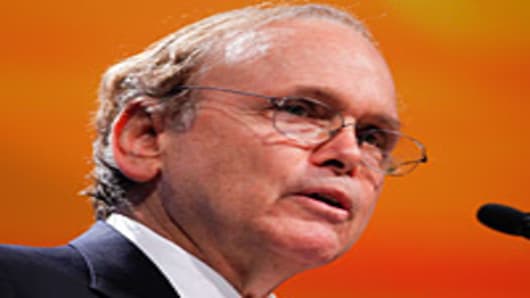
Photo: Bloomberg | Getty Images
Daniel Yergin
Yergin, CNBC's global energy expert, is chairman of IHS CERA.
1. In The Quest, you trace the historic conflicts in Iran’s relations with the West, and in particular, the United States. What today are the risks to the oil market from Iran?
There hasn’t been much geopolitics in the oil price in recent times, but that appears to be changing. Tension over Iran has been ratcheted up by the most recent United Nations report on Iran’s nuclear program.
The report was very explicit about the route to a weapon and suggested that the clock is really ticking. French President Sarkozy has called for a ban on Iranian oil. But the most likely response at this point is a new round of sanctions that would be more directly aimed at Iranian oil exports, such as prohibiting transactions with Iran’s central bank. In The Quest Iran is ranked at the top of the risks for the Gulf region, and these latest developments only reinforce it. As always, on sanctions, the question of what Russia and China do will be critical.
2. What about alternative oil supplies?
In terms of world oil, what is particularly striking is the rebalancing of Western Hemisphere oil supplies. We’re likely to see a much more north-south axis in hemispheric oil trade, and declining imports from the Eastern Hemisphere.
Three big things are happening. Two of them were hardly even on the horizon a decade ago. “Tight oil”—which uses the same technology as shale gas—is leading to an unexpected rebound in U.S. oil production. The tight oil, extracted from shale and other very dense rocks, was just 200,000 barrels per day in 2000. It could be as much as three million in a decade.
The second is the ability to produce the “presalt” oil in deep waters offshore of Brazil. If development proceeds more or less on plan, the “presalt”—combined with existing resources— could have Brazil producing twice as much as Venezuela by the beginning of the next decade.
The third are the advances in producing oil sands in Canada. The oil sands output is now about equivalent to Libya’s before its civil war, and this is a big reason that Canada is now our largest source of oil imports, by far.
3. But what about the Keystone XL pipeline and its postponement by the State Department?
Logistics—that is, our pipeline systems—need to catch up with the growth of supply from Canada and North Dakota, which is the pioneer state for tight oil. That’s what the new Keystone XL pipeline is all about. It’s striking that the postponement was announced the same week as the UN report on Iran’s nuclear program. Here is a pipeline that will, initially, move 700,000 additional barrels down to the United States, equivalent to about a third of Iran’s total exports. It would be about 1700 miles long, and we already have 168,000 miles of oil pipelines in the country.
4. What happens if it does not get a go-ahead after the Presidential election?
Other systems will be used to move some of the oil sands into the United States, including rail cars and the expansion of existing pipeline systems, which do not need new State Department approval.
Yergin on Canada's postponement and shale gas.
5. What about the response from Canada?
For Canada this postponement is a major shock. We’ve heard that from the prime minister of Canada and from the foreign minister. If the pipeline is not built, the Canadians will likely decide that they do not want to be totally dependent on the vagaries of U.S. politics and will seek an alternative route—moving some of the oil west to the Pacific and on to China and other Asian countries. After all, the distance from Vancouver to China is about the same as the distance from the Persian Gulf to China.
6. Why has this pipeline become so controversial?
I think people on both sides of the argument would agree that the pipeline is really a symbol for oil sands itself, which has become a subject of great controversy. The number one issue is the carbon footprint. It is helpful to look at the numbers. On a well-to-wheel basis, the CO2 emitted by a barrel of oil sands coming into the United States is about six percent higher than an average barrel. But that means that the U.S. is using other oils that are also in that six percent range.
by Daniel Yergin
7. Speaking of controversy, what about shale gas?
This is something that only burst into public view and in 2008 and 2009. But it was 25 years in the making. Indeed, that is one of the great stories in The Quest.
Shale gas owes its development to one man, George P. Mitchell, a Houston gas man, who was convinced that a way could be found to get natural gas out of shale rock. Mitchell would not give up. It took about 15 years, in the face of great skepticism and difficulty, to figure out how to do it.
It was another half decade before Devon Energy , which had acquired Mitchell’s company, found the way to connect hydraulic fracturing with horizontal drilling. And then another five years while the independents demonstrated proof of concept. It has grown very fast. It was two percent of our natural gas production in 2000. It’s now about 35 percent.
8. What about the environmental questions?
There are real environmental issues to be managed. I served on the Secretary of Energy’s committee that examined these issues in response to the request of President Obama last March. We submitted our first report in August and the second just two weeks ago.
9. What are the results?
The conclusion is that the hydraulic fracturing, the “fracking”, is very unlikely to affect water aquifers. Too much rock and too much density. Three issues do stand out, however managing the produced water that comes out of the well, air quality, and community impact. All need to be managed at a high standard.
We came out with 20 recommendations covering a range of things—from best practices and regional technical centers, to proper measurement of water and emissions, community engagement, support for state regulators, and targeted federal R&D to address specific environmental questions.
10. What about regulation?
One keeps reading that shale gas development is not regulated. That’s not true. It’s pretty intensively regulated, as is oil and gas drilling in general . But much of the regulation is done by states, which have historically regulated drilling, and some want to shift control more to the federal government. That is what part of the argument is really about.
11. A question about The Quest, what is your aim with this book?
Two things. First, so much has happened since I completed The Prize—beginning with the collapse of the Soviet Union and the rise of China, going right through to the nuclear accident at Fukushima in Japan and what started as the Arab Spring, but is now turning into a much longer and more uncertain project. I wanted to capture this sweep of history and provide a framework for looking ahead.
Secondly, I wanted to write about the whole energy spectrum—from oil and natural gas and electric power to climate change and the rebirth of renewables and the electric car—and see how the pieces might fit together for our energy future.
Follow Patti Domm on Twitter: @pattidomm
Questions? Comments? Email us at marketinsider@cnbc.com
