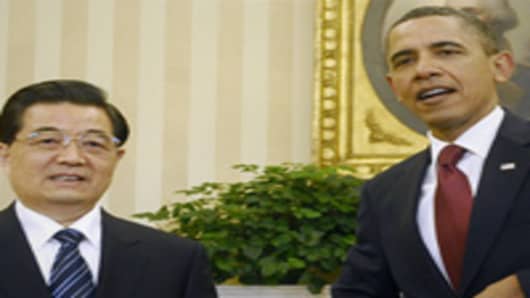
Many American analysts have applauded Obama’s aggressive stance, saying his forcefulness is smart because the Chinese only respect power. In a way those analysts are right: China respects power.
But many in China do not view Obama's recent assertiveness as a display of power but weakness. They view the President as desperate to find scapegoats to get votes in next year’s 2012 presidential election.
A rising chorus in China also thinks America is determined to keep China down, so they are pushing the government to respond forcefully. Obama runs the risk of precipitating a trade war or worse as a response.
A politically influential person from Beijing told me, "Obama's actions demonstrate he is trying to divert attention away from his inability to jumpstart job growth." He continued to say, “Aside from pandering for votes, Obama is trying to contain China’s rise. We need to stand up to America. Military action is the last resort but we need to show we are strong and won’t be pushed around anymore.”
The state-owned China Daily ran a similar line underscoring China’s unease with American intentions. Tao Wenzhao, a professor of China-U.S. relations at Beijing's Tsinghua University, wrote of Obama's recent moves, " Such a move by Washington is to contain a fast-growing China and to maintain its ebbing dominance in the region."
Unlike in previous U.S. election years when American politicians criticized China for easy votes and the Chinese responded with words only, there are differences this time that increase the risks of a trade war or worse.
First, China is undergoing a leadership transition in 2012. For the first time both China and America is having a leadership change in the same year. To cement power, leaders on both sides might appeal to factions calling for muscular responses, which could quickly spiral out of control.
Second, many Chinese feel China’s economic strength warrants the end of American hegemony. They bridle that global economic woes stemmed from America’s irresponsible financial and regulatory system yet Obama and the Senate continue to criticize China’s currency policy for the world’s economic ills.
Going forward, Obama needs to focus more on jumpstarting the American economy than blaming China. China respects power, but power that derives not just from military but economic strength as well. Obama should also engage in more bilateral, constructive discussions at the highest levels.
American businesses need to account for rising political risks in China and either look to other markets for investment or lobby Congress to take a calmer approach. It is likely that the Chinese government will make it more difficult for western businesses to get licenses or will crack down harder than normal when an American firm errs, as in Walmart’s case with the mislabeling of pork, to send clear messages to Washington. Already Chinese state-owned airlines have upped buying of Airbusplanes over Boeing’s .
A trade war or worse won’t benefit China or the U.S. In order for America to get out of a recession and ensure global stability, economic not military engagement with China is the answer. Cooler heads need to prevail on both sides of the Pacific Ocean.
Shaun Rein is the founder and managing director of the China Market Research Group (www.cmrconsulting.com.cn ) a strategic market intelligence firm, and is based in Shanghai.
He is the author ofthe upcoming book “The End of Cheap China: Economic and Cultural Trends that will Disrupt the World” published by John Wiley & Sons in the U.S. He does not own shares in any company mentioned. Follow him on Twitter at @shaunrein.