

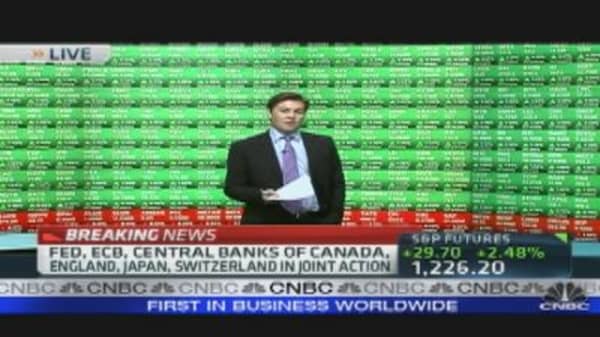
Major central banks around the globe took coordinated action Wednesday to ease the strains on the world's financial system, saying they would make it easier for banks to get dollars if they need them. Stock markets and the euro rose sharply on the move.

The European Central Bank, U.S. Federal Reserve, the Bank of England and the central banks of Canada, Japan and Switzerland are all taking part.
As Europe's sovereign debtcrisis has spread, the global financial system is showing signs of entering another credit crunch like the one that followed the 2008 collapse of U.S. investment bank Lehman Brothers.
The possibility that one or more European governments might default have raised fears of a shock to the global financial system that would lead to severe losses for banks, recessionsin the U.S. and Europe, and a stranglehold on lending.
"The purpose of these actions is to ease strains in financial markets and thereby mitigate the effects of such strains on the supply of credit to households and businesses and so help foster economic activity," the banks said in a joint statement.
The central banks agreed to reduce the cost of temporary dollar loans they offer to banks — called liquidity swaps — by a half percentage point. The new, lower rate will be applied to all central bank operations starting on Monday.
Non-U.S. banks need dollars to fund their U.S. operations and to make dollar loans to companies that need the U.S. currency. The dollar is the world's leading currency for central bank reserves and is widely used in international trade.
"Obviously, these moves are designed to increase the flow of dollar liquidity to European banks, which are struggling to attract short-term funding because of questions about their exposure to potential losses on holdings of European sovereign bonds," said Paul Ashworth, chief U.S. economist at Capital Economics.
He explained that Wednesday's move does not expose the Fed to propping up ailing European banks.
"The ECB actually makes the loans to these banks, so the Fed is not on the hook for any losses if a European bank failed," Ashworth added.
The central banks are also taking steps to ensure that banks can get ready money in any of their currencies if market conditions warrant by establishing a temporary network of reciprocal swap lines. Right now there is no need to offer non-domestic credits in currencies other than the dollar, the central banks said, but they "judge it prudent" to get such an arrangement in place ahead of time.
Stocks surged following the news. Germany's DAX was trading 4.7 percent higher, France's CAC was up 4.1 percent, and Dow futures in New York were up 2.2 percent. The euro surged up 1.4 percent to $1.35 and U.S. oil jumped $1.50 to $101.29.
In a sign of growing global credit strains, China's central bank cut the reserve requirement ratio for its commercial lenders on Wednesday for the first time in nearly three years. The move reduces the amounts that banks must keep in reserve and frees up funds for lending to cash-strapped small firms.
Fears of more financial turmoil in Europe have already left some European banks dependent on central bank loans to fund their daily operations. Other banks are wary of lending to them for fear of not getting paid back.
Such constraints on interbank lending can hurt the wider economy by making less money available to lend to businesses.
A credit ratings downgrade by Standard & Poors for six major U.S. banks on Tuesday added to fears that Europe's woes would hurt the financial system globally.
Analysts told Reuters it was encouraging that the central banks were stepping in to offer assurances about liquidity.
"It feeds into the idea that policymakers are at least beginning to address the problem," said Mark Cliffe, chief economist with ING Group. "With the dire scenarios doing the rounds the last few days, it's all the more important they step in with aggressive measures to support the banking system and show they're beginning to confront the financing problems of the sovereigns as well."
But others noted that, while the central bank action is helpful, there is still a need for policymakers in Europe to deal with their core problems and markets are unlikely to settle down until they do so.
"It is supportive," said Mark Thomas, head of Energy Europe, Marex Spectron in London. "Difficult to predict for how long."

