

It's been 30 years since gasoline took such a big bite out of the family budget.
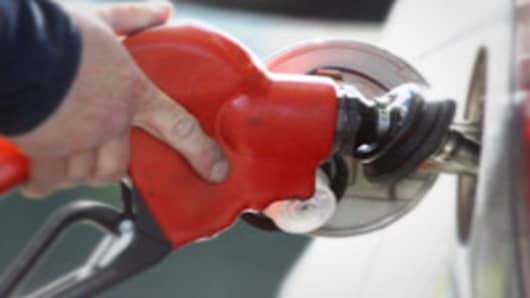
When the gifts from Grandma are unloaded and holiday travel is over, the typical American household will have spent $4,155 filling up this year, a record. That is 8.4 percent of what the median family takes in, the highest share since 1981.
Gas averaged more than $3.50 a gallon this year, another unfortunate record. And next year isn't likely to bring relief.
In the past, high gas prices in the United States have gone hand-in-hand with economic good times, making them less damaging to family finances. Now prices are high despite slow economic growth and weak demand.
That's because demand for crude oil is rising globally, especially in the developing nations of Asia and Latin America. But it puts the squeeze on the U.S., where unemployment is high and many people who have jobs aren't getting raises.
The trap has caught Michael Reed of Charlotte, N.C. He hasn't been able to find work since he lost his computer-support job in 2009. Now high gas prices are claiming more of what he has left. He and his wife won't exchange gifts this Christmas.
"I try to drive as little as possible so it doesn't take such a chunk out of my wallet," he says.
In 1981, when the economy was sliding into recession and oil prices were high because of Middle East turmoil, gas ate up 8.8 percent of the typical family budget, says Fred Rozell of the Oil Price Information Service.
Over the past decade, gas has taken up 5.7 percent of the family budget. If families had spent only 5.7 percent this year, they would have saved $1,300.
For this year, gas should average $3.53 per gallon. That's 76 cents more than last year. It's 29 cents per gallon more than 2008, when gas last set an annual record, $3.24. That year, the price of oil hit a record in the summer but collapsed when the financial crisis struck in the fall.
Besides leaving families less money to eat out and go to the movies, high gas prices take a disproportionate toll on consumer confidence. People are more aware of small changes in gas prices because they drive past the signs all the time.
And a buck spent on gas has less bang in the economy than, say, a dollar spent at a restaurant. The U.S. is an oil-importing country, so many of the dollars spent on gas ultimately leave the country instead of being invested here in new ventures and jobs.
James Hamilton, an economics professor at the University of California, San Diego, who studies energy prices, estimates that high gasoline prices reduced economic growth by about 0.5 percent for the year — a substantial hit for an economy only growing at an annual rate of about 2 percent.
Still, it could be worse. The U.S. economy is much more fuel-efficient than it was during the oil spikes of the late 1970s and early 1980s. In 1980, for every $1,000 of economic output, 1.07 barrels of oil were consumed. By 2010, it took half that — 0.53 barrels, says Judith Dwarkin, chief energy economist at ITG Investment Research.
Today, the U.S. uses almost no oil to generate electricity. The percentage of households using heating oil has fallen. And vehicles are less thirsty than ever — 20 percent more fuel-efficient than they were in 1980.
Also, the low price of natural gas has kept heating and electricity costs down for the same households spending more on gas.
Relief from high gas prices is nowhere in sight, though. Ed Morse, head of commodities research at Citibank, expects oil to average $100 per barrel next year, which would eclipse 2011's average of about $95 per barrel.
Tom Kloza, chief oil analyst at OPIS, expects gasoline prices to approach $4 per gallon again next spring.
Drivers are keeping gas guzzlers in the driveway, combining trips and buying more efficient cars. Compared with the year before, American gas consumption has been down every week for more than nine months, according to MasterCard SpendingPulse, a spending survey.
But that only helps so much. Hunter Collins, a software support technician who lives in Richmond, Maine, commutes 40 miles each way to his job in Falmouth. He has started to carpool with a colleague and to take his wife's more fuel-efficient car to work when it is his turn to drive.
It's still not enough. He says he's going to sell his beloved 8-cylinder Dodge Charger.
"She's my baby, but I'm going to have to switch to something more economical," he said.