

The impact of a Greek default on American banks would be negligible, JP Morgan Chase CEO Jamie Dimon told CNBC on Thursday, and while there are chances of a bad outcome in Europe, he is not concerned about unpleasant surprises in the region.
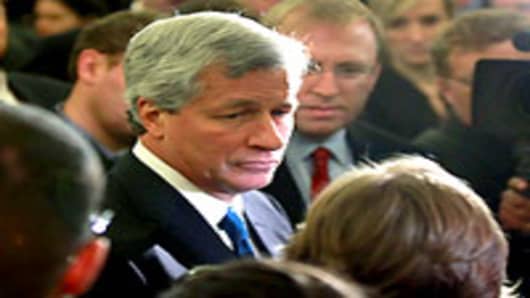
Mark Wilson | Getty Images
Jamie Dimon
"The direct impact of a Greek default is almost zero," Dimon said.
"The effect it has on the global economy will obviously filter down to the American banks too,” he added, but although “there may be a surprise somewhere”, he expressed little concern over such a development.
“There’s a teeny chance of a catastrophic outcome, which is why the muddle-through is the only good strategy. There is no other good strategy,” the JP Morgan Chase CEO said.
Not wanting to diminish Europe’s problems, Dimon said Greece, Portugal and Ireland were not the main issue.
“The real issue is Spain and Italy,” he said.
According to Dimon, the European Cental Bank took the "cascade problem" off the table, where a large bank would need to be bailed out and people would start taking deposits out of banks.
The ECB’s long-term refinancing operation in December had taken the bank liquidity problem off the table in Europe, he said.
“I’ve always believed they’re going to muddle through," Dimon said.
“Unraveling the euro is a terrible thing," according to Dimon. "This is a 50-year endeavor to get this continent together and that’s a wonderful endeavor. And now they run into a bump in the road…"
He said Europe's leaders were devoted to finding a solution, but that the situation was complex. "There are 17 nations, there are flaws in the Maastricht Treaty."
Dimon said Greek debt needed to be restructured and Italy and Spain both had to show austerity and growth policies.
A Greek default would not be a surprise, he said. "I don’t think that in and of itself is going to be the disaster."
No More Too Big to Fail
Dimon, who has been a vocal critic of a series of regulatory reforms in the United States, stressed that the idea that any bank was “too big to fail” needed to be addressed swiftly.
"We should subscribe it as bankruptcy for big dumb companies. Including banks," Dimon said, adding: "We have to get rid of too big to fail."
"What the American public wants to know is that it is not going to cost me money, and I think that could be done," he said.
“We did learn a lot of lessons. We’ve agreed with a lot of regulatory changes. Embedded in Dodd Frank and Basel…there are the seeds of it….we have to prove it to the world,” Dimon said, referring to new financial legislation.
Dimon argued that Lehman Brothers was too big to fail when it did in 2008, but “if Lehman or even AIG had gone bankrupt in 2004, it would have been an isolated sole event the world could have taken care of".
“At that point in time we were seeing failure after failure after failure…it was just too much at the time,” he said.
But former Treasury Secretary Hank Paulson, Federal Reserve Chariman Ben Bernankeand current Treasury Secretary Timothy Geithner saw the danger and did the right thing by stopping the unraveling of the system, Dimon said.
“It should be very different,” he said, arguing that an isolated failure should be possible without causing the whole system to start to unravel.
Dimon praised Bernanke, saying he had been "a total adult the whole time".
"You've never heard him scapegoat, point fingers. If it hadn't been for some of the actions the Fed took...the system could have got much worse," he said. "I think he's been an outstanding citizen and an outstanding Fed chief."
