

The Pentagon doesn’t know what happened to more than $100 million in cash held at Saddam Hussein’s palace in Baghdad during the Iraq war, according to a new report by the Special Inspector General for Iraq Reconstruction.
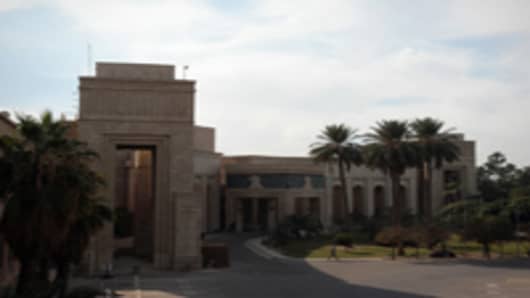
Ali Al-Saadi | AFP | Getty Images
Palace of the Republican Guard
What’s more, the Pentagon can’t find documents to explain what it spent as much as $1.7 billion on from funds held on behalf of the Iraqi government by the New York Federal Reserve, the report says.
The missing records raise new questions about how the US government handled billions of dollars in Iraqi funds during the war.
The new report, the latest in a multi-year investigation by the inspector general into missing money in Iraq, paints a picture of Pentagon officials digging through boxes of hard copy records looking for missing paper copies of Excel spreadsheets, monthly reports and other paper documents that should have been kept detailing what the money was spent on and why those expenditures were necessary. Apparently, there are no electronic records to back up the spending.
The Inspector General’s report concludes that the problem is simply one of “records management.” But the report explains the missing records make it impossible to conduct a complete accounting of what happened to the funds.
The missing money came from the Development Fund for Iraq, a cache of billions of dollars in frozen Saddam Hussein regime assets that was held at the New York Federal Reserve on behalf of the Iraqi people.
After the Coalition Provisional Authority turned over sovereignty to the new government of Iraq in 2004 after the US invasion, the government of Iraq turned over about $3 billion of the money to the Pentagon to help pay for contracts the CPA had authorized before it ceased operations. Of that money, most was held in an account worth about $2.8 billion at the Federal Reserve Bank of New York, and the remainder, $217.7 million, was held in cash in Saddam’s palace.
While the New York Federal Reserve was able to provide the Inspector General with some information on electronic payments made from the funds it held, the Department of Defense was unable to provide documentation to explain why it had authorized that expenditure of $1.7 billion of the funds held at the New York Fed. And although the Pentagon spent $193.3 million of the cash at the presidential palace, officials there told the Inspector General that they could not find documents to support $119.4 million of that spending.
The Federal Reserve Board of New York told the inspector General that all it needed to make payments from the DFI account was authorization of certain officials at the Central Bank of Iraq. And the New York Fed also said it had written authorization for $2.7 billion that was spent from the DFI account. Much of that money may have been spent on US Army Corps of Engineers projects.
But the Department of Defense, (DoD) can’t say specifically because it can’t locate the records, the Inspector General said. According to the report, “DoD officials have Excel spreadsheets supporting about $1 billion of the $2.7 billion, or 37%, it used from the sub-account. These spreadsheets cover the first four months of payments from the sub-account following the CPA’s dissolution. DoD is looking for documentation supporting the remaining $1.7 billion in payments.”
The Defense Department told the Inspector General it had conducted an exhaustive search for the paperwork. “Comptroller officials told us they reviewed more than 100 boxes of hard copy files and conducted multiple electronic database searches of DFI documents in their attempt to locate the missing spreadsheets,” the report said. It added that Defense Department officials said there were no backup records.
In written comments responding to the new report, the Pentagon’s Deputy Chief Financial Officer Mark Easton wrote that the Defense Department acknowledges “the difficulty in locating DFI documents for the entire period (2004-2007) is due to a records management issue.”
