

There are moments of grace, if we are lucky, in all our lives. Tom Furey’s came at the track.
The time was May 7, 2011 at Churchill Downs, in Louisville, Ky., aka the Kentucky Derby.
Furey, a retired IBM exec, was a 5-percent owner, or partner, in Animal Kingdom, scheduled to race that day. Furey owned Animal Kingdom through Team Valor International, a top stable in Lawrenceburg, Ky., and a leader in getting regular folks like Furey into owning parts of top racing

Photo: Barry Irwin
Barry Irwin
prospects.
Furey’s no billionaire, but on Churchill Downs' Derby Day it didn’t matter. He was an owner, and Team Valor’s head, Barry Irwin, allowed Furey and the other partners in Animal Kingdom to walk the thoroughbred to his starting gate, a true privilege.
It was on this walk that Furey sensed something special.
“He was amazing,” Furey remembers. “With 100,000 people cheering, and every horse in the parade bouncing he was just walking, like it was just to his shed.”
Soon Furey and the other partners were ensconced in Irwin’s box, another privilege of ownership, and had track-side seats as their horse, their horse!, rocketed from the gate.
The race was tight, and Furey couldn’t see the last turn. He asked another partner, Mark Polivka, to describe the action.
“I tapped Mark and said ‘where is he?’ And he said, ‘He’s gonna win it!’ "
After the win, Animal Kingdom’s value exploded. Today he is insured for $5 million, says Team Valor’s Irwin. That makes Furey’s 5-percent stake potentially worth $250,000.
Best of all, Furey’s share of Animal Kingdom actually cost nothing, because he had owned 5 percent in the colt’s mother, Dalicia. When she foaled Animal Kingdom, Furey’s ownership stake transferred over.
New Ownership Model
Expect more stories like Furey’s from winners circles around the world in the future, as the partnership model continues to democratize horse ownership in an industry that generates some $10-billon dollars a year. . Whereas the public may imagine one incredibly wealthy owner for a given horse, partnerships allow even middle-class folks the chance to own a piece of the dream.
There are horses syndicates at all levels, for all prices. You can buy into a horse for as little as $1,000, although more heralded prospects will likely run you at least $10,000 for a 5-to-10 percent share. The median cost for a yearling was $15,000 in 2011, according to the Thoroughbred Owners and Breeders Association.
The problem is: the horses don’t care what you spent. You can put a few bucks into a horse, and see it far exceed expectations, or you can spend millionsand lose it all.
“When people call me, the first thing I tell them is that it’s not an investment, it’s a total indulgence,” says Team Valor’s Irwin. “If you’re coming into this expecting to make money you’re crazy. If you’re hoping to make money that’s fine.”
With decades spent breeding, racing and training horses, Irwin knows from racing’s ups and downs. Indeed the action for would-be partners is not much different, in a way, from the action in the stands. If you think you’re going to make a killing at the track, you should have your head examined.
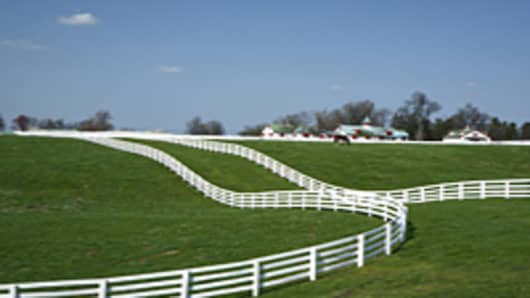
Harrison Shull | Aurora | Getty Images
Horse farm
It’s a lifestyle that you're buying. Furey, for example, got to see Animal Kingdom grow up. As an owner he gets to meet the jockeys before races, visit the paddocks and sit in Irwin’s box. He also got a Winner’s Circle picture from the Derby, racing’s holy grail. He also gets to own a top professional athlete, which is virtually impossible for people not listed on the Forbes 400.
But most of all Furey gets to buy one of the greatest thrills found anywhere. For professionals who have spent their careers competing at the highest levels — many of them former athletes — owning a race horse is just about as exciting as life can get, in two-minute intervals.
The partnership model was pioneered by W. Cothran “Cot” Campbell, the president of Dogwood Stable, who rolled out the first public partnership in 1969 for a horse named Social Arrest.
Since then Campbell and Dogwood have introduced 1,200 owners to racing, and bought more than $100 million in “bloodstock,” i.e. pedigreed horses. In total, Dogwood has backed more than 70 stakes winners and competed in 10 Triple Crown races, including a win at the Preakness Stakes for Summer Squall in 1990, which came with a $750,000 purse. (The median purse was $150,000 in 2011, according to the association.)
New Blood & Pure Bloods
The partnership model has brought badly needed fresh blood into horseracing, says Dan Metzger, president of the TOBA.
Whereas the world of ownership traditionally appeared cloistered and intimidating to would-be buyers, partnership models allow novice investors the chance to connect with already-proven stables and get as involved as they wish. It demystifies a place, the track, suffused with arcane rules and codes — especially at a time of shrinking attendance.

Alternative Investing - A CNBC Special Report - See Complete Coverage
Terry Finley, founder of the highly-regarded stable West Point Thoroughbreds, says that, without question, the rise of the partnership model has been a savior for the sport. Twenty years ago partnerships probably made up 20 percent of thoroughbred ownerships; today it probably likely 50-60 percent. (More precise data is unavailable because thoroughbred racing is very decentralized.)
Finley attributes the rise in partnerships to word of mouth from prior partners, and the addictive nature of the sport. It can also be the ultimate gift for the person, who has it all.
“You’re paying for the opportunity to catch lightening in a bottle,” he says. “I’ve seen Fortune 100 CEOs going ballistic when they win a race.”
Tax Status
There are even possible tax benefits to horse partnerships, says Robert Masiello, a 30-year old equity trader, and partner through West Point Thoroughbreds.
If you can establish yourself an “active” owner to the IRS, which requires far more involvement in the ownership of the horse than the mere writing of a check, you can depreciate the cost of the horse over three years (it was once seven). And any yearling horse counts as a capital expenditure, and can be written off immediately.
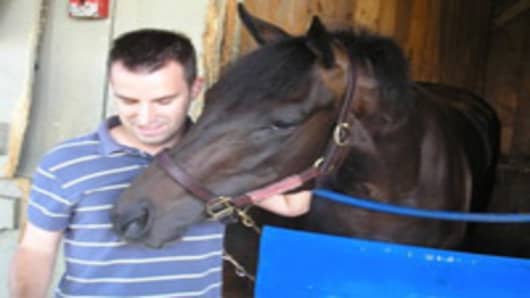
Photo: Robert Masiello
Trader and horse owner Robert Masiello with one of his horses, Dixie, in 2008
Masiello, however, downplays the financial upside of horse ownership. For him, ownership has been a journey of adventure, hopes realized and friendship.
He first became interested in racing as a college student at John’s Hopkins University, which is near Pimlico Race Course, and hosts the Preakness Stakes.
But as a successful trader he had a little extra money to invest, and called West Point in 2005 with $10,000. He conferred with Finley and they decided to put the money into a filly named Precious Penny, who raced well enough to pay off the investment. Masiello was hooked.
He has since invested close to $1 million through West Point.
Still, what has meant the most to him is not the amount of races won, but the friendships forged in the racing community.
“I used to spend every year in the infield at the Preakness,” he says. “To go from that to being on the other side, and having a horse running in the race, with all the other owners and trainers. That’s why you do it.”